












- KOMENTARZ
- WAŻNE
- W CENTRUM UWAGI
Trump launches military coalition against cartels in Latin America

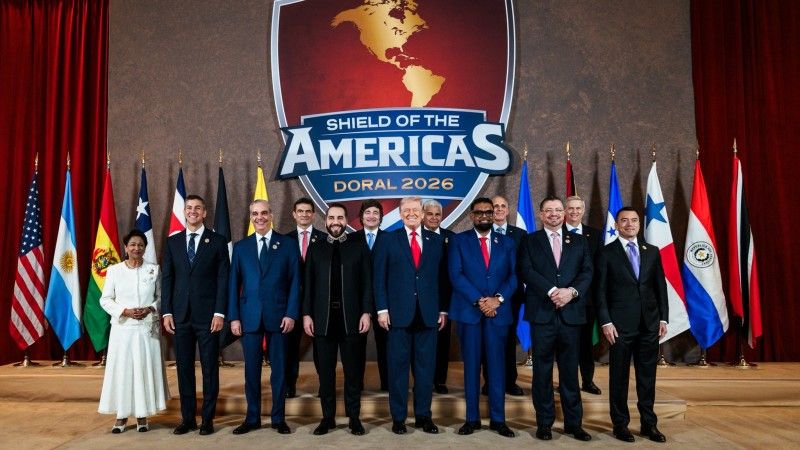
The United States is stepping up its security engagement in the Western Hemisphere. At the firstShield of the Americas summit in Florida, President Donald Trump announced the creation of a new regional coalition aimed at combating drug cartels using military force. The initiative signals a broader strategic shift in U.S. foreign policy towards Latin America.
President Donald Trump gathered more than a dozen leaders from Latin America and the Caribbean at his golf resort in Doral, Florida, to launch what he described as a new security framework for the Western Hemisphere. The initiative, named the Americas Counter-Cartel Coalition, is intended to coordinate military and intelligence efforts against organised criminal networks involved in drug trafficking and transnational crime.
During the summit, Trump argued that criminal cartels represent one of the most serious security threats in the region and called for stronger cooperation between national militaries. According to the proclamation signed at the meeting, participating countries will work with the United States to create what the administration described as „the most effective fighting force” against criminal networks operating across the hemisphere.
Seventeen countries have already signed the joint security declaration. Among the leaders attending the summit were Argentina’s President Javier Milei, El Salvador’s President Nayib Bukele and Ecuador’s President Daniel Noboa, whose government recently cooperated with U.S. forces in operations targeting organised crime groups.
The initiative comes amid a broader reorientation of U.S. foreign policy under Trump’s second administration. Washington has increased its military involvement in Latin America in recent months, including joint operations with Ecuadorian security forces and a series of maritime strikes targeting suspected drug-trafficking vessels in the Caribbean and eastern Pacific.
The administration argues that cartels have evolved into highly organised networks with capabilities comparable to paramilitary groups. According to U.S. officials, these networks not only traffic drugs but also contribute to migration flows, corruption and regional instability.
At the same time, the summit reflected Washington’s growing concern about the geopolitical dimension of security in the Western Hemisphere. While China was not explicitly mentioned in the official declaration, U.S. officials have repeatedly warned about Beijing’s expanding economic and infrastructure presence across Latin America. The coalition is therefore also seen as part of a broader attempt to reinforce American influence in the region.
The guest list at the summit highlighted the political alignment between Washington and several conservative governments in Latin America. Leaders such as Milei and Bukele have supported tougher approaches to organised crime, often emphasising security policies and stronger state enforcement. Notably absent were leaders from some of the region’s largest economies, including Mexico and Brazil.
For the Trump administration, Latin America appears to be returning to the centre of U.S. strategic thinking. Secretary of State Marco Rubio, who has long specialised in Latin American affairs, is widely seen as one of the key figures shaping this policy direction. His influence within the administration suggests that engagement with the Western Hemisphere will remain a major focus of U.S. diplomacy in the coming years.

From a broader strategic perspective, the summit illustrates how the Trump administration views global priorities. For Washington, Latin America has become one of the main areas of geopolitical attention, particularly in the context of organised crime, migration and great-power competition. At the same time, the United States remains heavily engaged in the Middle East, where current military operations continue to dominate the security agenda.
Beyond that, the Indo-Pacific region and the strategic rivalry with China remain central elements of U.S. foreign policy. Arctic issues – including discussions about Greenland and the growing importance of northern routes and resources – have also gained prominence in Washington’s strategic planning.
Against this backdrop, Europe, including Central and Eastern Europe and the war in Ukraine, does not appear to be among the top priorities of the current U.S. administration. While the United States remains capable of operating globally and supporting multiple security theatres simultaneously, the hierarchy of strategic interests is clear.
For countries in Central and Eastern Europe, this reality is an important reminder that American support cannot be taken for granted. As Washington balances commitments across several regions, European states may increasingly need to strengthen their own capabilities and regional cooperation in order to maintain long-term security.


