












- WIADOMOŚCI
- WYWIADY
Trump’s deal-making diplomacy and the limits of peace

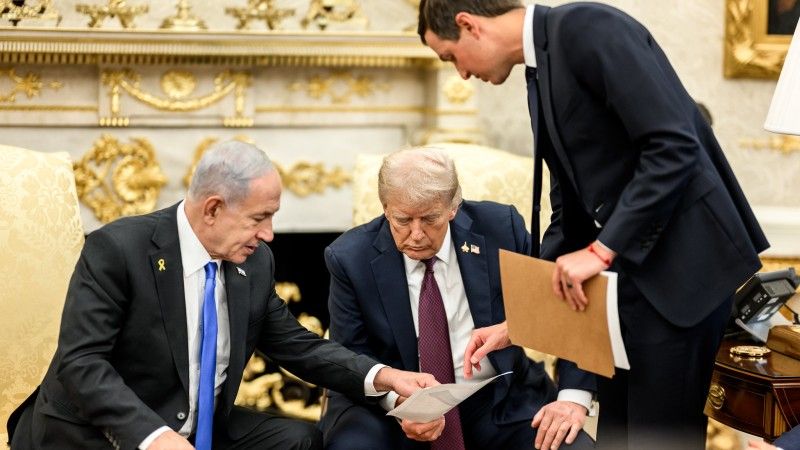
Donald Trump’s transactional approach to diplomacy is often described as bold and effective. Professor Zinaida Miller examines what this approach reveals about Trump’s policies toward the Middle East and their broader implications.
First part of the interview is HERE.
Magdalena Górnicka-Partyka: I would like to begin by asking about Donald Trump’s unconventional, transactional approach to diplomacy. From your perspective, is it more effective than traditional diplomacy?
Professor Zinaida Miller: It is certainly clear that Trump operates in a deal-making mode. In that sense, he is not entirely unique - countries such as China or several Gulf states have long pursued transactional approaches in international politics, more so than the U.S. or Europe traditionally have.
That said, it is unclear whether this represents a lasting shift or merely a temporary deviation. Effectiveness also depends on the goal. If effectiveness is defined narrowly in terms of U.S. dominance or Trump’s personal or familial interests, then yes, it may be effective. But if the goal is sustainable peace or a more equitable global distribution of resources, then no - it is not effective at all.
How do you assess Trump’s approach to what is often called the Middle East peace process?
First, I would say there is no real Middle East peace process. What exists now is a Gaza ceasefire plan that is not even a ceasefire. Hundreds of Palestinians have been killed since it began, alongside ongoing starvation, injury, and suffering.
Moreover, the West Bank has been entirely excluded. None of the current international discussions address the violence, dispossession, and displacement Palestinians face there. Even if this were a process - which it is not - it would still be incomplete.
If there is anything transactional, it is entirely about the interest of the U.S. and Israel, with Palestinians completely sidelined. Exercise of Palestinian self-determination, a right recognized under international law, is absent. Palestinian self-governance remains conditional on decisions made by Israel and the United States. This is not a transaction among all parties, but a continuation of long-standing patterns in which supposedly temporary measures become permanent and overwhelmingly favor Israel.
Trump has described this as the beginning of „eternal peace.” Do you agree?
No. There is nothing durable about the current situation. It depends entirely on Trump’s attention, which is notoriously fleeting. It is also unsustainable because systems of repression are never truly stable.
What is likely to endure in the short or medium term is the division of Gaza into two zones determine entirely by Israel and which will further concentrate Gaza’s population into less than half the already-crowded territory in order to facilitate further Israeli expansion and control. Israeli officials have been explicit that they intend to maintain their military positions along the so-called „yellow line”, and the U.S. has not pushed back - in fact, it has collaborated in this approach.
This seems consistent with Trump’s broader pattern of siding with the stronger party, as seen in Ukraine. Do you agree?
Yes. While diplomacy always involves power imbalances, this approach shows little effort to protect weaker parties. Instead, there is pronounced deference to the stronger actor, to the clear detriment of those with less power.
Why do you think Trump wants to be remembered as a „president of peace”?
Honestly, I don’t know, other than that he seems always to be motivated by self-interest and in this case, he believes this will help aggrandize him. But no matter what happens in these processes—which, again, are hardly legitimate peace processes—we should not lose sight of the fact that he is also currently waging enormous violence. That’s true in the ways that he is allowing Israel to continue to operate with impunity but it’s also about his unauthorized and illegal actions shooting at ships in the Caribbean and Pacific and his radical anti-immigrant agenda in the U.S. There is a deep contradiction here. At the same time that he claims to pursue peace, he is authorizing or defending extreme violence, often using legally dubious arguments. He wants to occupy both roles: peacemaker and warrior. That tension is fundamental to how he operates.
What about Trump’s reliance on figures like Steve Witkoff and Jared Kushner rather than the State Department?
This White House is extremely personality-driven. The result is the absence of institutional scaffolding. Historically, diplomacy relied on a professional civil service and a strong State Department. Under this administration, those structures have been hollowed out, leaving complex negotiations in the hands of a few individuals who are expected to manage multiple crises simultaneously.
Do you think the U.S. will remain committed to future phases after the ceasefire?
It’s basically impossible to predict what will happen in this administration because Trump himself is unpredictable in many ways. At most, he might remain engaged in ways that entrench Israeli control over Gaza, but I see no possibility that such engagement would lead to genuine peace, meaningful reconstruction, or Palestinian self-governance.
How do you view the growing isolationist wing of the Republican Party?
There is a real tension within the party between traditional neoconservatives and the isolationist MAGA wing. These divisions are growing, but they are unlikely to produce rapid policy change. Over the long term, however, shifts in public opinion - especially among younger generations - may reshape both parties« positions on Israel and Palestine.
Finally, what do you expect from Trump’s next steps in the Middle East?
Well, whatshould happen – serious economic and political pressure on Israel, the realization of meaningful Palestinian self-determination, and accountability for Israel’s genocidal violence and other violations and crimes- will not happen. What we are likely to see is a continuation of current policies, possibly including an international force that effectively cooperates with Israeli military control.
Even as Israeli control deepens, Palestinian actors will remain excluded. Meanwhile, the West Bank risks being ignored despite escalating violence and displacement. That, to me, is one of the most alarming aspects of the current moment. I do think there has been and continues to be real and meaningful organizing both in the U.S. and across the world on behalf of Palestinian emancipation – whether through domestic and local actions or through international institutions. That will go on. But at the moment, it isn’t enough to counterbalance the powerful actors in the US and elsewhere who continue to embolden the Israeli regime to act against Palestinians with impunity.
*Dr. Zinaida Miller is Professor of Law & International Affairs at Northeastern University in Boston, MA (USA), where she is faculty co-Director of the Center for Global Law & Justice. She has written extensively on transitional justice, human rights, international law, and the Palestinian-Israeli conflict, including for The New York Times. Miller serves on the Advisory Council of Harvard Law School’s Institute for Global Law & Policy (IGLP) and as a faculty member of the IGLP Global Scholars Academy.


