












- PILNE
- OPINIA
- WIADOMOŚCI
US envoys reopen the peace channel

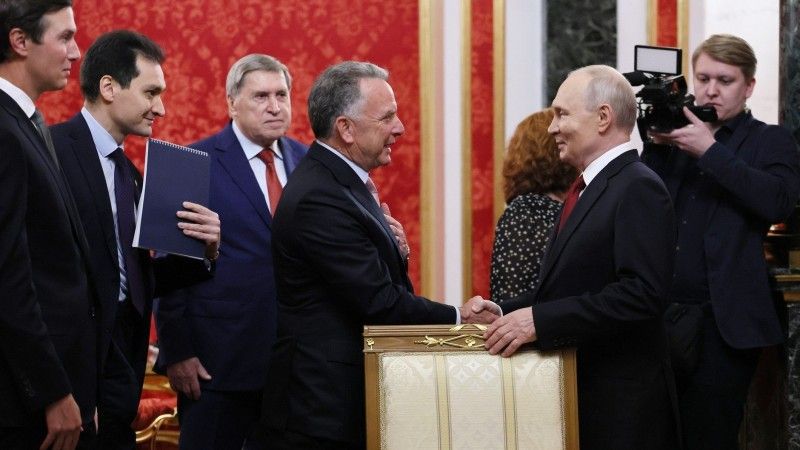
Photo. Author. kremlin.ru
Steve Witkoff and Jared Kushner have returned to the Moscow–Kyiv track after more than six months. Their visits did not produce a breakthrough, but they reopened a negotiating channel that had largely stalled. The timing is important: Russia continues to suffer very high losses, Ukraine is increasingly exhausted, and both sides are approaching another winter of war. Washington is now testing whether there is enough room to move from military pressure towards a gradual political settlement.
The talks in Moscow were not arranged suddenly. They had been discussed for months and the beginning of September was a relatively natural moment to return to them. Earlier, Russia had little interest in serious negotiations, while Ukraine was still benefiting from substantial military support from Western countries. Today the situation is different. Kyiv still has the capacity to stop Russian advances, but it is short of weapons, under pressure on the battlefield and increasingly aware that political conditions in Europe are changing.
Witkoff and Kushner spent more than three hours with Vladimir Putin in Moscow. The Russian side described the meeting as useful and substantive, but there was no agreement on the key issues. Moscow continues to demand Ukrainian territorial concessions and an end to Kyiv’s NATO ambitions. Putin has therefore not publicly abandoned the main conditions Russia has presented throughout the war.
At the same time, the Moscow meeting went beyond the battlefield. Russian officials also spoke about possible future economic cooperation with the United States. This is important because Washington is not looking only at where the front line could stop. The American approach appears broader: ceasefire or settlement, security arrangements, sanctions, economic normalisation and potentially future US–Russia projects may become parts of the same negotiating package.
The visit to Kyiv was equally important. It was the first official visit by Witkoff and Kushner to Ukraine in their role as American negotiators. They arrived one day after Moscow, bringing updated American proposals and what Witkoff later described as „new ideas”. Kyiv did not reject the process. Zelensky made clear that Ukraine was ready for talks and wanted the war to end as soon as possible, but he also repeated that any peace must include security guarantees and conditions that allow Ukraine to remain capable of defending itself.
This is where the main contradiction remains. Russia wants a weaker Ukraine outside NATO and continues to demand territory. Ukraine wants to preserve a strong army, obtain external security guarantees and avoid a settlement that would only give Moscow time to rebuild its forces. The territorial issue therefore remains the most difficult element, particularly in the Donbas. If negotiations move into a final phase, the most difficult decisions will have to be taken at the level of political leaders.
The discussions in Kyiv also showed that the United States is working on two scenarios at the same time. One is a political settlement. The other is preparing Ukraine for another winter of war if negotiations fail. Air defence, Patriots, interceptors and protection of energy infrastructure were all discussed. This is significant. Washington is reopening the peace channel, but it is not behaving as if peace were only days away.
The current process also confirms that the United States remains the only actor capable of leading negotiations of this scale. Europe is involved and France, Germany and the United Kingdom remain politically important, but they are not driving the process. Turkey is no longer central, nor are the Arab states. The coalition of the willing has influence, but limited ability to conduct the core Russian-American-Ukrainian negotiation.
For Ukraine, time is becoming increasingly important. Kyiv still has the ability to resist Russia, but it also faces shortages of weapons, internal corruption cases and more difficult political relations with some states that were essential at the beginning of the war. Zelensky also sees the political changes taking place in Germany and France. Ukraine therefore needs a settlement while it still has enough military strength to negotiate from a position that is difficult, but not desperate.
From the perspective of Poland and the Baltic states, the American role is particularly important. These countries were among the first to provide extensive support to Ukraine and remain directly exposed to the consequences of the war, including Russian military pressure, hybrid activity and threats to critical infrastructure. In September, American delegations are also expected in the region, with talks focused on broader security cooperation, including the presence and deployment of US forces on NATO’s eastern flank.
This matters because any future settlement in Ukraine will immediately raise questions about the military balance in Central and Eastern Europe. Poland, Lithuania, Latvia and Estonia will want to know what the American military presence will look like after a ceasefire or political agreement, whether existing deployments will remain in place and how quickly additional forces could be moved into the region if Russia begins rebuilding its military potential. There is, however, another issue that Poland and the Baltic states cannot ignore. A Russia that sits down at the table over the war is also a Russia that gives itself more room for sabotage, terrorism and hybrid attacks. Negotiations do not mean that Russian pressure on Europe will disappear. Moscow can reduce one form of escalation while increasing another.
This is why any progress in Moscow and Kyiv must be accompanied by greater vigilance across the eastern flank. Russia may negotiate over territory and a ceasefire while simultaneously increasing sabotage, diversion, cyber operations and recruitment of proxies inside NATO countries. The more Russia presents itself as ready to negotiate the war, the more closely Poland and the Baltic states should watch what Moscow is doing below the threshold of open conflict.


