












- ANALIZA
- WIADOMOŚCI
The Mecca Pact: An alliance of three states or the beginning of a new security architecture?

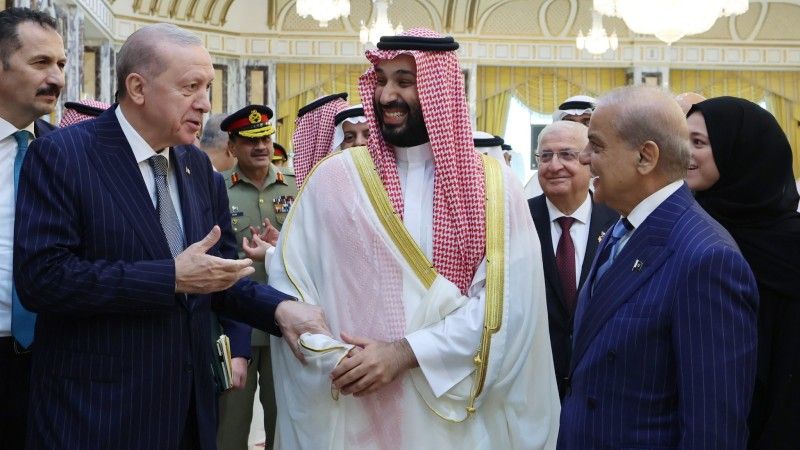
Photo. Directorate of Communications of the Presidency of the Republic of Türkiye
Saudi Arabia, Türkiye and Pakistan have signed an agreement providing for mutual defence and the creation of political and military cooperation mechanisms. Whether the Mecca Pact remains a trilateral format or develops into a broader security architecture will depend on the implementation of the announced mechanisms, the signatories’ positions during future crises and decisions on admitting new members.
On 7 August, Saudi Arabia, Türkiye and Pakistan signed the Mecca Pact. The joint communique provides that an armed attack against one state will be treated as an attack against all three and announces deeper defence cooperation. The full agreement has not been published. It is therefore impossible to determine how an armed attack is defined, which forms of assistance would be mandatory, or whether the clause applies to forces deployed outside member-state territory.
At this stage, the Pact establishes a formal mutual-defence commitment but does not yet constitute a regional security architecture. Such an architecture requires durable bodies, consultation procedures, common planning and rules for admitting additional participants. The announced bodies and procedures have not yet been used in a situation in which responsibility for an attack and the scope of the commitments were beyond dispute. As of 26 August, Egypt and Syria have confirmed that they are studying membership, Qatar has welcomed regional defence frameworks, and Bangladesh has indicated that it may consider participation. Reporting on an invitation to Iran remains contradictory. There is therefore no agreed list of candidates. The debate over additional participants nevertheless makes enlargement one of the criteria for assessing whether the Pact can move beyond a trilateral defence agreement.
Three capitals, three security calculations
For Riyadh, the Pact diversifies security guarantees after repeated attacks on energy infrastructure and shipping. It does not replace the relationship with the United States, but gives Saudi Arabia a role in shaping the new format’s rules and hosting its secretariat. As Reuters noted, the Kingdom is combining coalition-building with caution about direct entry into war.
Türkiye gains an additional channel for consultation and coordination without undermining its NATO commitments. Military and industrial projects expand opportunities for Turkish defence exports while giving Ankara an instrument for handling crises that the North Atlantic Alliance’s guarantees do not automatically cover, including in Syria. Pakistan formalises long-standing strategic ties with Saudi Arabia and Türkiye while retaining India as the primary reference point for its defence planning.
The three states’ interests do not produce a common list of adversaries. The International Institute for Strategic Studies notes that Ankara regards Israel as a greater threat than Iran, while Riyadh makes the opposite assessment. Islamabad has also sent conflicting signals on extending nuclear deterrence. There is no formal confirmation that Pakistan’s arsenal provides a nuclear umbrella to the other members.
The absence of a common threat hierarchy complicates the development of a unified defence plan. It instead favours a modular formula in which air defence, exercises, industrial cooperation and crisis consultations are developed through separate mechanisms. Such a structure fits the current divergences better than a unified military bloc.
From clause to institutions
After signing the agreement, the parties provided further detail on implementation. According to Reuters, the plans include structures involving ministers and commanders, exercises on land, at sea and in the air, and projects concerning unmanned systems, electronic warfare, artificial intelligence and the defence industry. A ministerial committee and a permanent secretariat in Saudi Arabia are also to be established.
An incident exposing ambiguity in the clause’s scope occurred only two days after the signing. The Houthis claimed a drone attack on Aramco’s Jazan refinery. Saudi Arabia’s energy ministry confirmed a fire and no casualties but gave no cause. Riyadh did not publicly activate the Pact or announce a request for assistance, according to Reuters. The absence of official attribution prevents Jazan from being treated as a test of mutual defence. The incident nevertheless raises a question left unanswered by the communique: whether an attack by a non-state actor triggers alliance commitment.
The difference between a declaration and a security architecture lies in procedures. Moving from a declaration to an operational system requires a crisis-consultation process, common air-defence planning, regular data exchange and exercises testing a specific mutual-defence scenario. Without these elements, the clause raises the political cost of silence by the partners but still does not define the military content of their response.
Israel expands the space of its red lines
Israel’s actions in Syria demonstrate why regional defence agreements are gaining political significance. After the fall of Bashar al-Assad’s regime, Israel took control of the previously UN-monitored buffer zone, expanded its military presence in southern Syria and continued strikes deeper into the country. Deutsche Welle reported permanent bases and regular Israeli operations beyond the disengagement zone. In practice, Israel has expanded the area in which it unilaterally enforces its security requirements.
The strike on Abu al-Duhur followed this pattern but concerned the possible deployment of Turkish forces in northern Syria. According to the Associated Press, it occurred hours after a Turkish delegation’s visit, damaged the runway and hangars, and caused no casualties. The Israeli side argued that allowing Turkish forces to deploy would violate an agreed status quo.
The Abu al-Duhur dispute concerns two competing principles. Israel regards preventive force on a neighbour’s territory as permissible when a possible foreign deployment is interpreted as a future threat. Damascus and Ankara instead invoke Syrian sovereignty and the country’s right to conclude military agreements. The incident was not a test of the Pact because neither Türkiye nor, according to available reporting, Turkish personnel were attacked. It did expose a fundamental controversy: whether one state may use force to impose restrictions on a neighbour’s defence partnerships.
Following the strike, the United States mediated Israeli-Syrian talks in Jordan. According to Reuters, the talks also addressed preventing Israeli-Turkish tensions from spilling over into Syrian territory. If US mediation constrains further Israeli operations in Syria, the Pact will remain a parallel political framework. If, however, Israel attacks the territory of a Pact member or its confirmed military forces deployed abroad, the signatories will have to determine whether the conditions for invoking the mutual-defence clause have been met. The fact that the Abu al-Duhur crisis was handled through a US-mediated channel marks the limit of the region’s current autonomy. Steven A. Cook of the Council on Foreign Relations interprets the Pact as evidence that the US-led order has ended. A durable change, however, can be established only when comparable crises are managed by the agreement’s own bodies. As long as regional states build alternative formats but leave de-escalation to Washington, the Pact diversifies sources of security without replacing the existing architecture.

Expansion will determine the Pact's function
Egypt already has a channel of cooperation with all three signatories: before the Pact was signed, it joined them in the R-4 format. Foreign Minister Badr Abdelatty confirmed that Cairo was examining the legal and constitutional consequences of membership, The National reported. Cairo’s accession would bring the security of the Suez Canal and the northern Red Sea into common planning. Egypt would also have to reconcile new commitments with its peace treaty with Israel and its relationship with the United States.
Syria is considering membership but has made no decision, Foreign Minister Asaad al-Shaibani said on 21 August, according to the Qatar News Agency. Following accession, a strike on Syrian territory would meet the literal condition of an attack on a member state. This would not predetermine a military response, but it would require the other capitals to define their position.
Qatar has welcomed regional defence frameworks based on cooperation and good-neighbourly relations, Anadolu reported, but has not announced negotiations. Membership would require reconciling a defence commitment with Doha’s role as a mediator and its parallel channels with the United States, Iran and non-state actors.
There is no confirmation that Iran has received a formal invitation. The Jerusalem Post cited an Al Mayadeen report that one had been delivered, while Iran’s foreign ministry spokesman denied that an official proposal had been made; he confirmed only talks on collective security. If the dialogue developed into an accession process, the label “Sunni NATO” would lose its meaning. It would not, however, automatically create a coalition against Israel. Rules for identifying an aggressor and taking joint decisions would become decisive.
Beyond the Middle East, Bangladesh has indicated that it may consider participation following a Saudi invitation. The consequences of enlargement therefore depend on the candidate. Egypt would strengthen the conventional dimension and bring the Suez Canal into common planning; Syria would introduce a direct dispute with Israel into the Pact; and Qatar would contribute mediation experience. Iran would break the agreement’s Sunni identity, while Bangladesh would extend it beyond the Middle East and introduce Pakistan-India relations into its calculations.

An alliance of three or an architecture?
As of 26 August, the Pact is a trilateral defence agreement with plans for institutionalisation. It does not yet constitute a security architecture: operational procedures remain undisclosed, no common command exists, and the incidents to date have not forced the partners to interpret the clause unambiguously. The Jazan incident lacked official attribution, while Abu al-Duhur did not involve an attack on a member state or its confirmed forces.
The divergence of interests supports a layered model rather than a copy of NATO. It would combine a mutual-defence clause for an attack on a member state, consultations during crises below that threshold, and military and industrial cooperation that does not require a common adversary. Such an arrangement separates the obligation to respond to aggression from the routine cooperation of states that maintain different relationships with Iran, Israel and the United States.
Israel has not been identified as an adversary of the Pact, but its actions in Syria increase the political importance of consultation and mutual guarantees. Whether the agreement becomes the beginning of a new security architecture will depend on the members’ ability to classify an attack jointly, activate procedures and agree on action during an actual crisis. Until then, it remains an alliance of three states with ambitions for broader influence.
About the author: Patryk Radke is a Junior Analyst at EastBridge Think Lab and Editorial Secretary of the academic journal Zoon Politikon. He specialises in the political and security dynamics of the Middle East, focusing on the Gulf states, regional conflicts, and the relationship between security policy and foreign investment.


