












- ANALIZA
- KOMENTARZ
- WIADOMOŚCI
Ukraine’s Multi-Theatre Diplomacy in Türkiye and Syria

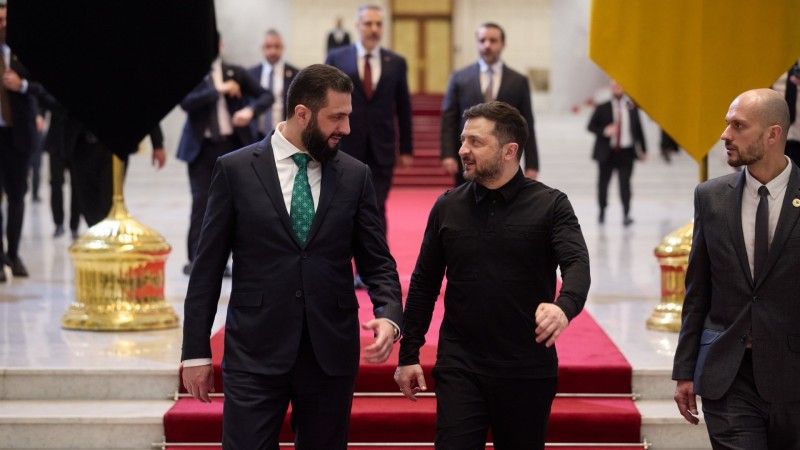
Photo. Official X Account of President Volodymyr Zelensky
The visit of Ukrainian President Volodymyr Zelensky to Türkiye, followed by his unexpected trip to Syria together with Turkish Foreign Minister Hakan Fidan in early April 2026, marks a development that must be analysed with multiple variables in mind. While Kyiv’s actions have so far been examined primarily in the context of Euro-Atlantic relations, the discussed visits – especially considering Trump’s second term in office – indicate a qualitative shift in Ukraine’s strategy. We are thus witnessing not only an effort to acquire new partners, but above all a process of expanding the war’s political sphere of influence beyond Europe and North America.
According to information provided by the parties involved, Volodymyr Zelensky’s talks in Damascus focused on both the war with Russia and potential cooperation with the Syrian partner in the fields of technology, food security, and broader defence-related matters. In parallel, Türkiye agreed to deepen strategic cooperation, including the transfer of military experience, the development of energy projects, and Ankara’s continued involvement in mediation processes, underscoring its balancing of foreign relations. The simultaneous analysis of both visits is not coincidental. They indicate a conscious attempt to transform Ukraine from a state reacting to aggression into one that actively shapes the security environment on a supra-regional scale.
It is also worth noting that the meetings in Türkiye and Syria took place shortly after Ukraine signed security cooperation agreements with Saudi Arabia, the United Arab Emirates, and Qatar, and is also conducting talks on similar agreements with other Middle Eastern countries. Under these agreements, Ukraine plans to provide weapons and defence technologies to Persian Gulf countries, including systems that could help unblock the Strait of Hormuz.
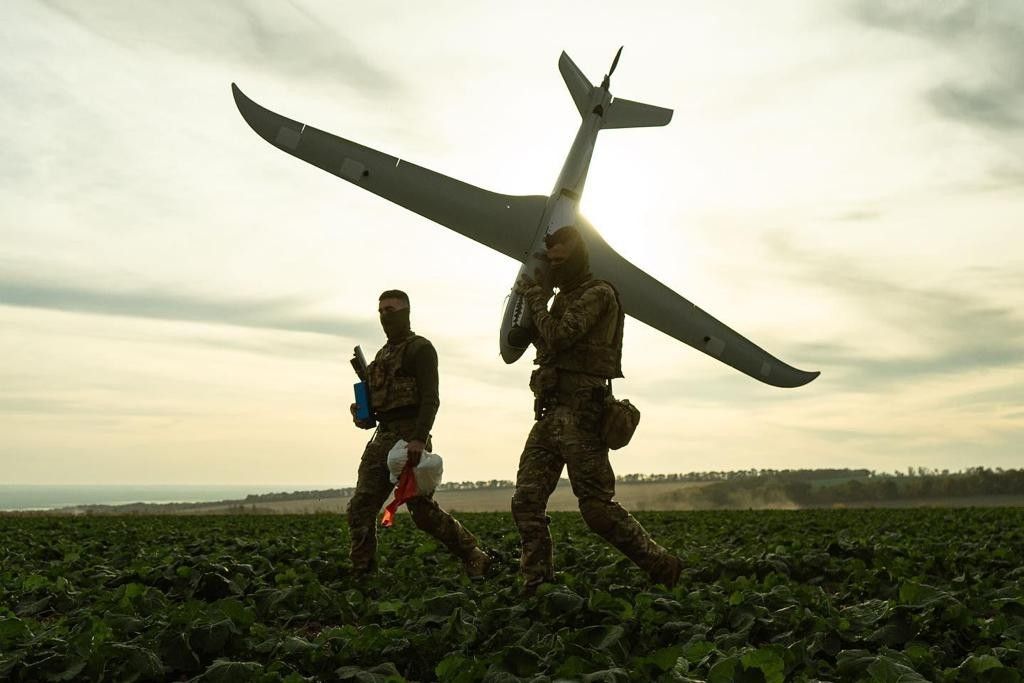
Operational Context: events preceding Zelensky's visit
An analysis of Volodymyr Zelensky’s visit to Türkiye and Syria would be incomplete without considering the sequence of events that immediately preceded it and gave it a distinct operational context.
A few days before the Ukrainian president’s arrival, an incident occurred in the Black Sea that may have significant implications for the interpretation of the entire visit. On March 28, the tankerAltura, owned by a Turkish company and transporting Russian oil, was hit in an attack unofficially suspected to have been carried out by a Ukrainian unmanned surface vehicle. Although there is no official confirmation, this was not an isolated incident but rather part of a broader trend of escalating asymmetric activity in the region.
This incident should be viewed not only as a military episode but also as a sign of the growing importance of energy infrastructure as operational targets. The Black Sea is thus transforming into a space where the boundaries between military action and economic pressure are blurring. In this context, Zelensky’s talks with Erdoğan on maritime security and energy supply stability are taking on added significance, moving from being merely a declarative element of the diplomatic agenda to a strategic necessity.
At the same time, just two days before Volodymyr Zelensky’s visit, Russia’s new ambassador, Sergei Vershinin, arrived in Ankara. This is noteworthy because the diplomat served for years at the Russian Foreign Ministry, where he was responsible for Middle Eastern affairs, including Syria and Iran, suggesting that this appointment is not accidental. It underscores Türkiye’s growing importance as a key link in Russian foreign policy, bridging European, Ukrainian, and Middle Eastern elements. The presence of a diplomat with such a clear regional profile suggests that Moscow recognises the growing interconnectedness of these strategic spaces and is seeking to adapt its actions accordingly to potential geopolitical shifts.
As a result, Zelensky’s visit should be analysed not as an isolated diplomatic act, but as part of a broader strategic game in which the Black Sea, the Middle East, and Russian-Turkish relations are beginning to form a single, increasingly integrated area of competition.

Türkiye: the axis of war diplomacy
One of the central elements of the transformation of Ukrainian supra-regional policy remains the role of Türkiye, which, since the beginning of the Russian-Ukrainian war, has functioned as a classic “bridge state”, i.e. a state that connects various geopolitical orders while striving for balance between different centres of power. Ankara maintains relations with Russia, remains a NATO member, and aspires to play a mediating role in the conflict. Volodymyr Zelensky’s meeting with Recep Tayyip Erdoğan not only confirmed this position but also indicated its deepening by shifting from a declarative to an operational and causal level, a step Türkiye seems to have been pursuing since the beginning of the Russian-Ukrainian conflict.
The significance of this visit should also be analysed within the broader geostrategic context of the Black Sea region, which in recent years has become a key area of rivalry between Russia and the collective West. Türkiye, by controlling the strategic Bosphorus and Dardanelles straits, possesses a unique tool to influence conflict dynamics. At the same time, the developing and planned cooperation with Ukraine in the fields of military technology and maritime security indicates the gradual transformation of bilateral relations into an element of a broader security architecture.
In this context, it is particularly significant that Ukraine, seasoned by years of active combat, is beginning to export its military experience as a strategic asset. Offering Türkiye know-how in technology, tactics, and operational conflict management (partly acquired through close military cooperation with Western military and logistical units) represents a reversal of the previous logic of mutual relations, in which Kyiv was solely a recipient of support. In this way, Ukraine is assuming the role of an active co-creator of the regional security system, while strengthening Ankara’s position as a central intermediary between various political blocs.

Syria: a space of symbolic breakthrough
The sequence of Volodymyr Zelensky’s recent trips, as mentioned above, is all the more suggestive. The Ukrainian president’s visit to Syria symbolically marks Ukraine’s entry into a space that has been one of Russia’s key areas of power projection for over a decade. Syria, for years a pillar of Russia’s presence in the Middle East, has served Moscow not only as a military base but also as a tool for building its global position.
In this context, Volodymyr Zelensky’s meeting with Syria’s new leader, Ahmed al-Sharaa, should be interpreted as an attempt to challenge Russia’s monopoly on influence. Importantly, the change of power in Damascus has created new diplomatic opportunities. Although the new Syrian authorities maintain relations with Moscow (despite its support for the ousted Bashar al-Assad), they are seeking to diversify them, thereby opening up space for new partners. Ukraine, which seems to be a natural ally here, is exploiting this situation, offering not only political support but also concrete benefits in the form of technology, military experience, and potential economic cooperation. This, however, given the past of the current Syrian leader, may be met with criticism from many.
At the same time, this visit fits into the broader context of regional security. The Middle East has become a space of intense technological competition in recent years, particularly in the field of unmanned systems. Ukraine’s experience in countering Russian and Iranian drones is becoming extremely valuable in this context, as demonstrated by the crisis in the Strait of Hormuz. Kyiv is thus beginning to function as a supplier of security solutions to countries in the Middle East, further strengthening its international standing.
A key element of this change is the ability to transform its wartime experience into a political and strategic asset. Ukraine is thus becoming an example of a middle power country leveraging the crisis to build its position. Through active diplomacy, technology exports, and the creation of new connections, Kyiv is strengthening its position as an entity whose significance extends beyond its immediate surroundings.

Russia: multi-front narrative erosion
Ukraine’s expansion into the Middle East has serious consequences for Russia. Moscow, which has spent years building a presence in Syria as part of its global strategy, now faces a new situation in which its sphere of influence is being challenged by numerous new and existing state and non-state actors. Furthermore, the problem of strategic dispersion is becoming increasingly apparent. Russia is simultaneously engaged in the war in Ukraine, maintaining a presence in the Middle East, and continuing to develop relations with Iran, which significantly increases its operational burden.
In this context, Ukraine’s actions can be interpreted as an attempt to increase pressure by further expanding the scope of diplomatic, logistical, and military competition. By entering a space previously dominated by Russia, Kyiv not only undermines its position but also forces it to respond simultaneously on multiple levels.
Globalisation of conflict as a survival strategy
As we analyse these events from a broader perspective, we can see that Ukraine is consciously changing the nature of the war, shifting it from a regional conflict to a global rivalry. This process can be described as the globalisation of the conflict, occurring primarily through diplomacy, in which political action is complemented by military action.
A key element of this strategy is therefore the diversification of partnerships, especially in regions and areas of cooperation related to so-called critical elements. In addition to its relations with the West, Ukraine is developing cooperation with Middle Eastern countries, including those in the Persian Gulf, offering them its military and logistical expertise. This creates a network of ties that goes beyond traditional alliances and introduces a new quality in international relations, based not so much on willingness and mutual sympathy, but rather on the necessity of such cooperation. Ukraine is not only seeking support but also actively building its position by offering specific resources, which – it cannot be ruled out – could ultimately lead to strategic dependence on the knowledge and experience of one of the parties, justified by the “absolute necessity“ of further cooperation.

Implications for NATO, the Middle East and the Global South
The expansion of Ukrainian diplomatic activity into Türkiye, Syria, and the broader Middle East has implications beyond the conflict with Russia. In the NATO context, Kyiv’s actions represent a shift in its role from a passive recipient of support to an active co-creator of security, thus introducing a new quality of relations in which the state – formally outside the North Atlantic Alliance – serves as an operational actor capable of exporting knowledge and solutions.This is particularly significant given that Ukraine’s current activity comes at a time of broader tensions within the Alliance and a growing risk of resource dispersion, as well as a partial shift of strategic attention to the Middle East. In this sense, Volodymyr Zelensky’s diplomacy can be interpreted as an attempt to counteract Ukraine’s marginalisation by integrating its interests into the broader context of global security. In this way, Kyiv signals that Ukraine’s stability is directly linked to the security of regions beyond Europe, including the Middle East.
Even broader consequences are affecting Ukraine’s relations with countries in the Global South. Ukraine, previously perceived primarily through the prism of its conflict with Russia and relations with the West, is beginning to actively seek support and cooperation from countries outside the traditional Euro-Atlantic circle. In this context, however, combining security offers with additional ones, including economic ones such as food exports and technological cooperation, is crucial. This strategy allows Ukraine to position itself not only as a combatant but also as a state offering concrete solutions to global problems, including food security, thus persuading countries relatively neutral towards ongoing armed conflicts to cooperate.

Conclusions
Volodymyr Zelensky’s visits to Türkiye and then to Syria should be viewed not as isolated diplomatic episodes, but as part of a broader strategy aimed at redefining Ukraine’s role in a world where increasingly less attention is paid to protracted conflicts. As a result, the Russian-Ukrainian conflict is no longer portrayed solely as a war based on territorial gains and losses, but as a tool for transforming the country’s position in the international system.
The ultimate question that arises from this analysis concerns the future of this strategy: will Ukraine remain a state merely defending itself or become a permanent element of the global security system?


