












- WIADOMOŚCI
- ANALIZA
- KOMENTARZ
Experience – a Ukrainian export commodity

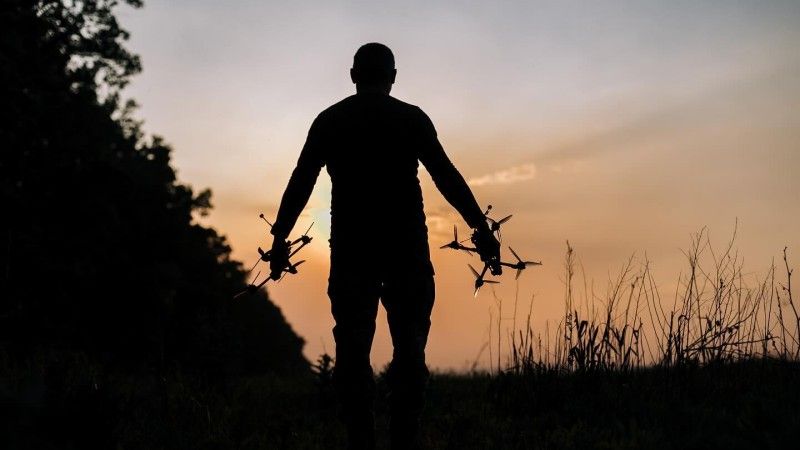
After years of the Russo-Ukrainian war, both sides of the conflict have gained considerable experience in employing new technologies under combat conditions. Today, we can observe how this experience is being used as a unique advantage in relations with other countries.
The full-scale war in Ukraine that began in 2022 is the first conflict in which drone technologies have been used on such a massive scale. The Ukrainians have demonstrated their proficiency in employing unmanned systems, and after four years of war, they are eager to apply the experience gained in their interactions with other states.
The War of the Future
We are standing on the threshold of what would once have been called the “war of the future” — a conflict in which machines do most of the fighting, with minimal direct human involvement. Drones conduct reconnaissance, guide artillery, and strike enemy targets — tasks that were previously carried out by humans.
Of course, we are not yet at the stage of completely removing the human factor from the battlefield. Most UAVs still require a pilot-supervisor who, while not directly engaged in combat, remains essential for mission execution. Nevertheless, the human role is gradually being reduced through the use of artificial intelligence. For example, navigation, targeting, and engagement are expected to be fully automated and AI-assisted in the new Turkish K2 drone.
Over the years, Ukraine has had numerous opportunities to employ and optimize the use of drones and counter-drone systems under combat conditions.
See also 

What Was Used on the Ukrainian Front
Various types of unmanned systems were used on the front lines, and these evolved over time. Thanks to the report by the TechStock2 (TS2) portal,Drones in Ukraine (2022–2025): A Comprehensive Report, we have insight into specific systems and how they were employed in the conflict. At the beginning of the war, the Turkish Bayraktar TB2 offensive drones were widely used. The UAV gained media attention for its effectiveness against Russian convoys transporting weapons and supplies. The system played a particularly important role in destroying Russian ground forces attacking Kyiv in the early stages of the war. Its role was later reduced to reconnaissance missions as Russian air defences adapted.
Perhaps the most popular combat systems in the Russo-Ukrainian war became the First Person View (FPV) kamikaze drones. These are small, relatively inexpensive systems originally designed for civilian use. The Ukrainians modified them, equipping them with explosive payloads and cameras that transmit live footage from the battlefield. The greatest advantage of FPV drones is their cost-effectiveness — the ratio between the price of the drone and its explosive payload compared to the damage it can inflict on the enemy. We are talking about an exchange of at most $2,000 per drone with explosives for tanks or artillery worth millions. These devices are also being mass-produced by Ukrainians. TS2 reports that by early 2025, production reached approximately 200,000 FPV drones per month.

Long-range drones are also used on the front. On the aggressor’s side, these include Iranian Shahed-131 and Shahed-136 drones, as well as their Russian variants, the Geran-1 and Geran-2. Ukraine has also sought to develop its own UAVs capable of striking targets deep inside Russian territory. Notably, the UJ-22, with a range of 800 km, has been used in attacks on Russian bases, ports, and depots beyond Ukraine’s borders.
Ukraine has also employed naval drones. These systems struck the Russian Black Sea Fleet and opened the possibility of resuming maritime exports from Ukraine. In recent years, Ukraine began arming naval drones with missiles and anti-aircraft weapons. Such systems were reportedly responsible for downing several Russian fighter jets and helicopters.
Due to the widespread use of drones, Electronic Warfare (EW) systems have become common in Ukraine. The most effective methods have proven to be GPS and radio signal jamming, which cause drones to lose control or disrupt their video feed. Both sides also use handheld anti-drone systems. These devices emit directional jamming signals that can disable smaller drones targeting troops on the front line. AI-assisted drones are helping to counteract signal interference — artificial intelligence guides the drones and selects targets to strike. Since there is no physical pilot, jamming control signals becomes irrelevant.

Ukrainian Support for the Middle East
On February 28, 2026, the United States and Israel launched an attack on Iran. The Iranian side responded with strikes on American bases across the Persian Gulf states. The attacks also targeted the energy sector in those countries, including oil refineries.
At the request of the U.S. administration, Ukraine came to assist in countering Iranian Shaheds. The Ukrainian side sent drone interception systems and specialists in this field. Units were deployed in the United Arab Emirates, Saudi Arabia, Qatar, Kuwait, and Jordan. In exchange for this assistance, Kyiv expects to receive PAC-2 and PAC-3 missiles for its Patriot air defence systems.
On March 27, 2026, Ukraine and Saudi Arabia signed a defence cooperation agreement. “The Ukrainians have been fighting for five years against the same kind of terrorist attacks using ballistic missiles and drones that the Iranian regime is now carrying out in the Middle East and the Persian Gulf region. And Saudi Arabia has what Ukraine is interested in. This cooperation can be beneficial for both sides,” emphasized Ukrainian President Volodymyr Zelensky. The day before, the Ukrainian leader had proposed long-term cooperation to Middle Eastern and Gulf countries to help defend their airspace against drones.

Opportunity for Europe
Western nations should also draw on Ukraine’s experience. Such cooperation is already taking place. In February, German Defence Minister Boris Pistorius and Ukrainian President Volodymyr Zelensky signed an agreement for Ukrainian soldiers to train the Bundeswehr. The training will cover the use of drones, artillery, armored operations, engineering units, and command-and-control systems. In mid-March, Ukraine concluded a defence agreement with the United Kingdom. Under the agreement, Ukraine will share its combat experience, technologies, and solutions tested during the Russo-Ukrainian war. In return, the British side committed to investing in Ukraine’s defence industry.

Other European countries, such as the Netherlands and Portugal, are developing drone units within their armed forces, and more are likely to follow. Ukraine is capable of assisting many partners. The most important cooperation for Ukraine should be with the United States, which is directly involved in the Russo-Ukrainian war negotiation process. If Ukraine can offer the US something it cannot obtain from any other partner, its negotiating position will be strengthened. A similar effect could be achieved by involving Europe in the negotiation process, although at present this seems highly unlikely.


