












- WIADOMOŚCI
- ANALIZA
Russia’s bases abroad. Unrecognised states, the former USSR and Syria [MAP]

This is the second part of the analysis of the deployment of Russian bases around the world. You can find the first part here.
Kyrgyzstan
The Russian military presence in Kyrgyzstan is not large. There are around 1,000 Russian troops there. They make up the personnel of the 999th Air Base, the 954th Anti-Submarine Weapons Test Base and the 338th Communications Node.
The 999th Base, which belongs to the Russian Aerospace Forces, includes a squadron of Su-25SM attack aircraft. In addition, it also operates Mi-8 transport helicopters and unmanned aerial vehicles such as the Orlan-10. The 954th Base and the 338th Communications Node belong to the Russian Navy. The anti-submarine weapons test base is particularly interesting because it is located on the outskirts of the city of Karakol, on the shore of the Przewalskaya Bay of Lake Issyk-Kul. The lake lies in the mountains at an altitude of 1,609 metres above sea level, and its maximum depth is 702 metres. The research complex was established back in Soviet times and was used to test all Soviet anti-submarine torpedoes and other types of anti-submarine armaments.
The above Russian military units are supported by the 72nd Territorial Military Vehicle Inspectorate, the 11th Military Garrison Prosecutor’s Office and Bank of Russia Field Office No. 10513.

Photo. mil.ru
Moldova
On the territory of Moldova, along the border with Ukraine, runs a narrow strip of land known as Transnistria. There is the Pridnestrovian Moldavian Republic, which is formally an autonomous region of Moldova and unofficially a state, albeit one recognised by almost nobody. It is practically supported only by the Kremlin. As a result, the Russian Operational Group of Forces, numbering over 1,000 troops, is stationed there. Their status is unusual, as most of them are Russians living in Transnistria itself. The republic has no other land connection with the outside world than through Moldova or Ukraine. Since 2022, the Russian contingent has had its air transport route through Ukraine blocked.
Transnistria is also home to a Russian Military Garrison Prosecutor’s Office, the 80th Military Garrison Court and Bank of Russia Field Office No. 64106.
South Ossetia
In the self-proclaimed Republic of South Ossetia, which is not recognised by most of the world, Russia’s 4th Military Base is operating. Its combat strength is equivalent to that of a Russian mechanised brigade. In recent years, it has numbered well over 3,000 troops. However, recently this strength has been reduced by the formation of the 74th Separate Mechanised Regiment. It was created for the needs of the fighting forces in Ukraine, where it has already been deployed.
South Ossetia is also home to a Military Garrison Prosecutor’s Office, the 528th Military Investigative Unit and Bank of Russia Field Office No. 43197.
Syria
In this case, it is probably hardest to describe the current status of the Russian military. For many years, it was stationed there in a sizeable grouping and tasked with supporting Bashar al-Assad’s government. After his fall, the Russian contingent began a hasty evacuation. However, from a formal point of view, the Russians have not completely withdrawn from Syria, and the new Syrian authorities have not ordered them to do so. Today, especially during the war between Israel and the United States and Iran, it is very difficult to judge whether the Russians will continue to be stationed there in the future. On the one hand, they certainly would like to; on the other, Russia no longer plays any truly significant role in the Middle East.

Photo. Russian MoD
In Syria, in recent years the Russian army established a force grouping consisting of the 555th Air Group at Hmeimim Air Base and the 720th Navy Material-Technical Support Facility in the port of Tartus. What hurts the Russians most is the loss, at least for now, of the ability to make intensive use of the naval base in Tartus. After the possibility of Russian warships passing from the Black Sea to the Mediterranean was closed, this base became crucial for naval operations in the region.
The 555th Group included ground units supporting it, such as an SAM regiment and an independent tank battalion. The 720th Facility was also used by a battery of Bastion coastal missile launchers.
Tajikistan
In Tajikistan, the Russians maintain their 201st Military Base. It has the strength of an enlarged brigade and consists, among other elements, of three mechanised battalions, a tank battalion, a mountain battalion, a reconnaissance battalion, a multiple rocket launcher battalion and an S-300 SAM battalion. These forces number around 4,000 troops. Or rather, they did, because recently the base formed the 75th Separate Mechanised Regiment, which was sent to the war against Ukraine. The 201st Base also includes an air group with a squadron of Mi-24 and Mi-8 helicopters.
In the town of Nurek there is also the 1109th Separate Optical-Electronic Node with the Okno-M observation complex. It falls under the 821st Main Space Reconnaissance Centre of Russia’s Space Forces.
Also stationed in Tajikistan are the Russian 213th Territorial Military Vehicle Inspectorate, the 257th Military Garrison Prosecutor’s Office, the 527th Military Investigative Unit, the 109th Military Garrison Court and Bank of Russia Field Office No. 83604.

Photo. Artur Rosiński/NewsMap.pl
Ukraine
Of course, the largest Russian force grouping is currently in Ukraine. On the occupied territories, there are several hundred thousand troops there conducting the war. On the territories of Sevastopol and the Republic of Crimea, occupied since 2014, the Russians have built and maintained a stationary network of military infrastructure, such as ports, airfields, barracks complexes, and so on. On the territory of the four so-called „new” administrative units where the war has been ongoing since 2022, Russia allocates relatively few resources to military infrastructure. It is not intended to be permanent there, because even the Russians do not know how the conflict will end. Most of the funding allocated to it goes to current operations, and most Russian military units on the territories seized since 2022 are based in field or temporary conditions, for example in occupied buildings and workplaces.

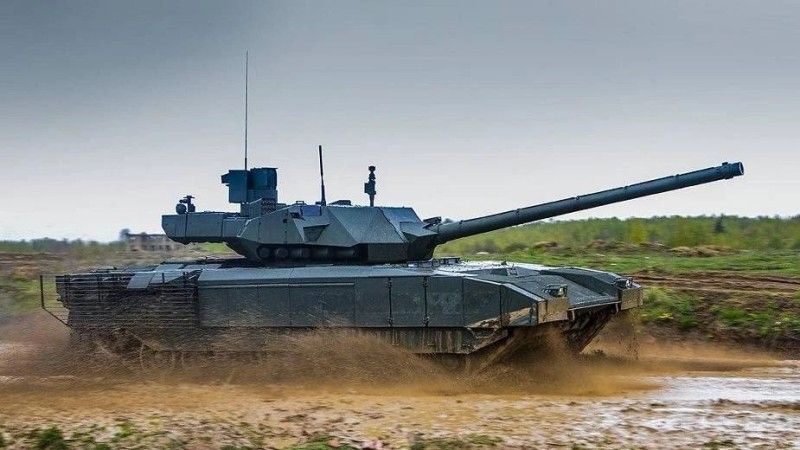
Photo. Rostec
Summing up…
In Soviet times, jokes were well known about how „if you want to see the world, you should join the Red Army.” Fortunately, those days are gone for good. But Russia’s imperial ambitions have not gone away. Russia still has many friends around the world and, when necessary, occasionally makes use of their bases. But these states are not inclined to allow new Russian bases to be established on their territory. In fact, it is not even clear whether Russia currently has the forces and means to build and maintain such bases. The best example of this is Sudan. As early as 2020, the two states signed an agreement to establish a new Navy Material-Technical Support Facility in Sudan. Yet to this day, even preparatory work has not begun there, and a base located there could to some extent replace the one in the Syrian port of Tartus.
It seems that in the coming years Russia will not return to the concept of developing distant overseas bases and will continue to focus on its presence in states directly bordering it. US hegemony in this area will remain unchallenged for the time being. At least until the Chinese Army spreads its wings.


