












- ANALIZA
- WIADOMOŚCI
USA withdrawing from the Baltic States? [ANALYSIS]

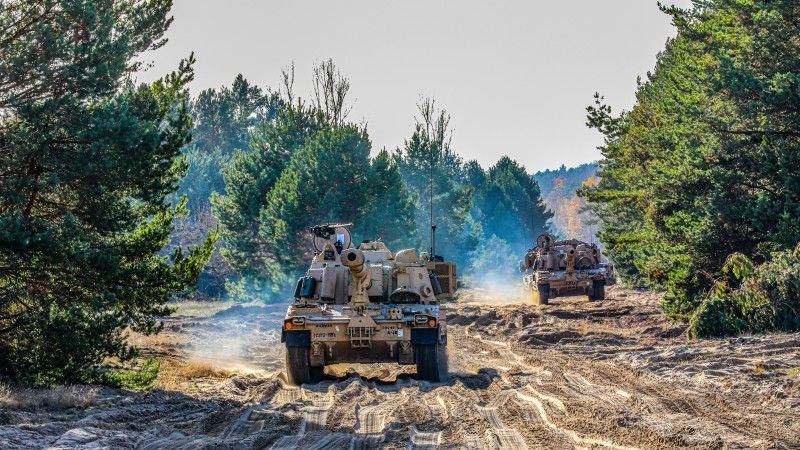
Photo. US Army Europe Africa/X
At the beginning of September the Financial Times reported that the U.S. administration had decided to suspend funding for building the defensive capabilities of the Baltic states (the Baltic Security Initiative, BSI). Is abandoning the BSI program equivalent to a decision to gradually withdraw the United States from this part of Europe?
So far, media leaks indicate that the soon-to-be-published new U.S. National Defense Strategy will primarily focus on the American continent, and that the U.S. Army’s engagement in Africa and Europe is to be limited. Increasingly, it appears that the number of American soldiers currently stationed on the Old Continent (roughly 100,000) will be significantly reduced. While, at least according to recent assurances from U.S. President Donald Trump, this reduction is unlikely to occur in the case of Poland, the risk is greater for countries such as Lithuania, Latvia and Estonia.
Given the above, the question arises whether the governments in Vilnius, Riga and Tallinn should be worried. According to data published by the Centre for Eastern Studies (OSW, under the BSI programme the Baltic states received a total of one billion dollars in 2021–2025, funds that were allocated to „training and exercises of American and Baltic armed forces in Lithuania, Latvia and Estonia and to covering the costs of transferring American weapons and military equipment to the armed forces of those states.” Is that a lot? Yes and no. Considering the substantially increased defence spending today, it is not a sum that can radically change the security of the countries in question.
The fact the decision to withhold funds from the American programme does not keep the Baltics awake at night is evidenced by their reaction. As OSW expert Bartosz Chmielewski (Germany and Northern Europe Team) told us, the absence of BSI „has not caused panic in the region.” „BSI funds in recent years no longer played a key role: respectively 5% and 3% of Estonia’s and Lithuania’s budgets. For Riga, Vilnius and Tallinn funds from the EDI (European Defence Initiative), which have not been suspended, are far more important,” the analyst reminded us.
What about troop reductions?
Cutting funding is one thing, but a potentially much more serious problem could be a reduction of allied troops in the Baltic countries. It is worth looking at the concrete current situation regarding NATO troop presence in the three Baltic states under discussion.
According to analysts, the Americans here play a supporting role for those more heavily engaged: the Germans (in Lithuania), the French and the British (in Estonia), and the Canadians (in Latvia). As Dr. Raubo emphasizes, however, this does not mean the U.S. Army is not operating in this area of NATO’s eastern flank.
„First of all, Lithuania has the capacity to host a rotational, battalion-sized battle group (in total the ability to host over one thousand soldiers) using facilities within the General Silvestras Žukauskas training complex (Pabradė) and the facility referred to by the Americans as Camp Herkus. Their equipment, during rotations, includes heavy equipment dedicated to mechanized/armored unit operations, including armored vehicles, main battle tanks, etc.,” he says, adding that the American presence in the region is largely focused on building interoperability through specific training initiatives, rather than on deterrence.
„This is generally characteristic of American actions aimed at gaining new capabilities to cooperate with NATO battle groups and with the host nations in Lithuania, Latvia and Estonia. In the latter country the Americans have also appeared with systems such as HIMARS rocket artillery, but again we are not talking about the stationing of a permanent, separate contingent,” he continued, drawing attention to the key role of V Corps (with a forward command in Poznań), as well as the presence of American soldiers in various command and control (C2) structures responsible for the defence of Lithuania, Latvia and Estonia.

Are the Americans changing their concept?
Can the Baltic states fear a reduction of American engagement in this part of the world? From the information available to date, the answer is somewhat affirmative. „The question of a potential withdrawal of American troops is being discussed in the Baltic Ministries of Defence, but its effects do not reach the public. Only occasionally do signals appear that such a scenario is being analysed,” Bartosz Chmielewski of OSW told us.
A hint also comes from a remark by Estonian Foreign Minister Margus Tsahkna, who, on the sidelines of the recent UN General Assembly, told the media that „there is no final decision, but there is a very, very clear sense that it will not happen overnight.”
Dr. Jacek Raubo points out that the issue is actually the implementation of a plan the Americans have been considering for some time. „The US authorities have long signaled that they will not shirk alliance responsibilities, but that they want to transform their classical role within NATO,” he said, adding that, accordingly, it is hard to expect Washington to be keen on permanently displacing larger American forces to the three Baltic states under discussion.
So what exactly is the American change of approach supposed to involve? „It is about a paradigm shift in which it is no longer primarily physically American armed forces, through a permanent/rotational presence, that are responsible for deterrence and defence. The change is to include greater dislocations of forces and assets from other NATO countries (after all, the U.S. has 31 allies within this defence alliance) to the most critical and threatened areas, including NATO’s eastern flank. The Americans would then be a supporting element with the capability to rapidly deploy forces and assets in the event of a crisis. The latter is to be made possible based on three key capabilities currently being built,” the Defence24 expert explained.
Do what can be done
The inevitability of these changes is not synonymous with a sense of hopelessness or paralysis of concrete actions. Recently Lithuania’s Foreign Minister Kęstutis Budrys said that „Vilnius is giving the Trump administration every argument to maintain its presence in Europe.”
In the whole situation it is worth noting recent actions by the Baltic states that followed the latest Russian incidents (September’s incursion into Estonian airspace by three Russian MiG-31s). „There is much to suggest that the Baltic states, led by Estonia, will call for strengthened air defence and for changes to the NATO surveillance mission — Baltic Air Policing. For Tallinn (but also Riga and Vilnius) a long-term goal is to change the current shape of BAP from a surveillance mission to an air defence mission,” Bartosz Chmielewski said.
And what specifically can NATO do? According to Dr. Jacek Raubo, the North Atlantic Alliance should continue the development of battle groups, „increasing their scale as possible tactical formations.” There are many more ideas. These include, among other factors: cooperation with host countries in terms of infrastructure, including space for crisis accommodation of additional forces, storage facilities and equipment support; enlarging training areas and creating new ones. The aim is „to maintain the capacity for training processes within the armed forces of Lithuania, Latvia and Estonia without limiting the ability to carry out the actions of battle groups or rotational forces appearing in the region”;
To all this Dr. Raubo adds strengthening rail, road and port networks, as well as creating fuel and energy infrastructure (plus protecting critical infrastructure).
„Ultimately, NATO should gain the capability to potentially increase the number of exercises and manoeuvres of various scales, also including episodes or entire scenarios in the Baltic states. We must also rethink the status of Air Policing Baltic, especially in an era of increased Russian pressure. A highly urgent and critical action is the increase of air-defence capabilities, thinking both of air force assets and of land and maritime components of multi-layered AD/AMDR and C-UAS systems. But most important is a systemic implementation of what has already been agreed, for example at the NATO Summit in Vilnius — that is, the ability to implement defence plans in practice on the eastern flank of NATO. It should be emphasized that plans are one thing, but now is the time for states from Portugal to Estonia to be able to allocate the promised forces and means to act within defensive operations, whether that action is below the threshold of conventional war or whether there is a need to conduct a full-scale combat operation (LSCO),” he concluded.


