- ANALIZA
- WIADOMOŚCI
What to make of the increased defence spending in East Africa

Recently, budget speeches among the six East African countries were read, signaling the start of a new financial year.
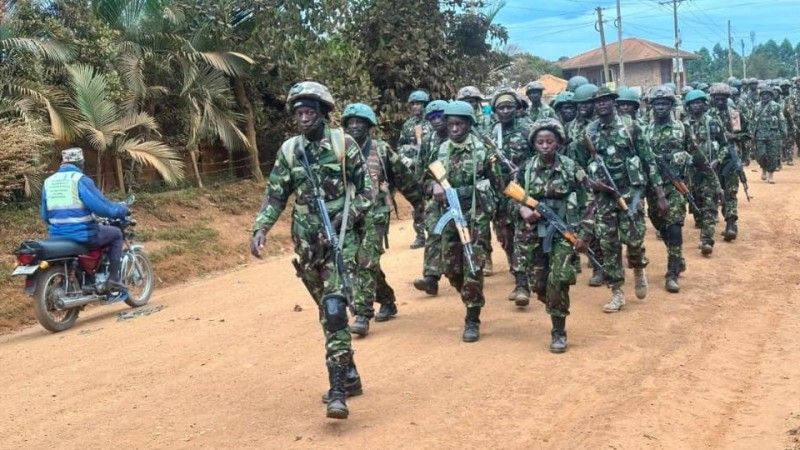
Photo. Uganda Peoples' Defence Forces
Defence and security spending took a sizable part of these budgets, with Tanzania getting an increment of 17.57% over the 2025/26 financial year. Kenya allocated $1.9 billion, an increase from the $1.47 billion in 2025/26. Rwanda allocated $5.3 billion, which was an increase from the 2025/26 budget. Uganda allocated $1.9 billion, a 14.16% increase from 2025/26. This can be attributed to the various security and conflict challenges across the region. From the conflict in the eastern Democratic Republic of the Congo to the political instability in South Sudan, such conflicts create pockets of instability for neighbouring countries. South Sudan’s proposed 2026/27 budgetary allocation for defence and security is noted for taking the largest portion.
According to SIPRI data on defence spending, there has been a gradual increase in the African continent, and these budgets prove that the trajectory continues. The data, released in April 2026, highlighted that Uganda’s expenditure was between 2.0% and 3.0%, while Rwanda, Kenya, and the Democratic Republic of Congo stood at 1.0–2.0%, and Sudan and South Sudan were between 3.0% and 4.0%. Budgetary allocations for defence and security continue to increase in the East African region, although only two countries out of six—namely the Democratic Republic of Congo and South Sudan—are experiencing significant political instability.
For Kenya, the defence sector received the second-highest allocation, ahead of critical sectors like health. Targeted at strengthening the armed forces, defence spending in the Democratic Republic of the Congo is an estimated $20.7 billion. In Uganda, the defence budget will focus on the modernisation, training, and welfare of the Uganda People’s Defence Forces (UPDF), the country’s army; strengthening border security; regional peace support organisations; counterterrorism; completion of the UPDF headquarters; as well as the full equipping of the National Referral Military Hospital. Tanzania’s budget will focus on improving its security capabilities and equipment.
Defence spending is often classified because it includes sensitive aspects of security, and disclosing specific details can trigger a crisis by alerting adversaries to a country’s capacity to handle challenges. However, high defence spending in countries that aren’t at war or experiencing significant security challenges, at the expense of critical sectors like health and education, is problematic. Extensive defence spending often signals trouble, but with no active conflict among four states out of six, this raises questions about a possible arms race in the region and arms diplomacy, among other concerns. Spending on defence at the expense of other sectors does not guarantee security because it ignores human security, which is a key component of security structures. Defence and security are often allocated to the same budget line, though expenditure details aren’t shared.
In Uganda, Kenya, and Tanzania, the high-handed suppression of protests and dissenting voices through violent militaristic crackdowns has become common. This raises questions about whether the defence budget allocations are intended to protect against external threats or internal dissent. This was evident in 2024 in Kenya, when security forces shot at protesters demonstrating against a proposed finance bill, resulting in the deaths of 13 people. In Uganda, since November 2020, when 51 people lost their lives to police violence, the use of tear gas has been a common occurrence whenever protests arise. Tear gas canisters, guns, and bullets are purchased through defence spending. This raises the question of whether defence and security spending is being used to crack down on citizens or protect them.