












- WIADOMOŚCI
- KOMENTARZ
Finland knows it will talk to Russia again

Finland is not naïve about Russia. It is strengthening its border, building military capacity in the north and anchoring itself deeper inside NATO. But Helsinki also understands something that is uncomfortable for many eastern flank states: one day Europe may have to talk to Russia again.
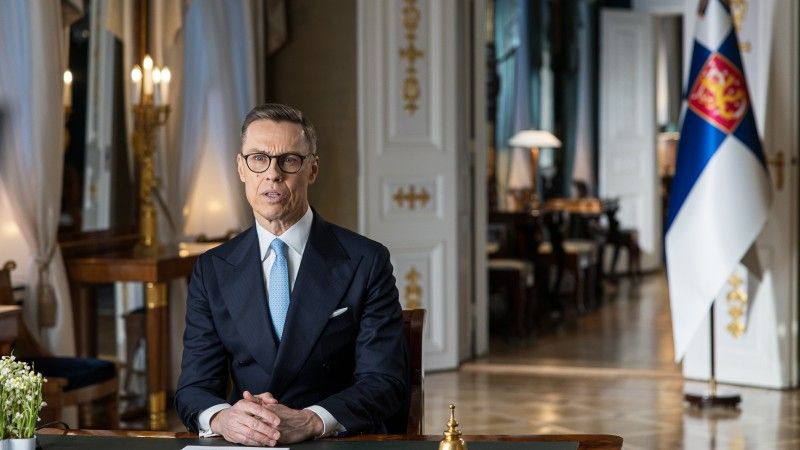
In an interview with NZZ, Finland’s President Alexander Stubb argues that talks with Vladimir Putin may be necessary, but only when Russia is not in a position of strength. His position should not be read as a soft line towards Moscow. He is not calling for a quick reset with Russia or for Europe to accept a deal negotiated over its head. His argument is more limited: if talks with Putin become necessary, they should take place only when Russia cannot dictate the terms, and they should be coordinated with the United States without assuming that Washington’s approach will always be identical with Europe’s interests.
Stubb believes Ukraine is now in its best battlefield position since the beginning of the war. He points to high Russian losses, the role of Ukrainian drones and missiles, the effectiveness of the “killing zone” at the front, and growing pressure inside Russia caused by Ukrainian long-range strikes and restrictions imposed by the Kremlin. In this logic, negotiations with Moscow are not an alternative to Ukrainian resistance, but something that could only make sense if Russia is not able to negotiate from strength.
His view on NATO is also important. Stubb says he has full confidence in Article 5 and argues that Finland and Sweden have strengthened the Alliance by joining it. At the same time, he does not expect Russia to test NATO kinetically. Cyberattacks, sabotage and other hybrid operations will continue, but he does not see logic in Russia directly testing Article 5 while it has failed to defeat Ukraine.
This matters for Poland, Lithuania, Latvia, Estonia and Romania. These states already face Russian hybrid pressure, disinformation, cyberattacks, sabotage attempts and political intimidation. For them, any future political relationship with Moscow will be difficult and will not be accepted easily by their societies. Finland’s position is relevant precisely because it combines two things that are often discussed separately: the need to prepare for long-term confrontation and the awareness that geography may one day force some form of political contact.
Stubb suggests that any European contact with Putin should first be attempted through EU institutions. If that does not work, the next format should be the E3: France, Germany and the United Kingdom. Only later should other formats be considered. This is not a proposal to hand negotiations to one leader or create a single European channel to Moscow. It is an attempt to keep the process coordinated and to avoid a situation in which Europe reacts only to decisions taken elsewhere.
The Finnish president also admits that Europe remains more dependent on the United States than the United States is on Europe. He rejects fears about a hypothetical “kill switch” in F-35 aircraft as unrealistic, but he does expect a shift in burden-sharing inside NATO, including in American capabilities and possibly troops. In practice, Europe should prepare for more responsibility, even if the U.S. remains central to deterrence.

The most important point is that Stubb does not believe relations with Russia after the war will return to the pre-2022 model. For Finland, this is obvious. It has more than 1,300 kilometres of border with Russia, and that border will remain. Some form of political relationship will eventually be necessary, but Russia will still remain the main threat to Europe even after the war in Ukraine ends.
Finland is preparing for Russia as a long-term security problem, not as a partner waiting to be normalised. Stubb accepts that geography will eventually force some form of political contact, but this does not mean trust, concessions or a return to the pre-2022 model. For Poland and the eastern flank, this is the real point: any future dialogue with Moscow must be linked to deterrence, NATO cohesion and Europe’s own ability to defend its interests.


