- ANALIZA
- WIADOMOŚCI
Why is Russia struggling to return to the oceans? [ANALYSIS]

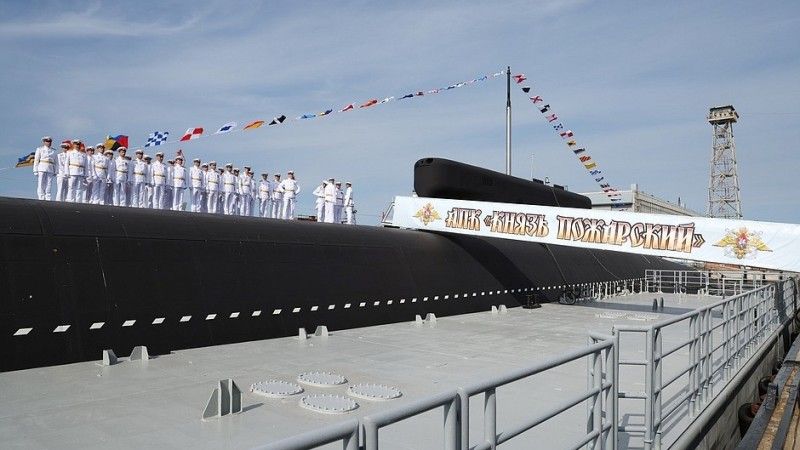
Photo. Russian MoD
In recent years, Russia has been making determined efforts to rebuild its Navy and return to the world’s oceans. Did the now-completed year 2025 bring it any closer to that goal?
Russia's fleet in the wartime reality
Due to its geographical configuration, Russia is forced to maintain four separate fleets. Each of them has different tasks, but all consist of submarines, surface combatants, and auxiliary vessels. As a result, demand for new ships is enormous—especially since a significant portion of those currently in service still date back to the final years of the Soviet Union and are severely outdated.
For years, the plans of the Russian naval leadership have been grand—and therefore unrealistic. Unrealistic primarily because of chronically insufficient funding allocated to new construction. Funds are transferred with some regularity almost exclusively for new submarines, above all nuclear-powered ones armed with strategic missiles. Nuclear „boomers” constitute one of the three components of Russia’s nuclear triad and underpin the country’s status as a nuclear power. In contrast, the construction of surface combatants and auxiliary vessels has been chronically underfunded.
The lack of funds for new ships significantly prolongs the construction process of those that have been ordered. Russian shipbuilding schedules are among the longest in the world. These timelines are further extended by the dispersion of orders across numerous Russian shipyards. Moscow still wants to be a maritime power and possesses many shipyards inherited from the USSR. Some of them, however, have undergone technical degradation and a sharp reduction in production capacity. The policy of distributing state contracts among many shipyards is, in theory, intended to keep as many of them alive as possible.

Photo. Russian MoD
The war with Ukraine has only exacerbated these problems. In this conflict, the Russian Navy plays a secondary—if not tertiary—role. Ukrainian naval forces in 2022 were so weak that they were unable to conduct any major maritime operations. Ukrainian activity focused instead on missile and air strikes, and above all on surface drones, and more recently underwater drones as well. With no real opponent at sea, the Black Sea Fleet withdrew beyond the reach of Ukrainian forces. A large part of it relocated to Novorossiysk, but Russian ships there also quickly proved to be unsafe.
Access to the Black Sea via the Bosporus and Dardanelles has been closed by Turkey. While Russia does have inland waterways connecting the Caspian Flotilla with the Baltic and Northern Fleets, only smaller vessels can transit them.
The unfavorable course of the war has forced Russia to prioritize the development of its ground forces, air defense, and—within technical limits—its air force. The needs of the Navy have been pushed to the very end of the queue. The final nail in the coffin for the Russian shipbuilding industry has been Western sanctions, which have limited or completely eliminated imports of naval equipment. Naval design bureaus have received new tasks and are now also engaged in reworking certain designs to use domestic substitutes (the so-called import-substituted projects, Russian: импортозамещённый проект).
In recent years, Russia has already been characterized by a small number of ships and auxiliary vessels entering service. However, 2025 can likely be considered even worse. According to various official Russian tallies, in 2025 the Navy accepted three submarines and 18–19 surface combatants, patrol boats, and auxiliary vessels from industry. Discrepancies in Russian figures result from several factors. The shipbuilding industry operates on a calendar year, while the military uses a training year starting on 1st December (rather than 1st January). Russian officials usually summarize the year as early as mid-December, before the holiday period beginning on 31st December and lasting into early January. In addition, Russian propaganda is eager to demonstrate only successes to the public. As a result, even floating targets—such as unpowered barges with masts and radar reflectors—are sometimes counted as delivered „units.”

For our purposes, let us count the vessels delivered in the calendar year 2025.
Submarines
Three submarines entered service:
- 11th June 2025 – the conventional submarine B-610 Yakutsk, Project 06363 Paltus (Improved Kilo / Warszawianka);
- 24th July 2025 – the nuclear-powered strategic missile submarine K-555 Knyaz Pozharsky (hull number 846), Project 09552 Borei-A;
- 16th December 2025 – the conventional submarine B-587 Velikiye Luki (hull number 454), Project 677 Lada.
The most important of these is, of course, the strategic boomer Knyaz Pozharsky. It is already the eighth submarine of the Borei and Borei-A projects. Two more—Dmitriy Donskoy and Knyaz Potemkin—are currently under construction, and two additional units are planned. In total, by 2036 there are to be 12 such submarines, with a combined capability to launch 192 Bulava strategic missiles. Each missile can carry up to six nuclear warheads with a yield of up to 100 kt, giving a theoretical total of 1,152 warheads. This represents roughly one third of the current number of active nuclear warheads in the entire Russian Armed Forces.

Photo. Russian MoD
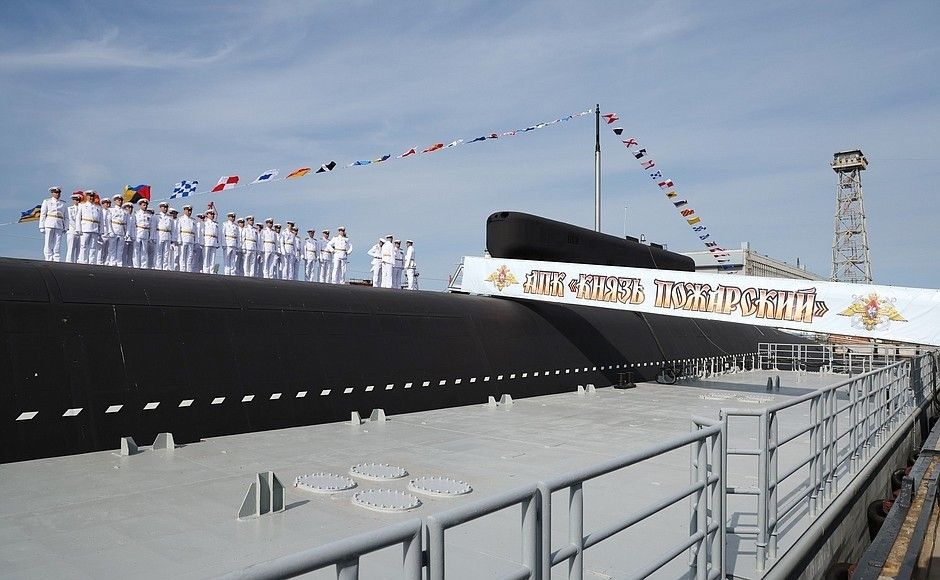
Photo. Russian MoD
As the last four of these submarines enter service, the remaining Project 667BDRM Delfin submarines—dating back to Soviet times—will be gradually withdrawn.
Among other noteworthy events in 2025 concerning nuclear submarines were:
- 27th March 2025 – the roll-out from the construction hall (a notional "launch") and christening of the submarine Perm, Project 08551 Yasen-M;
- 1st November 2025 – a similar roll-out and christening of the submarine Khabarovsk, Project 09851, armed with nuclear Poseidon underwater vehicles (torpedoes).
Perm is only the sixth unit of the Yasen and Yasen-M projects. The keel of the prototype submarine K-560 Severodvinsk was laid as far back as 1993. Five submarines in service over a program spanning more than 30 years is hardly an impressive result.
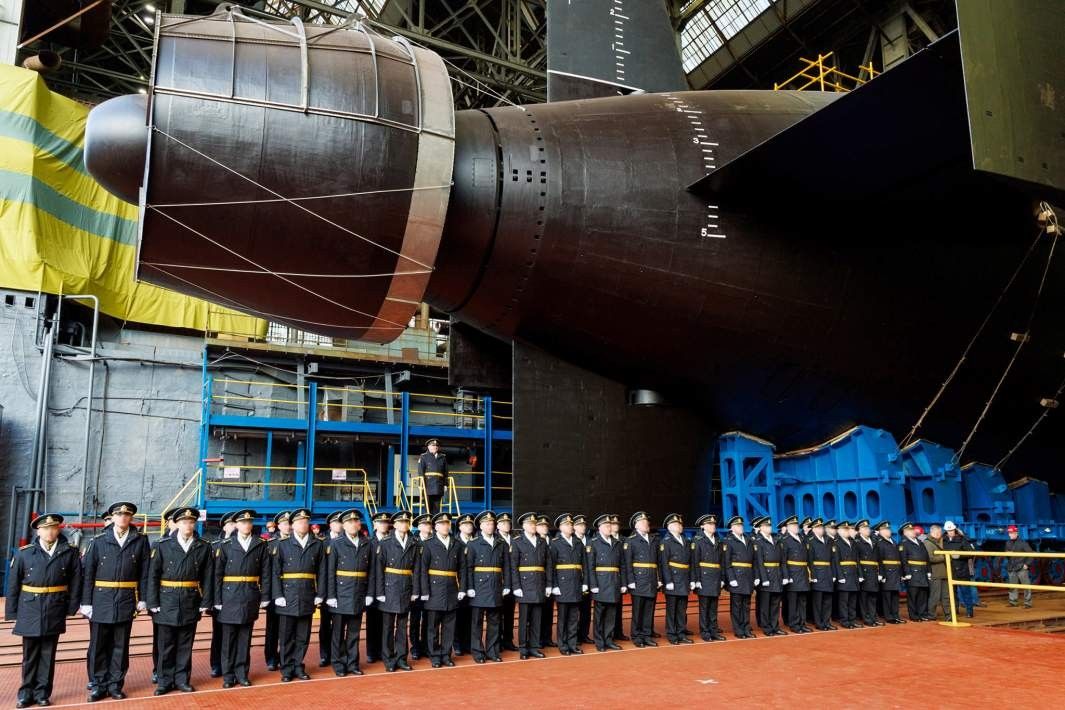
Photo. Russian MoD
Construction of Khabarovsk has progressed equally sluggishly. Its keel was laid on 27 July 2014—more than 11 years before launch. Until recently, it appeared that it would be a single Poseidon carrier. Last year, Russia reportedly conducted its first successful test of a Poseidon torpedo (launched from BS-329 Belgorod, Project 09852). Encouraged by these results, Russia is now speaking of building three additional Khabarovsk-class units. If this happens, their production will undoubtedly take many more years, as it is still unclear when Khabarovsk itself will even enter service.
Conventional submarines will be discussed in a separate article, as 2025 marked a new chapter for them in the Baltic Sea.
Surface combatants
In 2025, only five surface combatants flying the Russian naval ensign entered service:
- 7th May 2025 – the seagoing minesweeper (mine countermeasures vessel) Afanasiy Ivannikov (625), Project 12700 Alexandrit;
- 28th August 2025 – the patrol ship Viktor Velikiy (417), Project 22160;
- 28th August 2025 – the small missile ship (corvette) Typhoon, Project 22800 Karakurt;
- 28th August 2025 – the small missile ship (corvette) Stavropol (555), Project 21631 Buyan-M;
- 5th September 2025 – the Arctic patrol ship Ivan Papanin (400), Project 23550 Arktika.
Auxiliary flags were raised in 2025 on, among others:
- 24th July 2025 – the large hydrographic boat Mikhail Kalashnikov, Project 23040G;
- 10th December 2025 – the small hydrographic vessel Vasily Bubnov, Project 19910;
- 29th December 2025 – the rescue vessel Mikhail Chekhov, Project 22870;
- 30th December 2025 – the self-propelled floating crane SPK-63150, Project 02690.
In summary: two small missile ships, one mine countermeasures vessel, two patrol ships, and a handful of minor auxiliary units—and that is all. At this pace, Russia will not rebuild its maritime power; instead, it will continue to limit its ability to fight at sea and on the oceans.
Although construction of additional combatants and auxiliaries continues in many shipyards, tangible results are lacking. Vessels announced for delivery in 2025 have had their deadlines pushed back to 2026. This creates a domino effect, with subsequent ships also being delayed ever further. A few examples follow.
Construction of Project 22350 frigates is ongoing. Only three are currently in service. Additional units were launched in 2024 and 2025, but their commissioning should not be expected even this year—at the earliest in 2027. Three more frigates are under construction but have not yet been launched.

Photo. MO Rosji
Since the beginning of the 21st century, Russia has been „mass-producing” corvettes of the Project 20380, 20385, and 20386 families in various modifications. To date, flags have been raised on only 10 of them. Only one additional unit, Provornyy, is afloat and is expected to enter service in 2026. It was the corvette that partially burned on the slipway on the night of 17–18 December 2021. Eight more are under construction, and four more have been ordered—but none have been launched. Technically, two hulls were launched. At the turn of 2019–2020, the hull of the corvette Strogiy was launched, only to be returned to the fitting-out hall. In March 2021, the hull of the corvette Derzkiy was launched. It was to be a Project 20386 corvette featuring numerous innovative solutions. These proved so problematic that construction was halted. The hull was launched and set aside and will probably never be completed.
Another „mass” production was supposed to concern the small missile ships of Project 22800 Karakurt. Eighteen were ordered, but the contract for two of them was quickly cancelled. Of the remaining 16, only seven are currently in service, including the aforementioned Taifun, which was commissioned in 2025. A further seven have already been launched, but industry still cannot finish them. The ship closest to completion is Rzhev (400), which has already begun sea trials and whose commissioning is planned for 2026. The last two Karakurts are already under construction but have not yet been launched.
The mentioned commissioning in 2025 of the small missile ship Stavropol (555) of Project 21631 Buyan-M completed the construction of the entire series of these units. Stavropol is the twelfth. The ships were commissioned as follows: three in 2014, two each in 2015 and 2018, and one each in 2019, 2021, 2022, 2023 and 2025. As can be seen, the construction of these relatively small ships was very protracted over time.

Photo. Russian MoD
It is also worth mentioning the reincarnation of Project 1241 Molniya, known in Poland and worldwide under the NATO name Tarantul. At the shipyard in Rybinsk there remain several started but unfinished hulls of such missile boats. A few years ago it was decided to complete two of them in a heavily modified version as Project 12418 (this version differs significantly from the Project 12418 units built for Vietnam and Turkmenistan). The keels for both hulls were laid back in 1992. The second of them, Strelok, was launched on 15th August 2025. The first, Stupinets, was launched in 2024 and will probably join the Caspian Flotilla this year.
In 2025 the ninth minehunter—officially classified as a seagoing minesweeper—was accepted into service. Ships of Project 12700 Alexandrit were announced to be assigned to all four fleets and to the Caspian Flotilla, with some 20–30 planned. But so far only two more are in the water: Polarny (635), launched on 24 April 2025, is to be commissioned in 2026, while Dmitry Lysov (637), launched on 5 December 2025, is only due in 2027. Another four minesweepers of this type are at various stages of construction in the halls. One or two of them can be expected to be launched in 2026.

Photo. Russian MoD

Photo. Russian MoD
In Russia there is criticism of the Navy spending resources on building patrol ships. Border protection in Russia is handled by the FSB, and that service is building a relatively large number of small, lightly armed patrol vessels. Nevertheless, the Russian fleet itself wanted to have six multi-role patrol ships of Project 22160 intended for the Black Sea Fleet and two large Arctic patrol ships of Project 23550 intended for the Northern Fleet. In 2025 the prototype of Project 23550 and the fifth unit of Project 22160 entered service. One more patrol ship of each of these projects is under construction. The 22160 series has already been reduced: the fourth ship of this type, Sergei Kotov (383), was sunk on 5th March 2024 by Ukrainian drones. It had been in service for less than two years.

Photo. Russian MoD
We can conclude the review of combat ships under construction with landing vessels. Currently the Russians are building two universal landing helicopter docks (Project 23900 Priboy) and three large landing ships of the modified Project 11711 Tapir. Construction of the helicopter carriers is highly theoretical because their keels were laid back in 2020 in occupied Kerch, and little is known about further progress. Much more is happening with the Project 11711 ships being built in Kaliningrad. The ship Vladimir Andreev was launched on 30th May 2025, and the launch of the next, Vasily Trushin, is planned for 2026. However, plans to commission them in 2026 are rather unrealistic given typical Russian scheduling. Additionally, on 8th July 2025 the keel was laid for another ship of this type, Sergei Kabanov.

Photo. Russian MoD
The construction of specialist and auxiliary vessels looks even worse than that of surface combatants. In many Russian shipyards single such ships have been under construction for years. Sometimes they are built in small series, and only in the case of very simple and cheap units in larger series. Their construction cycles are disproportionately long relative to their level of complexity and cost.
It is important to note the complete absence in the fleet of large, multi-role replenishment ships capable of accompanying task groups of combat ships on long voyages. Surprisingly, none are even under construction. Meanwhile Russian ships, albeit on a very limited scale, sometimes operate far from Russia. Given the current military-political situation, many countries do not allow them to call at their ports. As a result, the Russians send ordinary, simple tankers on long voyages together with combat ships. On shorter transits, e.g., from the Baltic to the Mediterranean, they are accompanied by smaller vessels such as salvage tugs. Without building such large replenishment ships the Russians have little chance of returning more actively to the oceans, and in wartime they are condemned to operate close to their own coast.

Photo. Russian MoD
Summary
It appears that the proclaimed Russian return to the world’s oceans is not realistic in the coming years. The Russian Navy is at the bottom of the Kremlin’s defence priorities. The war in Ukraine has only reinforced the Russian belief that the land and the airspace above it are Russia’s domain. Of course Russia will not abolish its naval forces, but in the coming years they will only be renewed piecemeal. No breakthrough is expected in this area, despite the considerable efforts of Russian propaganda and the participation of President Vladimir Putin himself in many naval events.
Only submarines will be built with any sort of rhythm—especially nuclear strategic boats with intercontinental missiles. They are a very important element in maintaining Russia’s status as a nuclear superpower. And it is possession of nuclear weapons alone that gives Russia its current position in the world.