












- WIADOMOŚCI
Automating defence supply chain visibility

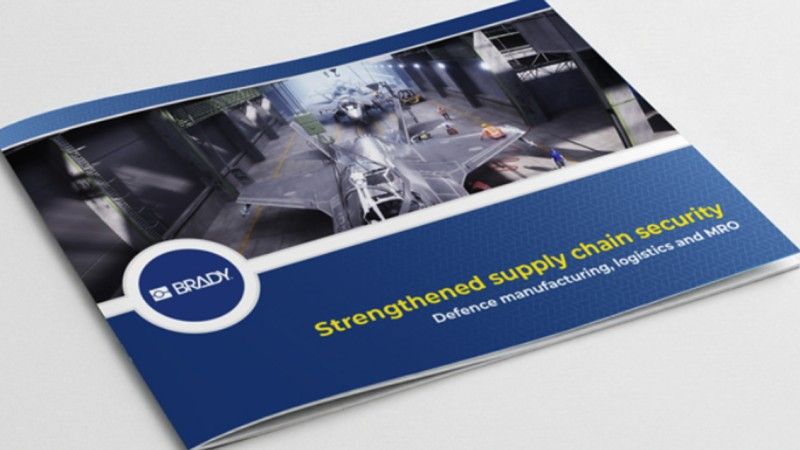
Photo. Brady
Support automated part verification and just-in-time processes. Automatically generate the data required for decision-making on the consumption of critical inventory. Reliable AIDC solutions can strengthen the integrity and resilience of the defence industry supply chain.
A universal solution
As the European Union moves to strengthen defence-industry supply chains, many companies are joining the ReArm Europe initiative. The growing number of suppliers serving the defence sector is increasing production capacity and capability, but it is also raising the level of complexity. A clear data structure that can be generated at different levels of automation is essential to maintaining supply chain integrity and resilience. What are the key elements of such a structure?
Unambiguous terminology
NATO has adopted the GS1 standard, which enables the use of globally unique serial numbers. The GS1 GTIN, or Global Trade Item Number, makes it possible to unambiguously identify a specific product from a specific supplier. It can be linked to the corresponding NSN, or NATO Stock Number, which focuses on the form, fit and function of a given product. Through this linkage, parts and products retain their unique identity, even as they move from the civilian sector into the military domain.
Unique part serial numbers can be converted into GS1-supported RFID codes and 2D barcodes, including Data Matrix and QR codes, enabling accurate recording of logistics data and work-in-progress production data. This creates an unambiguous, machine-readable global industrial language that helps strengthen and secure the European Defence Technological and Industrial Base, or EDTIB, from OEMs through to maintenance, repair and overhaul, or MRO.

Photo. Brady
Anti-counterfeiting safeguards
Every GS1-compliant barcode or RFID code can be readily verified against the global GS1 registry. Barcode readers and RFID readers can also automatically compare codes on physical part labels with digital data supplied by facilities upstream in the supply chain. Through automated part verification and provenance control, the data collected in this way can then be shared with facilities downstream in the supply chain, enabling anti-counterfeiting checks to be repeated across the entire supply chain.
Reliable labels
The benefits described above are available to every facility in the supply chain, provided that the label or direct part mark remains readable. This is achieved through optimal marking that retains its integrity throughout production processes at every facility in the supply chain. The ideal label or mark accompanies the part throughout its entire service life, allowing it to provide optimal support for all maintenance, repair and overhaul operations.
For the most part markings, the largest defence companies impose stringent requirements driven by the need to comply with NATO STANAGs or other relevant military standards. With this in mind, Brady continuously develops new labels in its laboratories, drawing on materials-science expertise, advanced test equipment, globally recognised FINAT and ASTM test methods, in-depth knowledge of relevant standards and norms across multiple industries, and a century of experience in identification.
Label materials are available that resist high and low temperatures, moisture, abrasion, weathering and chemicals, while providing optimal adhesion to smooth, rough or powder-coated surfaces, as well as to cables, wires, products and facility assets. These materials are made from polymers such as vinyl, polyethylene, polyimide and others, combined with topcoats and acrylic-, rubber- or silicone-based adhesives.
Most labels can be equipped with RFID technology, making all items within a defined zone immediately readable. Caution must be exercised, however, when using RFID technology in environments with high concentrations of ammunition, and all applications must be verified in advance.
Although a label may appear to be the least technologically advanced element of a supply chain visibility solution, the reality is quite different. In automatically tracked supply chains, the consequence of label failure is not the cost of the label in euro cents, but rather regulatory non-compliance, security breaches, scrapped components and potential downstream delays. Label reliability is critically important, which is why labelling technology must keep pace with evolving manufacturing processes.
Most parts can also be marked directly using precision lasers or mechanical engraving.
Precision printers
To create the right label, the right printer is required. Although a resolution of 203 dpi may be sufficient to print a large GS1 shipping label, at least 300 dpi is needed to produce most other types of GS1 label. For perfectly readable labels in smaller formats, 600 dpi provides greater precision in smaller areas and at tighter tolerances, improving barcode readability for any 2D code reader.
In addition to printer accuracy, print technology is also important. Thermal-transfer printing provides the print durability required to ensure visibility across the supply chain. Direct thermal printing begins to fade almost immediately, whereas thermal-transfer printing uses heated resin that is fused into the label surface, creating a durable mark.
Component marking is possible at almost any speed and at any level of automation. Inline laser-engraving devices, print-and-apply systems, printed-label feeders and simple standalone industrial printers can all retrieve the relevant data from enterprise systems and apply it to parts either directly or by means of labels.
Advanced readers
A vision scanner is required to read dense 2D codes based on GS1 globally unique serial numbers. Unlike older laser scanners, these devices can read complex codes from multiple angles and use algorithmic decoders or artificial intelligence to read even damaged, dirty and distorted 2D codes.
RFID readers, in turn, transmit and receive radio signals that are reflected by passive UHF RFID tags. This enables a wide range of applications, including reading thousands of labels simultaneously, detecting changes in radio-signal strength, automatically assigning tools to an identifier, and reading stress, temperature and humidity information from sensors embedded in ultra-thin RFID labels. Data can be processed locally in the reader or shared through a range of recognised industrial protocols.

Photo. Brady
Data automation
With advanced readers, modern marking technology and reliable labels, every facility can unambiguously identify parts, track work in progress, production output and inventory levels, and automate part reordering while increasing supply chain visibility. Using the GS1 system or a proprietary supply-chain serialisation system, it becomes easier to track incoming goods batches for just-in-time processes, while automated part authentication helps strengthen the integrity of defence-industry supply chains.
Learn more about identification solutions for the defence industry.
Free guide: Strengthened supply chain security
By bringing all the elements of a high-quality traceability system together in one place, Brady can offer an end-to-end, fully configurable solution covering reliable part marking and reading at various levels of automation.
Our solution increases the transparency of component provenance, strengthens protection against counterfeiting, delivers real-time authenticity data to software systems, deploys digital twins for continuous improvement, tracks warehouse inventory and triggers reorders once defined thresholds are reached.
„Strengthened Supply Chain Security” covers, among other things, the following applications:
- Strengthened supply chain security
- Supply chain visibility
- Identification at production speed
- Automated inventory lists
- Inventory status monitoring
- Automatic tool assignment
- Automated asset reads
- Reducing risks related to machine maintenance
Download the free defence-industry identification guide.
Sponsored article


