












- WIADOMOŚCI
Early warning aircraft from the USA for Poland?

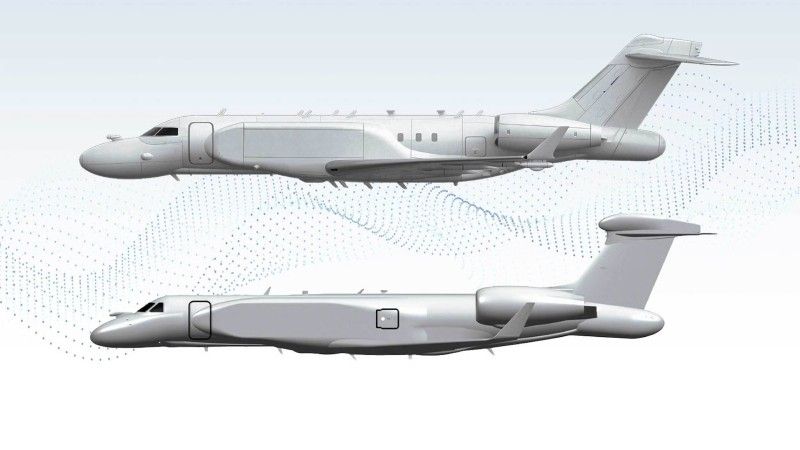
Photo. L3Harris
The Air Force is pleased with the Saab 340B AEW-300 early warning aircraft. However, airmen stress that this is only a temporary solution, sufficient until 2030. A new aircraft of this class is needed, with far greater capabilities, including command-and-control capability.
On the Western market, three jet-powered early warning aircraft are on offer. The first is the Boeing E-7 Wedgetail, which, due to its size, price and Poland’s geographic location, is being ruled out by Polish military officials. Two smaller solutions based on business jets are much more interesting. The first is the Saab GlobalEye, created at the request of the United Arab Emirates, but also selected by Sweden and France.
The second is the American AERIS aircraft, which uses Israeli solutions and was formerly known as Conformal AEW&C (CAEW for short). The designer and integrator of this system is L3Harris. A similar aircraft in Italian air force markings, although based on the Gulfstream G550 (designated E-550A in Italian nomenclature), helped defend Polish airspace in September 2025 when Russian drones entered it. The Americans point out that their company has 70 years of experience in developing airborne early warning and control (AEW&C) aircraft. To date, it has delivered more than a hundred militarized business jets of various classes, including reconnaissance and surveillance aircraft.
L3Harris points to several technical advantages of its solution. The first is the conformal arrangement of the radar antennas: two larger ones on the sides of the forward fuselage, and two smaller ones on the nose and tail. This eliminates the aircraft’s aerodynamic problems resulting from mounting the radar above the fuselage. It also allows operations at higher altitudes, which is crucial for an early warning aircraft. The higher such an aircraft flies, the farther it can “see” with its sensors.
Having antennas on all sides also makes it possible to monitor airspace in 360 degrees. Although the front and rear antennas do not have parameters as strong as the larger side antennas, in practice the difference is slight. This gives the aircraft the ability to observe a designated sector almost independently of its position in space—whether it is moving along the designated area, flying toward it, or retreating from it.
The manufacturer also declares full interoperability of its solution with F-35 fighters, without the need for integration work. In fact, L3Harris systems have been selected to date by many countries whose air forces operate Lightning IIs, led by Israel, Italy and the Republic of Korea.
The system has been integrated with two aircraft types: the Gulfstream G550 (AERIS A) and the Bombardier Global 6500 (AERIS X). Its advantages are also said to include an open architecture, which makes it easy to modernize and adapt to the customer’s needs.
L3Harris also declares a willingness to cooperate with Polish industry. It has already proposed a concept for “Polonization” of the aircraft, taking into account Polish solutions, as well as further development (and also overhauls, maintenance and support) based on domestic centers. There is even a proposal to carry out the specialized installation work in Poland.


