- ANALIZA
- WIADOMOŚCI
Partner or rival? Europe's internal division over Türkiye's role

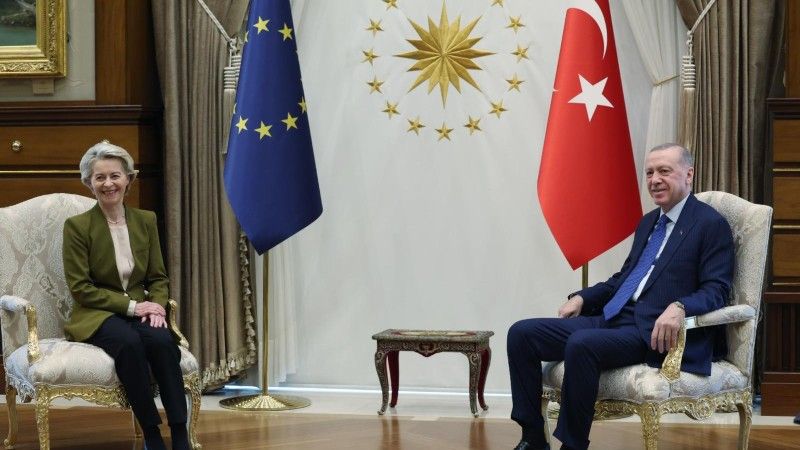
European Commission President Ursula von der Leyen’s statement that Europe must be “completed” so that it does not fall under the influence of Russia, Turkey, or China sparked not so much diplomatic tension between Brussels and Ankara as it revealed a deep structural divide within the European Union itself. The reactions that followed this statement—from sharp criticism by Charles Michel to subsequent attempts by the European Commission to clarify and soften von der Leyen’s words—showed that the EU still lacks a coherent strategy toward key partners, including Turkey.
This dispute is not simply about a diplomatic gaffe. In fact, it reveals a fundamental problem in European foreign policy, where there is a noticeable lack of consensus on whether Turkey should maintain its status as a strategic partner of Europe, indispensable to the continent’s security, or whether it should be perceived as an increasingly autonomous regional power, perhaps even a competitor, and therefore treated with caution, guided by the principle of limited trust.
Von der Leyen vs. Michel – a personal conflict or a symptom of a deeper crisis?
The conflict between Ursula von der Leyen and former European Council President Charles Michel began years earlier. A symbolic moment remains the so-called “sofagate” incident in 2021 during the two politicians’ visit to Ankara, when Michel sat next to President Recep Tayyip Erdoğan, while von der Leyen was moved to a sofa further away, at the side of the room. However, the seating arrangement had been determined in accordance with the European side’s requests. The European Council’s protocol team was the only EU representative present at the preparatory meeting in Türkiye. The Commission did not send its protocol team due to the COVID-19 pandemic. Many commentators, as well as von der Leyen herself, described the incident as sexist. This event not only exposed personal tensions between the two politicians but also revealed the chaos of competencies within the EU’s institutional architecture.
The current dispute over Türkiye, however, is more than just a continuation of personal rivalry. Responding to von der Leyen’s statement, Charles Michel reiterated that Türkiye remains “a key NATO ally, a migration partner, an energy corridor, and an important security actor on Europe’s flanks.” The former President of the European Council thus openly challenged the narrative promoted by the President of the European Commission.
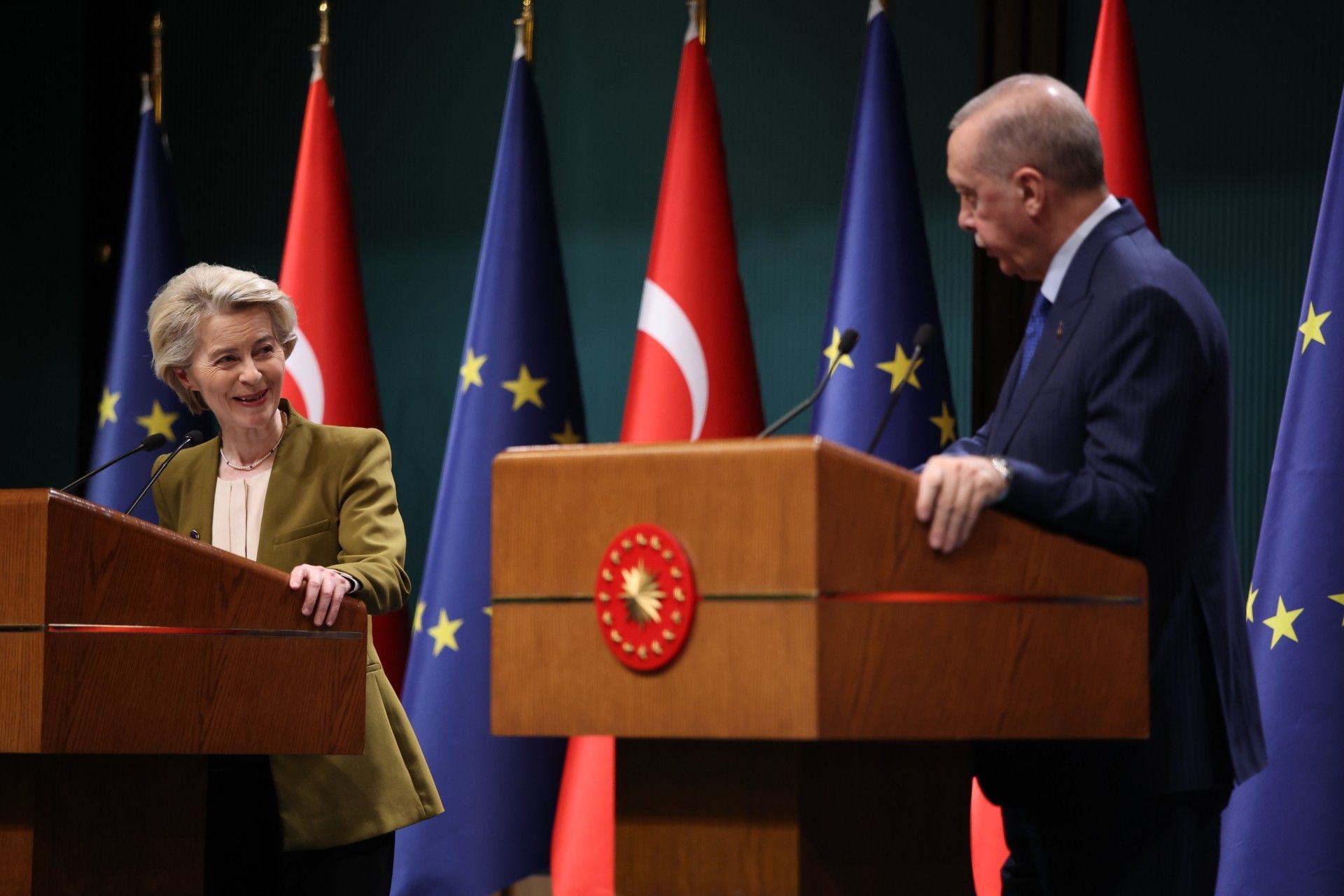
This clash highlighted the existence of two competing visions of policy toward Ankara:
1. The normative camp, represented by some members of the European Commission and countries such as France, Greece, and Cyprus, views Turkey primarily through the prism of political disputes, rule of law issues, and tensions in the Eastern Mediterranean.
2. The pragmatic camp, which includes Italy, to some extent Germany, and parts of the EU and NATO security structures, recognises the strategic necessity of cooperation with Turkey in the areas of defence, migration, energy, and logistics.
A more pragmatic approach toward the Turkish defence industry is increasingly gaining ground even in countries traditionally distrustful of Ankara. A symbolic example is the statement by Belgian Defence Minister Theo Francken, who in May 2026 described the Turkish defence sector as a “role model for Europe,” emphasising that Türkiye itself is a “powerful economic and geopolitical power” and a key NATO ally. Francken openly admitted that a significant part of the Belgian defence sector wants to learn from the Turkish arms industry, particularly in terms of innovation, production capacity, and the efficiency of defence technology development.
These statements clearly demonstrate the growing gap between the political rhetoric of some EU elites and the strategic pragmatism of those responsible for security and the defence industry. The more Europe grapples with the problem of its own limited military and industrial capabilities, the harder it becomes to ignore the fact that the Turkish defence sector has become one of the fastest-growing and most competitive elements of Euro-Atlantic security. In practice, this means that despite political tensions and a lack of full institutional trust, European-Turkish cooperation will most likely continue to deepen—not for ideological reasons, but out of pure strategic necessity and pragmatism.

Geopolitical rhetoric versus strategic reality
The paradox of the EU’s approach toward Türkiye is that the more it speaks of “strategic autonomy,” the more it reveals its dependence on Ankara in key security areas.
Türkiye possesses the second-largest army in NATO after the United States, a developed arms industry, and the ability to conduct independent military operations from Libya to the Caucasus and the Black Sea. Ankara also controls the Black Sea Straits, which are fundamental to limiting Russia’s power projection in the Mediterranean. In the context of the Russia-Ukraine war and uncertainty regarding the future of US involvement in Europe, Türkiye’s importance to the European security architecture has clearly increased.
At the same time, the EU remains unwilling to accept that Ankara no longer wants to function solely as a “peripheral partner,” but rather as an autonomous regional power with its own interests and ambitions. Therefore, the current dispute over Türkiye is not merely a political debate but also a conflict over the future shape of the European security architecture.
In reality, the EU is attempting to reconcile two contradictory goals. On the one hand, Europe wants to benefit from Türkiye’s military potential, industrial capacity, and geographical location. On the other hand, it refuses to grant Ankara full access to decision-making processes and cutting-edge technologies.
At the same time, Europe increasingly understands that Türkiye is too important to ignore, yet too independent to fully embrace. Consequently, it is becoming clear that the language of integration and future membership is gradually giving way to the language of “strategic necessity” and “transactional cooperation.”
"Competitive interdependence" and "selective integration" instead of full partnership
EU-Türkiye relations increasingly resemble a model of “competitive interdependence”. They need each other strategically, while simultaneously competing economically, politically, and technologically.
At the same time, their defence relations appear to be shaped not by full institutional integration, but rather by a model of “selective integration”. In practice, this means pragmatic cooperation where necessary and mutually beneficial, while maintaining political limitations stemming from a lack of full trust. Europe needs Turkish industrial production and defence capabilities, but at the same time seeks to retain the technological “brains” within the European core.
This explains why bilateral partnerships, joint ventures, and pragmatic sectoral agreements are playing a greater role than the full integration of the Turkish defence industry into the EU’s security structures.

The problem of trust – the biggest strategic barrier
The biggest problem on the European side is not the lack of Turkish military potential, but rather the persistent lack of strategic trust and the reluctance to pursue deeper political reconciliation.
Concerns persist in European capitals regarding Ankara’s independent foreign policy, particularly its relations with Russia, including the purchase of the Russian S-400 system, which continues to exert a strong psychological influence on European perceptions of Türkiye’s strategic credibility, as well as its military operations in Syria and Libya.
Furthermore, issues related to the rule of law and the state of democracy in Türkiye make it difficult for many European governments to politically justify deeper defence cooperation with Ankara.
This is where the greatest paradox of European policy emerges: the EU needs Turkish capabilities more than ever before, yet it is becoming increasingly difficult for European actors to politically accept Ankara’s growing autonomy, which does not always align with the typically European model of functioning within the international system.
The EU's problem: lack of a shared strategic vision
The European Union’s biggest problem is not Türkiye itself, but rather the lack of a common definition of what the EU wants to be, and what role it should play, as a geopolitical actor.
Statements by Ursula von der Leyen and EU Commissioner for Neighbourhood and Enlargement Marta Kos perfectly illustrate this inconsistency. While the President of the European Commission places Türkiye alongside Russia and China as a potential geopolitical threat, Marta Kos emphasised in her speech to the European Parliament that “Europe needs Türkiye in light of the changing geopolitical realities in Europe and the Middle East,” adding that the country is the EU’s fifth-largest trading partner and that bilateral trade between the two sides is twice the volume of trade with Mercosur or India.
Such contradictory messages undermine the EU’s credibility as a strategic actor. This problem is particularly evident in the context of the EU’s ambitions to build a “geopolitical Europe.” It is difficult to speak of strategic autonomy when the European Union itself cannot clearly define its position toward one of the region’s most important countries.

Conclusion: partner, rival, or strategic necessity?
The entire crisis surrounding Ursula von der Leyen’s words has revealed one fundamental truth: the European Union still lacks a unified vision for its future relations with Türkiye, one that all member states would be able to agree on.
If the EU truly wants to become an independent, fully autonomous, and effective geopolitical actor, it is difficult to imagine a credible European security architecture without Ankara. However, if Europe continues to view Ankara solely through the prism of political and normative disputes, relations will increasingly drift toward strategic rivalry or further attempts to avoid addressing growing problems and ambiguities.
Today’s reality, however, clearly demonstrates that Europe and Türkiye remain interdependent. The problem is that both sides are increasingly reluctant to acknowledge this publicly. This is precisely why the current phase of EU-Türkiye relations can best be described not as a partnership or rivalry, but rather as an era of strategic necessity and pragmatic interdependence.