












- WIADOMOŚCI
EU Unveils Schedule of €150 billion SAFE Defence Loans

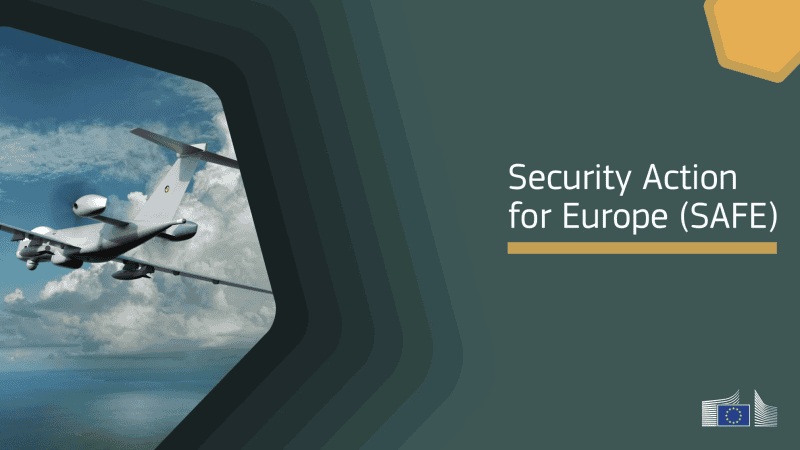
In response to Russia’s aggression and a rapidly deteriorating security environment, the European Union has officially launched SAFE (Security Action for Europe) – a new defence financing instrument designed to unlock up to €150 billion in long-term loans for Member States. Adopted by the Council of the EU on 27 May 2025 and operational as of 29 July, SAFE will support urgent and large-scale defence procurements, with an emphasis on joint projects and strategic industrial investments. The initiative is a central pillar of the EU’s ReArm Europe Plan and is intended to rapidly strengthen Europe’s defence industrial base, improve interoperability, and increase military readiness by 2030.
SAFE marks a major evolution in the EU’s approach to defence policy, introducing for the first time a loan-based mechanism backed by the Union’s credit rating to finance national military investments. Unlike previous instruments limited to grants or small-scale programmes, SAFE enables Member States to access competitively priced, long-maturity loans to fund procurement in key categories – from artillery and ammunition as well as ground forces equipment to cyber, air defence, drones, and strategic enablers. The EU expects this new mechanism to trigger over €800 billion in defence-related spending across the bloc by the end of the decade.
To avoid fragmentation and maximise industrial impact, most SAFE-supported projects must be conducted jointly between at least two eligible countries, including Ukraine and EEA–EFTA partners. However, individual Member State procurements will also be temporarily supported to address urgent capability gaps. Projects will be divided into two categories, with strict origin requirements – at least 65% of components must come from the EU, EEA–EFTA, or Ukraine. Category 2 projects (e.g. air defence, space, C4ISTAR, AI/ EW) must additionally meet higher sovereignty and modification standards, ensuring full operational control within the Union.
The initial response from capitals has been strong: by 29 July 2025, 18 Member States – including Poland, France, Italy, and the Baltic countries – had submitted expressions of interest, with a combined indicative demand of €127 billion. Next, governments are expected to submit detailed National Defence Investment Plans by 30 November. If approved, loan agreements could be finalised as early as February 2026, triggering advance payments and allowing procurement projects to begin by mid-year.
Crucially, SAFE is not limited to the EU’s internal market. While only Member States may access loans, partner countries like Ukraine, Norway, and the UK may participate in joint procurement and contribute industrially. The mechanism is explicitly designed to support Ukraine’s integration into the European defence architecture – offering co-financing opportunities and industrial participation on equal terms. With defence production ramping up and Europe seeking greater strategic autonomy, SAFE may become the defining instrument of EU military rearmament in the second half of the decade.


