












- WIADOMOŚCI
- WYWIADY
Europe needs defence innovation at battlefield speed

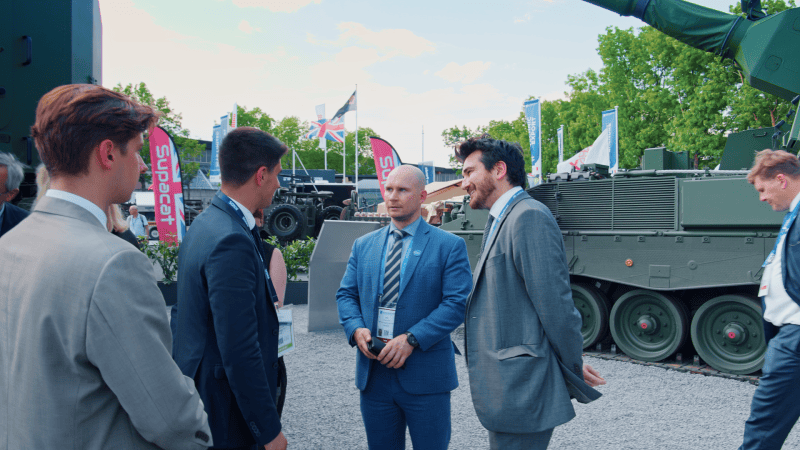
Photo. Skeleton Technologies
The war in Ukraine has shown that military advantage no longer depends only on tanks, artillery and missile systems. Energy resilience, mobility, platform endurance, drones, counter-drone systems and the rapid integration of new technologies into existing weapons are becoming just as important. In a conversation with Dr Aleksander Olech, Arnaud Castaignet, Senior Vice-President for Strategic Affairs at Skeleton Technologies, argues that Europe must combine the scale of major defence groups with the speed of specialised technology companies.
The agreement between Skeleton Technologies and KNDS France shows a wider shift in Europe’s defence industry. Cooperation can no longer rely only on large state programmes that take years and often fail to keep pace with the battlefield. The new model is based on major defence groups integrating technologies developed by specialised companies across Europe. For Estonia and other smaller states, this means moving from the role of equipment buyers to providers of critical technologies. For Europe, it is a test of whether its defence industrial base can react to war faster than Russia.
Dr Aleksander Olech: How should we read the agreement between Skeleton and KNDS France in the broader context of European defence cooperation?
Arnaud Castaignet: This agreement reflects an important evolution in European defence-industrial cooperation. Europe is moving from cooperation based mainly on large state programmes to a more networked model, where major defence groups integrate specialised technologies developed across the continent.
KNDS France working with an Estonian dual-use technology company specialised in advanced power systems is significant in that context. It shows that the French defence industry is increasingly open to using the best European innovation, including from Central and Eastern Europe and the Baltics. The geography is key, and we all saw the presence of French defence companies increase in the region in recent years, but the quality of technology remains the first criterion. This is exactly the kind of industrial cooperation Europe needs: large defence groups bring platform expertise, qualification, production scale and export channels, while specialised companies bring speed, deep technology and new engineering approaches.
The war in Ukraine has accelerated this shift. It has shown that operational advantage depends not only on traditional defence platforms, but also on how quickly new technologies can be integrated into those platforms. This agreement is therefore not only a bilateral project between two companies. It is part of a broader European trend: strengthening the defence industrial base by connecting large primes with high-performing technology companies across the EU.

What does this project say about the role of Estonia and smaller European states in advanced defence-industrial partnerships?
It shows that smaller European states are no longer only buyers of defence equipment. They can also be providers of critical technology.
Estonia is a good example. It is a small country, but it has a strong technology ecosystem, a very clear understanding of the Russian threat, and close practical experience through support to Ukraine. That creates a different kind of defence innovation culture: fast, pragmatic and focused on operational relevance.
This matters for larger European defence companies. French industry has enormous platform expertise, engineering depth and industrial scale. But innovation in areas such as power systems, autonomy, sensors, cyber, electronic warfare, drones, and counter-UAS systems can also come from Tallinn, Warsaw, Riga or Vilnius. Skeleton Technologies is, of course, not the only example of collaboration involving Estonian companies with large defence primes: KNDS also collaborates with Milrem Robotics on modular UGV solutions. Frankenburg Technologies collaborates with Airbus Defence and Space, equipping Airbus’ interceptor drones with its missiles. There are several other examples in this regard.
For Estonia, this type of cooperation also shows that small countries can contribute to European strategic autonomy not only through defence spending or frontline geography, but through sovereign technology that becomes part of advanced European military platforms. The future European defence industrial base should make better use of this diversity, and incentivise cooperation between defence and non-defence companies.

Photo. Skeleton Technologies
How are drones, loitering munitions and other aerial threats changing the requirements for modern weapon systems?
Ukraine has changed the economics and tempo of warfare. European armies must now prepare not only for aircraft, helicopters or cruise missiles, but also for large numbers of low-cost drones, FPV drones, loitering munitions and coordinated aerial attacks. These threats are cheap, numerous, difficult to detect, and can be used continuously.
That changes the requirements for modern weapon systems. Platforms need faster target acquisition, faster reaction time, more sustained engagement capability, better mobility, and the ability to operate under electronic warfare conditions. They also need to engage many targets without quickly exhausting expensive missiles or overloading the platform.
In practice, this means that modern air defence and counter-drone systems are no longer just about the effector. The full system matters: sensors, power architecture, software, fire control, mobility, thermal management, reload speed and reliability under battlefield conditions.

Why is energy resilience becoming so important for air defence, counter-drone systems and mobile military platforms?
Modern armed forces need both simple, affordable systems that can be deployed at scale, and highly capable platforms that integrate multiple advanced technologies. Those platforms are becoming significantly more power-intensive and electrically complex.
Many modern air defence systems, counter-drone platforms and advanced combat vehicles combine radars, electro-optical sensors, electronic warfare systems, communications, battle management systems, active protection systems and advanced turrets. These subsystems all require substantial electrical power, often with very different and rapidly changing demand profiles. In combat, they must frequently operate simultaneously and react within extremely short timeframes.
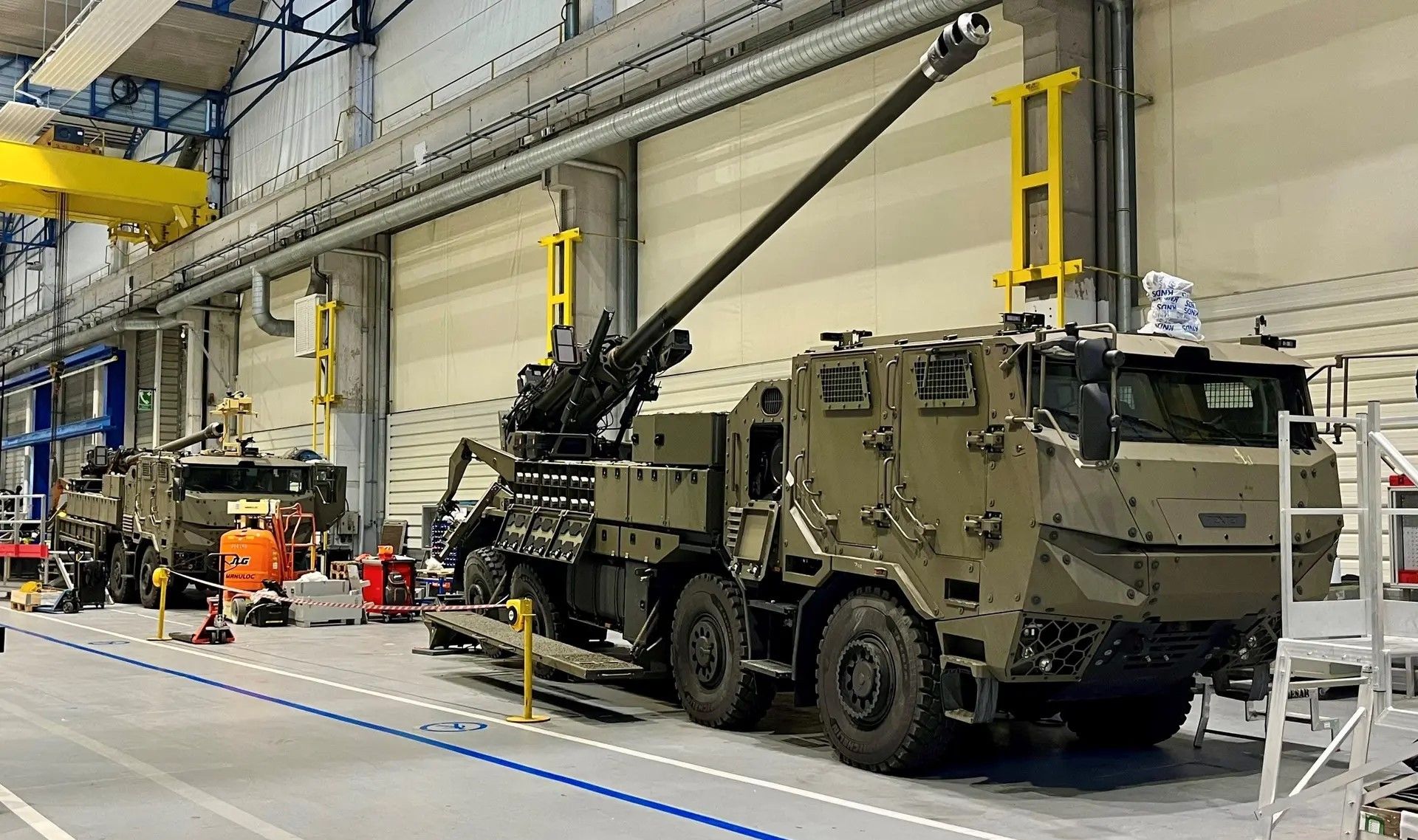
Energy resilience is about ensuring the platform can continue to fight under those demanding conditions. If power becomes the bottleneck, the whole platform becomes less effective. A vehicle may have the right weapon, but if it cannot sustain sensor performance, electronic warfare, targeting, turret movement or repeated engagements, its combat effectiveness is reduced. This is where advanced power systems become critical. Skeleton’s power systems based on supercapacitors can deliver extremely high power with microsecond response times, ensuring that critical subsystems receive the power they need, exactly when they need it.
Think of a modern combat platform as an orchestra. Every instrument has its own role and timing. The same is true for radars, sensors, communications, electronic warfare and weapon systems. They all have different power requirements, often at the same moment. The role of the electrical architecture is to orchestrate them so the entire platform performs as one integrated system. That orchestration is what ultimately delivers energy resilience: keeping the platform operational, responsive and effective throughout the mission.
See also 

Has the war in Ukraine accelerated demand for technologies that make weapons faster, more mobile and more reliable?
Yes, very clearly. Ukraine has shown that survivability often depends on speed and mobility. Systems that remain static are detected and targeted. Platforms need to detect, engage, move and be ready to fire again quickly. Reliability also matters enormously, because equipment is used intensively, with limited maintenance and in difficult field conditions.
The war has also shown the importance of availability. In peacetime procurement, performance specifications often dominate the discussion. A system that is 70% as capable but available, repairable and deployable at scale can be more valuable than a more sophisticated system that is scarce, fragile or difficult to maintain.
This has accelerated demand for technologies that improve reaction time, sustained performance, mobility, maintainability and operational readiness.
Should Europe build defence innovation through large state programmes, or through faster cooperation between specialised companies and major defence groups?
Europe needs both. Large state programmes remain necessary for strategic capabilities such as combat aircraft or submarines, for instance. Integrating specialised or younger companies also helps them learn new processes and forms of collaboration with primes. But these programmes are often too slow to respond to rapidly changing battlefield needs.
Ukraine has demonstrated that innovation cycles in warfare are now measured in months, sometimes weeks. Drones, electronic warfare and counter-drone technologies evolve constantly. Procurement and industrial cooperation need to adapt to that tempo, as well as large defence primes.
Both worlds have strengths: major defence groups provide platform integration, certification, production discipline, while specialised companies provide focused innovation, speed, but also increasingly affordable mass production.
How important is it for Europe to reduce dependence on non-European technologies in critical defence systems?
It is extremely important. European defence sovereignty is not only about final assembly or having European flags on platforms. It also depends on control over critical components, supply chains, software, materials and enabling technologies. At Skeleton, building a non-China-dependent value chain has been a strategic priority from the outset, because security of supply is just as important as technical performance for critical defence capabilities.
The war in Ukraine and the broader geopolitical environment have shown how quickly supply chains can become constrained or weaponised. There are extremely strong dependencies in technologies as diverse as Li-Po batteries – which are often used in drones – or military explosives and energetics. Another Estonian company, Wolfram Europa, is, for instance, addressing this and aiming to develop European sovereign energetics industrial capacity.
Europe will continue to cooperate with allies, especially within NATO and partner countries such as Japan, South Korea, and increasingly Gulf countries as well. We saw with the war in Iran that Europe’s interests can be very much aligned with the interests of the UAE, Saudi Arabia, or Qatar, for instance, and defence cooperation has strongly increased in recent months.
Europe needs a much stronger European technology base. This is particularly true for technologies that determine operational availability, resilience and freedom of action in a crisis. Reducing dependence on non-European and non-allied technologies is therefore not protectionism. It is a question of military readiness, industrial resilience and strategic autonomy.

What role can France and Estonia play together in strengthening Europe’s defence industrial base?
France and Estonia are very complementary. France has one of Europe’s strongest defence-industrial bases, with major primes, deep engineering expertise, export experience and the ability to bring technologies into complex military platforms. In France, the business ecosystem is very much open to collaborating with the defence sector, including banks, investors and export control authorities. France is proud of its nuclear deterrence and has the will to protect Europe. Estonia brings a strong technology ecosystem, frontline strategic awareness, speed of execution and close understanding of the lessons emerging from Ukraine. Together, they can help build a more agile European defence industrial base: one that combines scale with speed, and strategic depth with battlefield-driven innovation.
This is also politically important. European defence cooperation should not only be west-west or prime-to-prime. It should connect the whole continent, including the Baltics and Central and Eastern Europe, into Europe’s core defence-industrial architecture. France and Estonia can be a strong example of that model.


