












- ANALIZA
- WIADOMOŚCI
Is Kim Jong Un triumphing? Trump pulls back forces from the drills

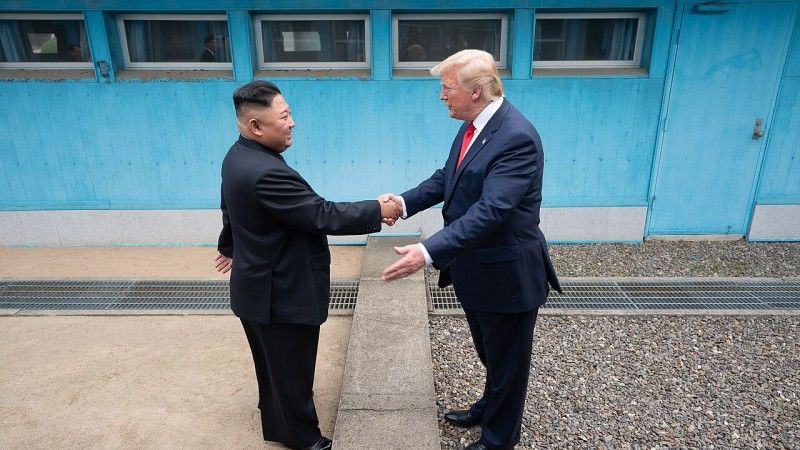
US President Donald Trump intends to significantly scale back the involvement of American forces during the annual joint manoeuvres conducted with the army of the Republic of Korea. The primary reason is said to be his relationship with… Kim Jong Un.
On Monday, 17 August, the United States and South Korean soldiers began their annual joint military manoeuvres. Up to 18,500 soldiers are expected to participate on the host side (Korea), while the number of US participants remains unknown (just under 30,000 American troops are currently stationed in South Korea). The history of the 10-day “Ulchi Freedom Shield” exercises dates back to 1976. On the 50th anniversary of their inauguration, they were very nearly cancelled.
Trump complains about Seoul
It appears that the only obstacle to such a decision was… time. “Since it is too late to cancel (this year’s exercises – editor’s note), I have instructed Secretary Hegseth to significantly reduce Joint Military Exercises,” the American leader wrote on one of his social media platforms. In his view, the manoeuvres “(…) send a signal that is entirely inappropriate and hostile toward a nation that, since Donald Trump has held the office of president, poses no threat and shows respect.” That nation is North Korea and its leader, Kim Jong Un.
In May, SecDef Hegseth met with the ROK Defense Minister and praised South Korea for their “commitment to increase defense spending and your leadership in assuming primary responsibility for the security of the Korean Peninsula.”
— Haley Britzky (@halbritz) August 16, 2026
“It demonstrates alliance burden-sharing that all… https://t.co/H8PqlwwIAf
In justifying this assessment of the US-South Korean exercises, Trump cited the high costs of the manoeuvres, their unequal distribution (with Americans allegedly paying significantly more), the South Korean refusal “in the process of the denuclearisation of Iran,” and the negative impact on Trump’s relationship with the aforementioned Kim Jong Un.
Shifting moods
Although Trump’s sniping at his ally in Seoul is no longer extraordinary (in 2025, the USA imposed 25 per cent tariffs on the Republic of Korea under the so-called Reciprocal Trade Act), the latest message, critical of the South Korean authorities, stands in some contradiction to what Secretary of Defence Pete Hegseth said only recently.
In May, he hosted his South Korean counterpart, Minister Ahn Gyu-back, at the Pentagon and praised Seoul for its “commitment to increasing defence spending and leadership in assuming primary responsibility for the security of the Korean Peninsula.” At the time, South Korea was even described as a role model for other American allies.
In the sequence of recent events and various statements by key politicians from the described countries, another remark is worth noting. Donald Trump’s words can be interpreted as an attempt to de-escalate the dispute with Pyongyang, aligning with a recent statement by South Korean President Lee Jae-myung, who publicly called for the commencement of peace talks with North Korea. Lee would like to replace the armistice in force since 1953 with an official peace treaty (war continues de jure to this day). However, these attempts may come to nothing unless the attitude of the North Korean authorities changes, and there are no signs of that for the time being.
See also 

Pyongyang tests
Trump’s message appears just days after North Korea conducted tests of an intermediate-range ballistic missile. One of the tested missiles (the Kim regime launched two ballistic missiles in August) was fired on 12 August from Wonsan (in the eastern part of the country) towards the East Sea (also known as the Sea of Japan) and reportedly flew approximately 700 kilometres before falling into the water.
It is worth noting that similar demonstrations by Pyongyang have appeared several times over recent years during joint United States and South Korean exercises. Time will tell whether the conciliatory gestures from the presidents of the USA and the Republic of Korea will have any impact on changing the policy of the regime in Pyongyang.
Today, rather than the “calming” of Kim Jong Un, a deterioration in relations between Washington and Seoul seems more likely. Trump’s decisions could be of considerable importance here and may trigger a series of highly significant consequences. The loosening of US-South Korean ties could, among other things, lead to a return to considerations regarding the Koreans acquiring their own nuclear weapons.


