












- OPINIA
- WIADOMOŚCI
- KOMENTARZ
“Homar-F”: A rocket agreement across divides

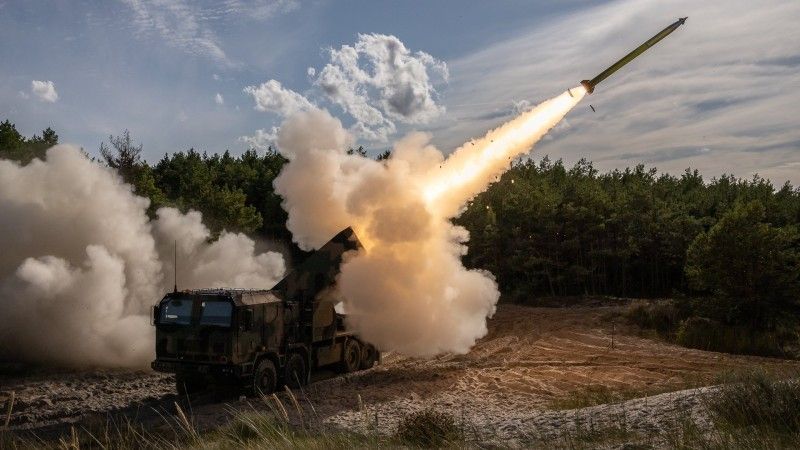
Photo. Dowództwo Generalne Rodzajów Sił Zbrojnych / X
Hanwha Aerospace and Thales have reached an agreement on integrating Korean guided missiles with a new French rocket launcher. The matter also has a Polish dimension and angle.
On the opening day of the Eurosatory 2026 defense industry exhibition in Paris, we learned that the ArianeGroup-Thales-Soframe triumvirate had lost the competition to the rival MBDA-Safran consortium for the supply of a new rocket artillery system for the French Army (Armée de terre). Even so, the prototype of the new X-Fire launcher, which had been tested at a range only a few weeks earlier, did not disappear from Thales« exhibition stand. This was not an attempt to put a brave face on failure, but rather an example of pure business pragmatism. Instead of protesting the decision made by the French government, the group of companies centered around Thales intends to give X-Fire capabilities that its competitor does not possess.
A number of important developments took place in the background. ArianeGroup, Thales« partner in the Frappe longue portée terrestre (FLP-t) procedure for a new rocket launcher for the Armée de terre, presented two new ballistic missiles at Eurosatory. The smaller, single-stage B-Strike 1000 missile, with a range of approximately 1,000 km, is to be integrated with the aforementioned X-Fire launcher. In addition, Thales signed a memorandum of understanding with South Korea’s Hanwha Aerospace. The agreement concerns the integration of three types of Korean munitions with the X-Fire system. Adding further intrigue is the fact that one of these missiles will be produced in Gorzów Wielkopolski, Poland.
Prudence is common sense
For the X-Fire system, ArianeGroup and Thales developed the FLP-t 150 guided rocket, with a range of 150 km. This effector was first launched at the turn of April and May at the missile technology test center of France’s Directorate General of Armaments (Direction générale de l’armement, DGA) on Île du Levant, off France’s southern coast. A few weeks later, Thales and Soframe conducted a successful firing of the 68 mm X-Fum training rocket. Evidently, reaching these milestones had no measurable impact on the DGA’s assessment, as the agency entered into exclusive negotiations with the rival MBDA-Safran consortium.
The manufacturers of the FLP-t 150 missile are fully aware that the road from presenting a prototype to launching serial production is long and uneven. For this reason, Thales« press releases had pragmatically emphasized from the outset the readiness to integrate the X-Fire system with effectors originating outside France. In this way, the time required to enter service can be significantly shortened, since a potential user would not have to sit idle and wait for research and development work on the FLP-t 150 missile to be completed before placing an order for X-Fire launchers. Thales has found a convenient partner in South Korea’s Hanwha Aerospace.
The Hanwha-Thales agreement lists three types of Korean munitions to be integrated with the French launcher: the CGR-080 guided rocket, with a range of 80 km; the CTM-MR, with a range of 160 km; and the CTM-290 tactical ballistic missile, with a range of 290 km. All were developed for the K239 Chunmoo multiple-launch rocket system. The first and third of these effectors have been ordered by the Polish Armed Forces for the Homar-K launcher, a heavily Polonized variant of the K239 system. Work is under way to launch production of the CTM-MR, which is also expected to receive an anti-ship variant designated CTM-ASBM.
Hanwha Aerospace From the Polish perspective, this information may be significant. In December last year, the Armament Agency placed an order for more than 10,000 CGR-080 guided rockets. These rockets will be produced, at least in part, at a new factory in Gorzów Wielkopolski. The facility will be managed by Hanwha WB Advanced System. This joint venture was established by WB Group and Hanwha Aerospace to launch production of combat assets for the Homar-K launcher, as well as for K239 Chunmoo variants ordered by Poland’s NATO allies: Estonia and Norway.
Lance-roquettes à la polonaise
The Polish Armed Forces are the largest export user of the K239 Chunmoo system. To date, the Armament Agency has contracted 290 Homar-K launchers. According to available data, in 2022 the Republic of Korea Armed Forces themselves operated 218 vehicles out of 367 ordered. By the end of last December, 156 launcher modules had been delivered to Poland, of which 108 vehicles had been completed by that time. System integration — including the Jelcz P882.57 chassis, the weapon module with associated equipment, the WB Group Topaz fire-control system, and many other components — is carried out by Huta Stalowa Wola, a subsidiary of the Polish Armaments Group. Homar-K will be integrated with Polish-made 122 mm rockets. HSW will develop and deliver transport-launch containers for these rockets.
The deep level of localization achieved with Homar-K contrasts with the negotiating position so far adopted by the American side in the Homar-A project. To date, this branch of the Homar program has resulted only in the purchase of 20 M142 HIMARS launchers in their original configuration for the Polish Armed Forces. U.S. authorities have so far not consented to the production in Poland of basic GMLRS missiles. The demonstrator of the target Homar-A system, with a HIMARS launcher mounted on a Jelcz P663.45 chassis, has not evolved into a full-fledged prototype. In the author’s view, the chances of changing this state of affairs are slim, even though former Minister Mariusz Błaszczak had already tempted Washington with the prospect of purchasing as many as 500 Homar-A launchers.

Photo. Adam Świerkowski / Defence24
One of the reasons why Poland’s Ministry of National Defence opted for negotiations with the American side on the Homar-A system is the new PrSM missile intended for HIMARS. Today, these effectors have a range of up to 500 km, while in the future they are expected to reach 1,000 km. The U.S. Army used this munition in combat during the U.S.-Israeli war with Iran. However, the lack of U.S. consent for production in Poland of even the basic 80 km-range GMLRS missiles casts a shadow over the prospects for genuine Polonization of the Homar-A system. Delays in planned deliveries of American weapon systems and key munitions to export users do not help either. This move was forced by the Pentagon in order to replenish its own wartime stocks after the war with Iran.
Meanwhile, France is developing a rocket artillery system that is not only independent of American export restrictions and targeting architecture, but will also be integrated with munitions used in Poland — and produced locally. Moreover, the B-Strike 1000 ballistic missile being developed by ArianeGroup, with a range of 1,000 km, looks promising as a more modern, fully European counterpart to Russia’s Iskander system. It is worth emphasizing that France and Poland are both participants in the European Long-Range Strike Approach (ELSA), while the authorities in Warsaw have concluded strategic partnership agreements with both Paris and Seoul.
Global scale rivalry
Will Homar-A be consigned to the dustbin of history by a hypothetical Homar-F? In many respects, the X-Fire system appears better suited to Polish requirements and needs, at least on paper. However, it is still far too early to draw conclusions of such magnitude. Talks have appeared on the U.S.-Polish negotiating table regarding the potential production in Poland of missiles for the Wisła air-defense system, meaning Patriot, although no formal arrangements have yet been made. Meanwhile, the road from concept to serial production of the French B-Strike 1000 ballistic missile will be long, especially since the authorities in Paris have not yet decided to introduce this system into service with the Armée de terre.
It remains unknown how flexible American negotiators will prove to be when they see rocket-system competition from Europe and South Korea gaining strength on the Old Continent. So far, the only country to have received approval for the assembly and co-production of GMLRS missiles — but not the newer ER GMLRS or PrSM — is Australia, a very close U.S. partner. Talks concerning surface-to-surface and surface-to-air munitions are also being conducted with German industry, although rocket launchers from Israel were recently purchased for the Bundeswehr. Meanwhile, a month ago Cezary Tomczyk, Secretary of State at Poland’s Ministry of National Defence, reported that the U.S. State Department had issued preliminary approval for the establishment in Poland of a facility producing missiles for Patriot and HIMARS systems. Nothing is settled, especially since the Dutch and Germans are also competing to host such facilities.

Photo. Thales


