












- ANALIZA
- WIADOMOŚCI
Russia takes Africa once again

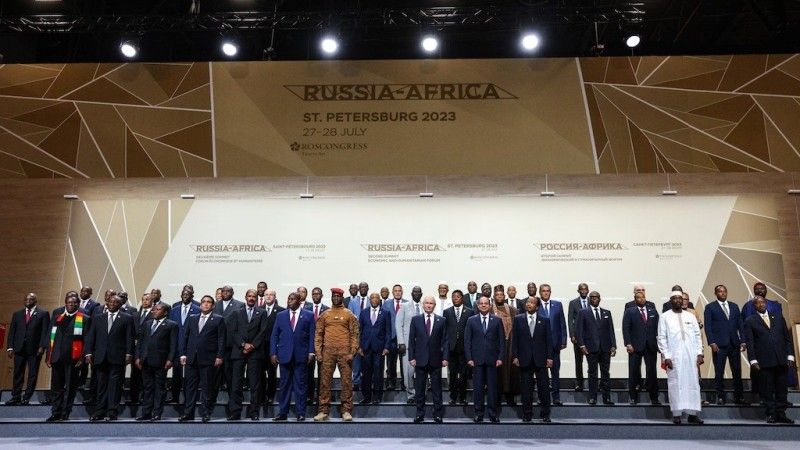
Photo. Russia–Africa Economic Forum / https://summitafrica.ru/en/archive/2023/summit-outcomes/
At the end of October, Moscow will host the third Russia–Africa summit. According to the Russian Ministry of Foreign Affairs, more than 30 countries have already confirmed their participation. This will not be a mere image-building exercise, as the Kremlin will once again use the conference to conduct bilateral talks, sign agreements, and argue that despite the war against Ukraine, Russia remains the primary partner for Africa.
The first summit (though there were several smaller conferences) took place in 2019 in Sochi, and the second in 2023 in St. Petersburg. Now, Russia is once again inviting African delegations, fully understanding that in foreign policy, consistent relationship-building is what matters. Meetings held with fanfare and extensive media coverage give African partners a sense that they are important and are being received in the same manner as the world’s most prominent leaders.
The most important actions of such a summit are not taken during the plenary session. Only bilateral talks, meetings of relevant ministers, the coordination of projects, and direct contact with leaders allow Moscow to transform a political event into concrete military, energy, and diplomatic influence. Dozens of such meetings take place during Russia–Africa formats.
It must be emphasised here that the Russian Deputy Foreign Minister, Georgy Borisenko, has already conducted a briefing for African diplomatic missions accredited in Moscow regarding the preparations for the third Russia–Africa summit. At the same time, the personnel of Russian embassies on the African continent have begun lobbying and a series of bilateral meetings.
This is also significant in the context of Russian delegations to the continent, as during the NATO summit in Ankara, Lavrov was – once again – visiting African countries. Russia leads in terms of high-level political delegations to the African continent compared to the USA, France, the UK, India, and China.
Russia comes to Africa with a rich offer, including grain, fertilisers, energy, nuclear power, weaponry, military cooperation, and digital technologies. Meanwhile, by inviting them to Moscow, it also has specific ideas. This year’s summit programme includes energy issues, food security, and scientific and technical cooperation. Cybersecurity also appears, which for many African states is an area requiring rapid development, potentially leading to a dependency on Russian solutions.

Russia has enormous potential; its embassies and networks of contacts in Africa have functioned for decades, and its diplomatic presence is being further expanded. Russia is working on the development of 10 more missions and is preparing to open further embassies in, among others, Gambia, Togo, and the Comoros. This is particularly important because it is impossible to win the competition for influence solely remotely, by writing posts from Brussels, Paris, Warsaw, or Kyiv. Diplomats and attachés present on the ground are needed, ones who have contacts with the administration, the military, universities, and local media.
China organises the Forum on China–Africa Cooperation, and delegations from 53 African states participated in the 2024 summit in Beijing. India has organised its own Africa–India summits and is preparing the next one. Russia is already organising its third very large one. Europe only reacts when Moscow has already built contacts, signed an agreement, or started an information campaign. An EU–Africa meeting then takes place, but it lacks a dominant character.
In this context, a fairly simple question must be asked: how does Europe expect to defeat Russian disinformation in Africa if it cannot maintain a comparable political presence? It is not enough to publish rebuttals regarding the war in Ukraine. Russia combines propaganda with offers of grain, energy, military support, and technology. First, an ambassador appears, then a delegation, an agreement, training, or a delivery, and finally a narrative of Russia as a state that does not preach or impose conditions. It must be noted that Russia promises a lot (often lying), but it provides significant attention, and that is what African countries are after.

Ukraine does not have the resources or the diplomatic network to compete with Russia on its own across the entire continent. It can expose Russian crimes, present the consequences of the war, and develop contacts with selected states, but it cannot replace the potential of the European Union, the USA, or Russia itself. It is Europe that possesses the financial means, the market, the technologies, the development experience, and the ability to present a more attractive offer. The problem is that these elements remain scattered across all European countries, while Russia presents even limited capabilities as part of a single strategy.
The next Russia–Africa summit does not mean that Moscow has won the competition for the African continent. The Russian offer has limitations, and its projects often do not live up to the promises made. However, Russia is present, it talks, it plans, and it tries to sell. If Europe wants to limit Russian influence, it must not only do exactly the same but act even more effectively and with a richer offer. There is a failure to demonstrate Moscow’s flaws and lies here. A lack of response to Russian initiatives is not merely neutrality, but also an outright voluntary surrender of space that the Kremlin will immediately exploit.
Africa is not just about wars, illegal migration, and problems. It is a wealth of raw materials, new markets, and the youngest continent on the globe. Either Russia will rule (and it still has the Wagner Group / Africa Corps at its disposal) or Western countries will step forward with further offers. There is no doubt that the USA, Canada, and the European Union would be capable of dominating Russia, if they wanted to. Where there’s a will, there’s a way, right?


