












- WIADOMOŚCI
Behind Putin’s $15 billion arms revenue claim

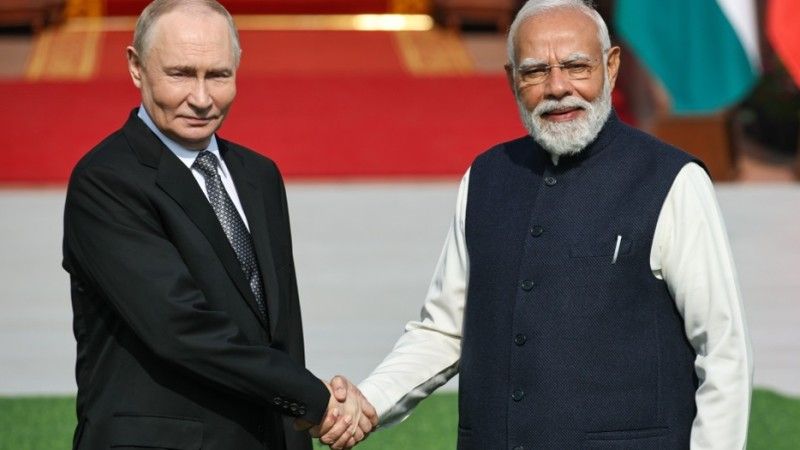
Putin’s claims of booming arms-export revenues contrast with fragmented data and shifting partners, exposing both how Russia adapts to Western sanctions and the inhibitors it faces.
During the latest meeting of the Commission for Military Technical Cooperation with Foreign States, Putin claimed an estimated $15 billion in foreign exchange earnings from arms deliveries to more than 30 countries in 2025. He further stated that over 340 projects aimed at expanding military and technological cooperation with 14 countries are either planned or in the development stage for 2026-2028.
What do these numbers actually mean?
These numbers remain dubious given the lack of full transparency in Russia’s economic data, including the defence sector, following its full-scale invasion of Ukraine in 2022. It is not unlikely that Russia purposefully claims that its defence contracts are more lucrative than they actually are to obfuscate the true state of its economy and sow uncertainty among its adversaries.
Moreover, the term „foreign exchange earnings” in its current form is flexible and does not clarify elements like transactions included, whether the value is gross or net, and whether it corresponds to delivered goods or contracted ones. This ambiguity leaves substantial room for interpretation.
SIPRI »s latest report on the trends in international arms transfers found that between 2020 and 2024, Russia figured among the top five exporters, at a 7.8 per cent share of global arms exports. At the same time, Russian arms exports went down by 64 per cent in comparison to the 2015-2019 levels.
Other reports suggest that by the end of 2024, Russia’s arms transfers decreased by 92 per cent in comparison to their levels in 2021. Such a trend can be explained by resource overexertion and the fact that much of the military equipment has been actively used ever since the start of Russia’s full-scale invasion of Ukraine.
In 2020-2024, Russia’s major arms deliveries went to:
- 74 per cent – Asia and Oceania
- 12 per cent – Africa
- 7.4 per cent – Europe (Armenia, Belarus, Serbia)
- 6.4 per cent – Middle East
Among these, two-thirds of all Russian arms transfers went to the following three states:
- 38 per cent – India
- 17 per cent – China
- 11 per cent – Kazakhstan
During the latest meeting of the Commission for Military Technical Cooperation with Foreign States, Putin explicitly highlighted the continued cooperation with the African and Asian countries.
Russia’s military footprint in Africa
African countries receiving the largest volumes of Russian arms include, among others, Algeria, Egypt, Libya, Mali, Sudan, Ethiopia, Angola, Rwanda, Democratic Republic of Congo, and Nigeria. According to the report by the Associated Press, Russia utilises cargo ships to deliver tanks, armoured vehicles, artillery, and other military equipment, like radio jamming equipment, to West Africa. Two of such vessels, Baltic Leader andPatria, both sanctioned by Western states, reportedly dock and unload in Conakry, Guinea.
Furthermore, the continued military presence in Africa, through the African Corps (formerly the Wagner Group), gives Russia access to strategic resources. GIS, for example, reports that Russia maintains:
- 1,000-1,500 military personnel in Sudan
- 1,200-1,800 military personnel in the Central African Republic
- \> 1,000 military personnel in Mali
Military presence enables Russia to receive access to strategic resources, like gold (Sudan, Mali), diamonds (Central African Republic), and uranium (Central African Republic), which can also be used for economic or military purposes.
Stockholm School of Economics argues that despite the ongoing Russia-Africa trade, its strategic benefits remain limited, with outreach concentrated in a few countries rather than reflecting a broader partnership. On the other hand, it is not unlikely that the trade numbers will grow in 2026, especially given Russia’s gradually fading footprint in certain Asian countries. Nevertheless, the significance of any such gains will ultimately depend on the scale and sustainability of Russia’s deliveries to other markets.
Russia’s fragmented presence in Asia
Beyond Africa, Putin also pointed to Russia’s arms transfers to Asia, but the depth and strategic significance of this cooperation vary considerably by country.
Interestingly, while claiming enhanced cooperation with the Asian partners, at the same time, Russia vanished from Asia’s biggest airshows . For example, for the second consecutive year, Russia has been absent from the Singapore Airshow, which is the largest aerospace exhibition in Asia.
While retreating from Singapore, Russia recently showcased its new MLRS, the Sarma, at a Saudi Arabian weapons show. Furthermore, in January last year, Russia sold the Pantsir-S1 air defence system to Saudi Arabia for $2 billion, indicating that Saudi Arabia might realistically become one of Russia’s major arms delivery spots.
Russia also continues its military cooperation with China, which is its second biggest partner in terms of arms transfers. However, a recently leaked document indicates that the Russian defence industry has continued producing components for Chinese Su-27 and Su-30 fighter jets at high financial cost, with component prices reportedly rising by nearly 200 per cent, to avoid straining relations with Beijing. This dynamic points to a broader trade-off between preserving strategic ties with China, one of Russia’s key partners, and pursuing more commercially lucrative deals.
Furthermore, Russia still pursues limited objectives with countries like Myanmar, where the Russian and Myanmar officials recently signed a five-year military cooperation agreement. While the deal was concluded, the officials provided few details about the agreement itself, and thus its strategic significance remains to be seen.
India appears to be the market where Russia maintains its strongest foothold. According to CSIS, India continues to be one of Russia’s biggest arms and defence trading partners. In late 2025, Indian defence executives reportedly held meetings in Moscow to discuss potential joint ventures with Russia. It is also noteworthy that such enhanced cooperation might jeopardise Indian firms« access to Western technology and risk companies« exposure to the Western secondary sanctions. Consequently, India has grown increasingly cautious in pursuing defence-related deals with Russia, as illustrated by its hesitation over the potential acquisition of the Su-57 under the 2018 Multi-Role Fighter Aircraft programme. In addition, if we compare 2020 to 2024, India’s arms imports from Russia decreased from 1091 to 463, as expressed in TIV (trade-indicator values expressed in millions). Therefore, while the cooperation itself is poised to increase, India’s growing concern might limit its actual outputs and further decrease Russia’s arms transfers to this country. Nevertheless, India-Russia defence cooperation remains worth monitoring, especially considering the planned joint ventures in 2026.
Iran represents another potential destination through which Russia may seek to generate revenue from arms transfers. In recent years, the flow has largely run in the opposite direction, with Iran supplying Russia with weapons systems, most notably Shahed-136 loitering munitions and Mohajer-6 drones. At the end of 2025, however, multiple media outlets leaked documents from Rostec, Russia’s state-owned defence conglomerate, and its subsidiary, Concern Radio-Electronic Technologies, which indicated a $6.5 billion deal reached with Iran to buy 47 Su-35 fighter jets. If this deal is completed, it would be one of Russia’s largest exports since its invasion of Ukraine and would represent almost half of Putin’s currently stated revenue from arms transfers.
Lastly, the statement recognised continued cooperation with countries of the Caucasus and Central Asia, especially Kazakhstan, Uzbekistan, and Armenia, with 93.4 per cent, 68.2 per cent, and 42.4 per cent of Russian arms important between 2020 and 2023, respectively. Interestingly, Kazakhstan ranks among the top 40 arms importers, underscoring its particular significance as a potential source of economic value for Russia.
Restraint, recognition, and resolve
Although the examples mentioned are by no means exhaustive, they nevertheless showcase a pattern that the Russian arms transfer cooperation seems to be focused on specific points on the map. Among the regions discussed, Saudi Arabia, Iran, India, and Kazakhstan stand out as the most consequential hubs for arms transfers.
Overall, given the amount of data uncertainties, a restraint in making conclusive numerical estimations is warranted, but so is the real recognition of the threat stemming from Russia’s ongoing military and economic cooperation, which offsets the Western sanctions. While the Russian arms transfer is fading in some parts of the world, it is blooming in others.
The continued Russian arms transfers, regardless of the exact nominal value, pose a threat to Western states and serve as an enabler to the Russian war machine. These entanglements underscore the need for Western sanctions to address not only Russia itself, but also the secondary channels through which it circumvents restrictions. The Indian example showcases that states with significant economic exposure to Western markets may recalibrate their engagement with Russia, potentially limiting Moscow’s capacity to offset sanctions and sustain its war effort.
Lastly, it is worth remembering that arms transfers are not the only way through which Russia maintains its economy afloat. The „shadow fleet” operations, Arctic activities, and ongoing energy exports collectively help in sustaining Russia’s war effort and must be addressed in a holistic fashion. Assessing Russia’s military posture must go hand in hand with monitoring its economic pursuits that enable its military power in the first place.


