












- WIADOMOŚCI
- ANALIZA
A modern military begins underground

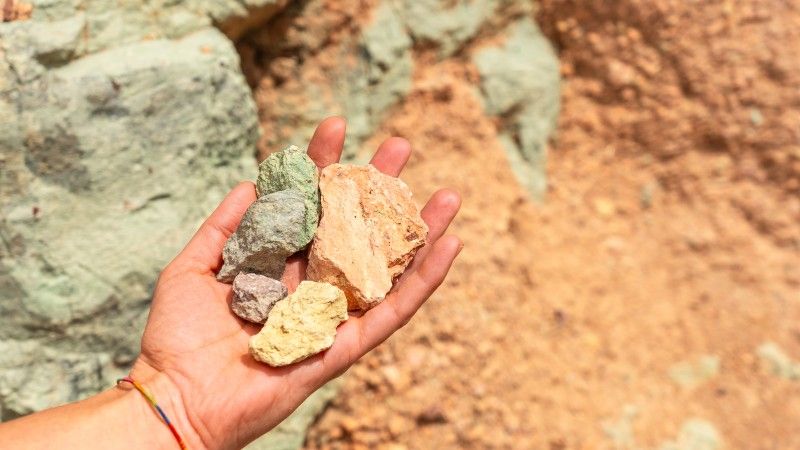
Until recently, „critical minerals” sounded like a buzzword from green-transition conferences or a niche topic for geologists. In reality, there is nothing new or exotic about them. These metals have been known for decades. What has changed is that without them, modern armed forces, the defence industry, and the energy sector simply stop working.
In a world where wars are won not only with tanks but with supply chains, access to lithium, rare earth elements, or tungsten is becoming as important as the number of divisions. The problem is that mining and processing have become concentrated in a handful of vulnerable locations, often beyond Western control. That is where a quiet, raw-materials dimension of the security competition begins - far less spectacular than military parades, but far more decisive.

Raw-material bottlenecks of security
Critical minerals for defence are resources essential to national security and military production - such as tungsten, cobalt, tantalum, or lithium - whose absence threatens the manufacture of weapons systems. Rare earth elements (REEs) are a specific group of 17 elements with unique chemical properties used in electronics, energy systems, and military technologies. Their criticality depends on application, for example neodymium in motors and radar systems. Not every critical defence mineral is a rare earth, but some rare earths are strategically indispensable.
Rare earths are neither particularly rare nor particularly heroic. They do not appear in battlefield reports and rarely inspire political speeches. Yet they underpin the entire architecture of modern military capabilities. Without neodymium, dysprosium, terbium, or yttrium, armed forces lose what now matters more than numbers: precision, situational awareness, and technological superiority. Missiles become less accurate, radars see less, and drones turn into expensive toys without propulsion or „eyes.”
Their criticality is geopolitical, not geological. Many rare earths are more abundant than gold, some even more common than copper. The problem is that they are dispersed, difficult to separate, and environmentally burdensome to process - one reason the West long outsourced this stage of the supply chain. The result is that key components of NATO weapons systems now pass through refineries and separation plants outside the Alliance, often in countries that treat resources as leverage rather than as commodities of a free market.
From a military perspective, this is a textbook security bottleneck. Neodymium and dysprosium determine the performance of motors, guidance systems, and radars; terbium and yttrium affect sensors, sonar, and ISR systems; europium underpins command and data visualization; cerium influences the speed and quality of precision manufacturing. None of these elements fires a shot, but the absence of any one of them can silence an entire system. Even short supply disruptions can halt military modernization faster than budget cuts.
That is why rare earths increasingly resemble strategic infrastructure rather than raw materials - hidden in containers, refineries, and long-term contracts. In modern military competition, advanced technology and money are not enough. What matters is secure access to a handful of seemingly insignificant metals, without which high-tech power rests on a fragile foundation.
Poland's realism
For Poland, critical minerals are not an abstract debate. In a crisis, can ammunition, steel, and military equipment still be produced if global supply chains break? Poland is no raw-materials Eldorado, but it is not defenceless either. Its strength lies not in resource diversity, but in a few hard pillars that matter more in wartime than geological novelty.
The most important is copper. Poland is among the few European countries capable of sustaining a full domestic copper supply chain - from extraction to processing. In war, that is the difference between real production capacity and potential on paper. Copper feeds ammunition, virtually every modern combat platform, military energy systems, and the industrial infrastructure that underpins any prolonged conflict. Coking coal plays a quieter but still essential role as the foundation of armour steel, barrels, and military structures.
At the same time, Poland still treats part of its own resource potential as an inconvenient footnote. By-products of copper mining - such as cobalt, nickel, molybdenum, or rhenium—exist in theory, but in practice remain untapped due to limited recovery capacity. In a crisis, the defence industry would be forced to rely on imports precisely when imports would be least available. This is a classic bottleneck, likely driven by economic constraints rather than negligence - at least one hopes so.
An even bigger issue is Poland’s total dependence on imports of minerals essential for modern weapons systems: rare earths, titanium, tungsten, antimony, and semiconductor metals. Without them, there is no military electronics, no precision munitions, and no meaningful modernization. In an escalation scenario, these supplies would disappear first - well before fuel or steel.
The answer is not an illusion of mining self-sufficiency, but brutally pragmatic industrial resilience. Recycling, refining, processing, and the ability to operate in mobilization mode matter more today than new extraction licenses. With the right decisions, Poland could become a material backbone of NATO’s eastern flank - not a country that „has everything,” but one that can act when others are waiting for supplies that never arrive.

Ukraine: Europe's reserve
Any discussion of resource security must include Ukraine. Today, Ukraine is not only a battlefield, but also one of Europe’s largest untapped resource bases. The war has reminded us that military security does not begin at the combat - it begins much earlier, in mines, smelters, and supply chains. Ukraine’s deposits of lithium, graphite, rare earths, titanium, and manganese make it a natural pillar of future European defence and reconstruction supply chains.
For now, this potential exists largely on geological maps. Some deposits lie in active war zones, infrastructure has been damaged, and processing capacity is limited. Ukraine has resources, but lacks capital, technology, and time - the very assets that are scarce in wartime.
From the EU and NATO perspective, Ukraine represents more than a reconstruction project. It is the only realistic opportunity to shorten critical-mineral supply chains and reduce dependence on China in defence - relevant sectors. Its resources could feed steel, ammunition, aerospace components, and military electronics, strengthening the industrial resilience of the eastern flank. Integrating Ukraine into Europe’s resource system should therefore be treated as a security issue, not merely an economic one.
If approached strategically, Ukrainian minerals could finance reconstruction, enhance defence capabilities, and reshape global supply chains. One condition is key: control over resources and decisions must remain in Ukrainian and allied hands.
Here Poland can play a pivotal role - as intermediary and integrator. With its industrial base, refining capacity, and access to EU capital, Poland could become the natural processing hub for Ukrainian resources. Combining Ukrainian deposits with Polish industrial capacity could create a Central-Eastern European critical-minerals hub, strengthening both EU and NATO resilience.

Defence begins in the mine, not the budget
Modern defence increasingly begins not in budget act, but in deposits, smelters, and ports. A country can spend 3 or 4 percent of GDP on defence and still lose to one that controls copper, titanium, tungsten, or rare earths. Without them, armed forces function only in modernization plans, while defence spending remains an accounting entry rather than real combat power.
Critical minerals today play the role that oil and ammunition played in 20th-century wars. Without them, weapons production simply stops. Supply disruptions drive up prices and fuel „defence inflation” that no additional billions can fix. Budgets grow, but the number of tanks, drones, and missiles does not. Supply-chain resilience matters more than cost.
Raw materials play a less obvious but equally important military role. They also stabilize state finances in crises. Countries with domestic extraction and processing can finance debt more easily, mobilize industry faster, and convert minerals into weapons - and weapons into exports and budget revenues. This is a more useful form of strategic reserve than gold in a vault.
For Poland, the conclusion is uncomfortable but clear. Copper and silver provide a solid industrial foundation, but most critical minerals remain bottlenecks. Without resource alliances, recycling, and processing capacity, even record defence spending risks looking impressive only on paper.
See also 

No titanium, no armed forces: Warfare needs minerals
If one lesson stands out, it is that 21st-century military advantage does not originate on the training ground or in budget acts. It begins earlier - in geological surveys, smelters, refineries, and the unremarkable logistics routes linking mines to battlefields. Without tungsten, titanium, graphite, or rare earths, even the most advanced weapons remain ambitious concepts, and defence spending becomes an expensive simulation of security.
Poland’s role may be more significant than its resource map suggests. Copper, silver, and industrial capacity give it the chance to become a node where allied resources turn into combat power. Dependence on imported critical minerals creates a classic bottleneck: an adversary does not need to destroy tanks - only their industrial backbone. In this logic, smelters and refineries can be as strategic as armoured brigades.
Ukraine’s experience shows that wars begin long before the first shot - in decisions about control over resources, processing, and supply chains. Critical minerals do not win wars by themselves, but their absence can lose them faster than budget shortfalls. A missing kilogram of tungsten or neodymium can be more dangerous than hundreds of millions of euros that cannot be turned into equipment.
The real question is no longer how much we spend on defence or how modern the systems we plan to buy are. The question is who controls the resources, processing, and logistics without which those systems will never exist. On that answer depends whether security remains an elegant strategic concept - or becomes a capability that works when plans end and war begins.
You can have the best commanders, the most expensive equipment, and record defence budgets. But what is the point of this if budgets do not shoot, and tanks, fighters, and warships without the right metals would be just expensive mock-ups? If wars of minerals, systems, resources, and logistics now defeat wars of divisions, who really commands today - the commanders/generals/admirals or the supply chain?
And the last question, still asked far too rarely: do we really want to defend the state, or are we just pretending to do so, hoping that someone else will provide tungsten, titanium, and most importantly – peace?

Dr. Andrzej Fałkowski, Lt. Gen. (ret.), former Deputy Chief of the General Staff of the Polish Armed Forces (DChoD) and Polish Military Representative to the Military Committees of NATO and the European Union.


