












- WIADOMOŚCI
Ukraine: the most mined country in the world

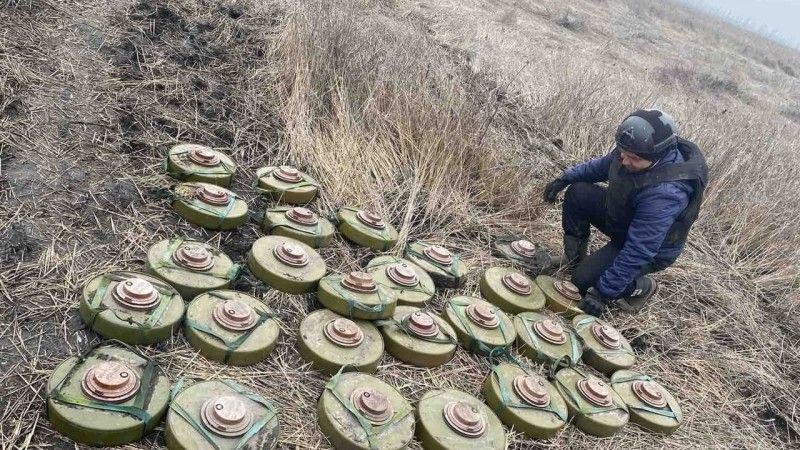
Kyiv claims that 174,000 km2 of Ukraine’s territory is mined or contaminated with unexploded ordnance. Ukraine is now more heavily mined than Syria, Afghanistan, and countries in Africa and the Balkans.
Kyiv estimates that 6 million Ukrainians live in areas where they are at risk of death or injury from landmine explosions. The World Bank has estimated the cost of demining Ukraine at 38 billion USD. Ukraine’s defensive war against the Russian Federation, ongoing since 2014 (when the resurgence in the use of mines was first observed), has confirmed that mines—particularly anti-personnel ones—are in widespread use on the modern battlefield. Especially in a war involving Russia. Unsurprisingly, not only Poland but also the Baltic States and Finland—Russia’s neighbors—have decided to reconsider their stance on anti-personnel mines and withdraw from the Ottawa Convention, which prohibits their production and even storage.

A trip to Ukraine is enough to see that the “Ottawa” framework is an unrealistic absurdity. I do not question the humanitarian value of efforts to limit the use of weapons that cause civilian casualties. The problem is that during wartime, such restrictions are not observed—especially by the Kremlin. Although Russia did not sign the Ottawa Treaty, it is theoretically bound by the so-called Amended Protocol II on Prohibitions or Restrictions on the Use of Mines, Booby-Traps and Other Devices, dated May 3, 1996, to which it became a party in March 2005. Two decades later, there is no country that violates these provisions more blatantly.
I have been witnessing the war between Ukraine and Russia firsthand since 2018, when I first traveled to Donbas. Sadly, many of those places have since become historical sites—now under Russian occupation and lying in ruins. A visit to the front-line town of Avdiivka was enough to be horrified by the sheer number of warning signs marked “mines.” And that was the “old war,” because the new one has proven even worse. Traveling across Ukraine since March 2022, I have one rule ingrained in my mind: never step off the beaten path. Grass, soil, the edge of a forest—mines or unexploded ordnance could be lurking anywhere. Moreover, exploring destroyed houses is equally dangerous. I recall the story of a Polish volunteer who noticed a tripwire attached to a “left-behind” grenade on the handle of a door blown out of its frame. For that very reason, I was afraid to enter trenches abandoned by Russians near Kyiv, as they always left behind such “gifts.” The same was true near Mosul, where the so-called Islamic State even left booby-trapped children’s toys. Mines, mines, mines…
As “Human Rights Watch” warns, Russians are using drones to drop mines deep behind the front lines. “HRW analyzed more than 80 photos and videos shared by witnesses (…) showing a quadcopter drone hovering over the main road in the Antonivka district of Kherson and releasing five small charges (…) anti-personnel mines (…) which landed on the street.”
“A few days ago, there were 40 Shahed drones above us. Now they can drop mines, so even if nothing explodes right away, there’s always a chance something will go off later,” lamented a Ukrainian woman living near the Russian border. It has been documented that even Geran-2 drones are being used by Russians to drop mines. The scale of Russia’s mining operations is enormous. Ukraine had no choice but to respond in kind, confirming that the modern battlefield is defined by mines.


