- WIADOMOŚCI
- OPINIA
Joint statement on the U.S-EU trade framework announced. What does it mean for the European Union?

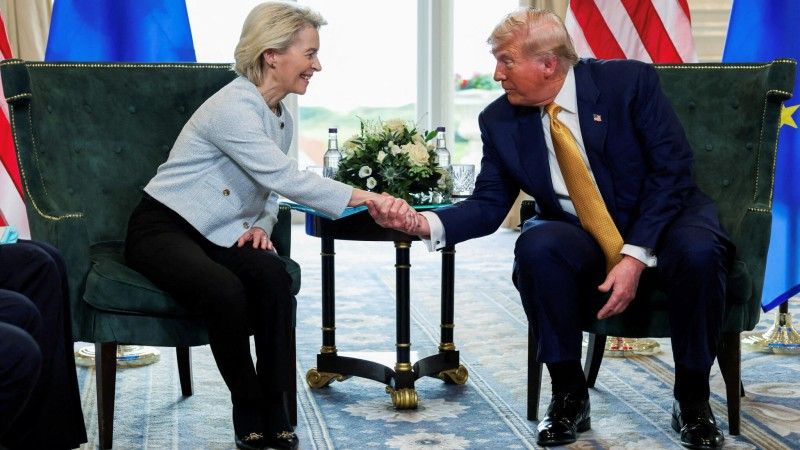
United States and the European Union announced the joint statement on the trade framework. It contains a resolution agreed during the last month’s meeting of Donald Trump and Ursula von der Leyen. This deal brings about a lot of controversy and discussion regarding the EU’s negotiating position towards stronger partner. How will it shape Europe’s future?
Details of the "most favourable" deal
In most cases the document confirmed the conclusions of Trump-von der Leyen meeting from Scotland on July 27. One of the important things is that Brussels will eliminate tariffs on all U.S. industrial goods while granting preferential access for many agricultural and seafood products that are not sensitive for its own market. The United States, for its part, agrees to exempt aircraft and its components, cork, and generic medicines from elevated tariffs, applying instead its most-favoured-nation rates to these imports.
From the EU’s perspective, the key point is that Washington will cap tariffs at 15% on goods, such as cars, pharmaceuticals and semiconductors. For Europeans the crucial issue was the U.S. lowering tariffs on autos and auto parts from 27.5 percent to 15 percent. It was achievable, but on the condition that the EU formally introduces legislation to eliminate tariffs on all American industrial goods, as until now Brussels has imposed a 10 percent levy on car imports.
In the view of European Union, taking steps against global overcapacity in steel and aluminium remains essential, which is why both sides will explore the possibility of setting tariff-rate quotas. Brussels made this a key request to prevent its steel and aluminium exports from facing a 50 percent tariff.
Not only about the tariffs
Moreover, the European Commission plans to consider offering U.S. companies additional flexibilities in applying the EU’s carbon border levy and to ensure that new obligations — such as Corporate Sustainability Reporting Directive (CSRD) and Corporate Sustainability Due Diligence Directive (CSDDD) — do not create unnecessary barriers.
In terms of the energy and technology sector, Brussels undertakes to purchase $750B worth of U.S. LNG, oil, and nuclear products by 2028 as well as buy at least $40B worth of U.S. AI chips. What is more, European companies will invest an additional $600B in U.S. strategic sectors by 2028. At this point it is worthwhile to reflect on why these commitments take such a one-sided form and do not lead to the United States being the one to invest in Europe?
In addition, the statement also includes defence-related issue, such as provision to increase procurement of U.S. defence equipment to strengthen NATO interoperability. It is quite confusing, because in May, the Council of the European Union adopted the regulation establishing the SAFE – new financial instrument designed to fill gaps in the defence abilities, based on the joint procurement made by the member states with possible cooperation with third countries. One of SAFE’s main objectives is to reduce dependence on U.S. military equipment. Yet, in a joint statement, the European Commission indicated an interest in increasing purchases from American suppliers.

Voices from Brussels
As stated by Maroš Šefčovič, the Trade Commissioner, the agreement should be perceived as a highly favourable as the „alternative would have been a trade war with sky-high tariffs”. Ursula von der Leyen emphasised that this is not the end of the process and European Commission is going to engage with the United States to agree more tariff reductions. As for now, they would like to identify more areas of cooperation, and to create more economic growth potential.
Different attitude is represented by Christine Lagarde, President of the European Central Bank. She highlighted that even though the recent trade deals have mitigated global uncertainty, EU needs to deepen its trade ties with other countries and change its approach to become more export-oriented economy.
Is it the same deal for everyone?
Representatives of the European Commission argue that we should be satisfied with the results of this agreement. Nevertheless, a closer look at the details makes it hard to talk about equality between the partners. On the one hand, tariffs could have been higher but why were they not set lower? Given that the European Union recently surpassed China in terms of GPD, should it not be treated as a stronger and more serious partner? The decision-makers from the European Union need to represent greater sense of agency in negotiations with international actors and strengthened unity on key sectors such as international trade, security, innovations and building competitive advantage. European Union has to protect its international position. Without assertiveness and prioritising the interests of every member state – not only the biggest one – it will be challenging to create a strong, assertive and resilient Europe.
Author: Amelia Wojciechowska