- ANALIZA
- WIADOMOŚCI
Türkiye’s opposition in crisis: A new phase of political confrontation

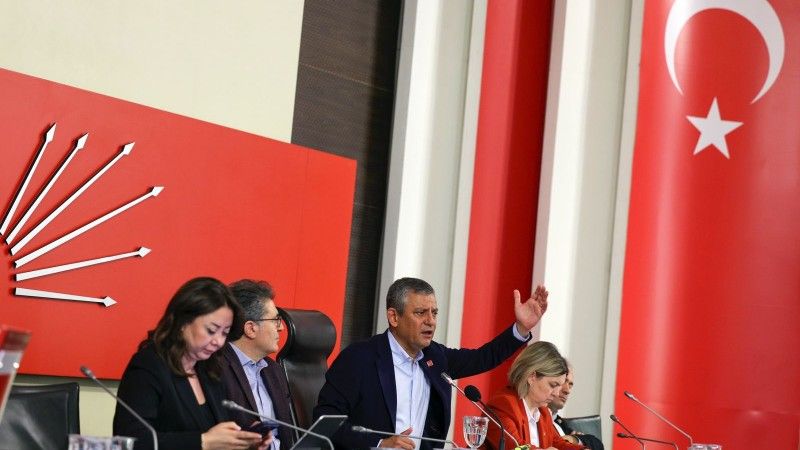
Recent events surrounding Türkiye’s largest opposition party, the Republican People’s Party (CHP), could prove to be one of the most significant political moments in Türkiye since the Gezi Park protests. The CHP leadership dispute is no longer simply a personal conflict between Özgür Özel, the party’s current leader, and Kemal Kılıçdaroğlu, the former CHP leader who, following recent court decisions, is expected to return to his previous position. The current crisis is gradually evolving into a much broader test for Turkish democracy, the party system, and the political future of President Recep Tayyip Erdoğan.
The appeals court’s decision to invalidate Özgür Özel’s election as CHP leader and reinstate Kemal Kılıçdaroğlu has triggered a political earthquake. Unprecedented scenes then unfolded as police stormed the opposition party’s headquarters in Ankara, using tear gas and rubber bullets against party activists and supporters. Özel himself described the operation as a „judicial coup,” while many observers began openly warning about the accelerating erosion of Turkish democracy.
The CHP as the last real counterweight to Erdoğan
The current situation is strategically significant primarily because the CHP remains the only political force capable of genuinely threatening the dominance of Recep Tayyip Erdoğan and the AKP at the national level. The success of the 2024 local elections completely transformed the political atmosphere in Türkiye. The opposition not only maintained control of the country’s largest cities but also, for the first time in many years, generated a genuine sense of political change.
It was under Özgür Özel’s leadership that the CHP began to regain the dynamism it had lacked during the years of Kemal Kılıçdaroğlu’s leadership. For many voters, it was particularly significant that the CHP ceased to be solely an „anti-Erdoğan” party and instead began to be perceived as a potential alternative to the government, capable of bringing something new to Turkish politics.
In this context, the appeals court’s decision to invalidate Özel’s election and reinstate Kılıçdaroğlu caused a political shock. The judiciary has long been one of the key instruments of political struggle in Türkiye. The authorities have consistently rejected accusations of politicising the justice system, emphasising the independence of the courts – a position frequently questioned by independent domestic and international observers.
Moreover, for a significant part of the opposition, the current actions are seen as part of a broader process aimed at neutralising political opponents ahead of potential early elections.
Political operation or internal crisis?
Formally, the entire case is based on allegations of irregularities during the 2023 CHP congress, at which a new chairman was elected. However, the political context of these events has led a significant portion of Turkish society to perceive the court’s actions as part of a much broader strategy.
It is difficult to analyse the events in Ankara in isolation from previous actions taken against the opposition. For months, Turkish courts and prosecutors have been conducting numerous criminal proceedings against CHP politicians, local officials, and opposition activists. The most symbolic case remains that of Ekrem İmamoğlu, who has been imprisoned for over a year on corruption charges. For opposition supporters, this represents a classic example of the political elimination of a potential rival to Erdoğan.
The current crisis can therefore be interpreted as an attempt to weaken the CHP from within. The reinstatement of Kılıçdaroğlu — a politician associated by part of the electorate with a series of electoral defeats — sparked significant dissatisfaction among younger activists and the more active segment of the party base. Importantly, the conflict is no longer limited solely to rival party factions. Increasingly, what is emerging is a clash between two different models of politics.
On the one hand, there is a traditional, highly centralised political culture based on party elites, internal networks, and strong leader-centered politics. On the other hand, a new form of political mobilisation is emerging, based on a sense of civic empowerment and the belief that political legitimacy should stem directly from the will of voters rather than from behind-the-scenes institutional arrangements.

A grassroots rebellion inside the CHP
Interpreting the current crisis solely as an AKP operation against the opposition would, however, be an oversimplification and would reinforce media narratives about the state’s complete control over the country’s opposition parties. Although a significant portion of Turkish public opinion perceives the actions of the courts and police as part of broader political pressure on the CHP, there is also a real and deep internal conflict within the party itself that should not be overlooked. In practice, the current crisis is likely the result of the overlap between these two processes.
Kemal Kılıçdaroğlu led the CHP for thirteen years. During this period, despite repeated defeats in national elections, the party managed to maintain strong organisational control and its own internal system of loyalties. Only the defeat to Erdoğan in the 2023 presidential election triggered a serious succession crisis and a broader debate about the future of the entire opposition. Many activists believed that the CHP needed not only a new leader but also a fundamental transformation of its political culture.
For many CHP activists and voters, Özgür Özel’s victory signalled the beginning of a new political era. The new leadership came to symbolise a more dynamic and less hierarchical form of opposition politics. This is why the conflict quickly began to resemble not only a personal power struggle but also a clash between two different models of how the CHP should function.
On the one hand, there was the older party establishment, linked to Kılıçdaroğlu and the traditional model of party governance. On the other hand, a new generation of politicians sought to transform the CHP from a permanent opposition party focused primarily on anti-government rhetoric into a viable governing alternative.
This is precisely why the current crisis has such destructive potential. It is not only the result of state pressure against the opposition but also the consequence of years of tension, frustration, and unresolved problems within the CHP itself. At the same time, despite this significant internal dimension, it is impossible to ignore the fact that the conflict quickly evolved beyond the framework of an ordinary party dispute.
The involvement of state institutions soon became a crucial factor. According to Turkish media reports, police entered the CHP headquarters following a formal request by Kemal Kılıçdaroğlu’s lawyer, Celal Çelik, who asked the Ankara authorities to assist in transferring control of the building to the party’s new court-appointed leadership. The governor of Ankara subsequently approved the operation.
This moment proved to be politically the most symbolic. For a significant portion of the opposition electorate, the use of police force against CHP activists at the request of individuals associated with the party’s former leader symbolised the complete breakdown of political trust within the opposition.
This situation, regardless of the actual sources and mechanisms driving the current crisis, clearly strengthens the ruling camp politically by destabilising the only political force capable of posing a genuine threat to Erdoğan in the next elections.

Türkiye increasingly polarised
The events in Ankara revealed another important reality: the growing scale of political polarisation in Türkiye. The narrative of „defending democracy” is now clashing with the narrative of „defending the rule of law”. The opposition accuses the government of instrumentalising the judiciary and attempting to eliminate political competition, while the government, in turn, argues that the courts operate independently and that the state is merely enforcing the law.
The problem, however, is the continuing erosion of public trust in state institutions at a time when the coming months could prove extremely challenging for the Turkish political scene. The crisis within the CHP therefore carries a real risk of fragmenting the opposition, weakening voter mobilisation, and further deepening social polarisation.
Regardless of how the leadership struggle ends, it is already clear that something much larger than a personal conflict between Özel and Kılıçdaroğlu is at stake. In reality, the issue concerns the future model of Turkish politics – namely, whether it will continue to be based on leader-centered dominance or begin evolving toward a stronger civil society and more autonomous forms of political mobilisation.