












- ANALIZA
- WIADOMOŚCI
AI in multi-domain operations: Capabilities and challenges

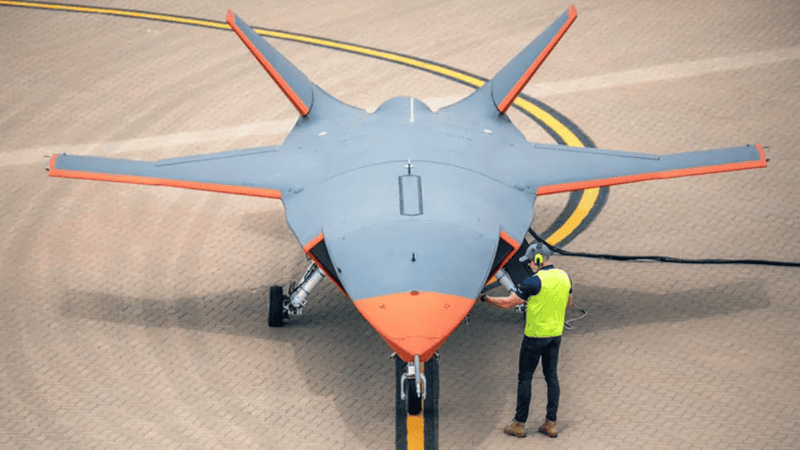
Photo. Boeing
Artificial intelligence systems are becoming increasingly important in planning and conducting multi-domain operations thanks to their ability to quickly process information, analyze vast datasets and make decisions in real time.
Multi-domain operations, because of their complexity and the need to integrate actions in land, sea, air, space, cyber and information environments, require new tools for management and coordination. In this context AI is no longer merely a support tool; it is becoming one of the key components of command systems and battlefield management.
In operational planning AI is used to integrate data from a wide variety of sensors — from unmanned aerial systems such as the MQ-9 Reaper, through observation satellites like Sentinel or Lacrosse, to open sources (OSINT) and cyber sources. Thanks to deep-learning techniques it is possible to filter informational noise, identify relevant patterns of enemy behavior and predict potential actions.
An example of such an application is the Israeli Fire Factory system, which automates the entire attack-planning process — from selecting targets based on intelligence, through setting priorities, to synchronizing fire support.
AI systems enable advanced predictive analysis that supports the creation of operational scenarios and the assessment of the outcomes of different courses of action. Prognostic models, based on real and simulated data, allow optimal disposition of forces and allocation of resources in time and space. An example are experiments conducted under the U.S. Army Futures Command’s Project Convergence, where AI analyses data from multiple sensors and proposes the most effective courses of action, taking into account current troop locations, enemy resources and predicted reactions.
In support of decision-making at the tactical and operational levels AI plays an invaluable role. Optimization algorithms analyse thousands of possible action combinations in a fraction of a second, indicating to commanders the most effective options in line with operational objectives. Another example of a similar solution is the Loyal Wingman (MQ-28 Ghost Bat) being developed by Boeing in cooperation with the Royal Australian Air Force. It is an autonomous combat drone designed to support crewed aircraft, perform reconnaissance, disrupt enemy systems or carry weapons, and its operation also relies on artificial intelligence systems.
In systems of this kind AI not only analyses the operational situation but also identifies targets, assesses their priority and selects the most appropriate means of strike. In highly dynamic environments, where human reaction time is too slow, AI can also assume partial control over task execution.
In military logistics AI offers capabilities for dynamic supply-chain management and demand forecasting. Analysis of weather, topographic and operational data enables optimal planning of supply routes, placement of logistic nodes and identification of risks related to supply interruptions. Examples include solutions based on IBM Watson for Defense Logistics, which predict equipment failures and indicate the best moments for maintenance.
Within NATO projects such as Logistics Functional Area Services (LOGFAS), systems are being developed that — thanks to AI — can automatically adapt logistic plans to changing conditions on the ground, increasing the operational resilience of forces.
In cyberspace AI is used in both defensive and offensive operations. In systems protecting military and civilian infrastructure, such as Darktrace, AI detects anomalies in network traffic and automatically responds to cyberthreats before they reach their objectives. In offensive operations AI can be used to generate disinformation campaigns, disrupt enemy communications or take control of their IT systems.
An example is the SABLE SPEAR project, in which AI analyses the effectiveness of information spread on social media and models the impact of disinformation on audience behaviour. Combined with autonomous systems, AI makes it possible to conduct cyber-kinetic operations with unprecedented precision.
In the air and space domains AI supports air-traffic management, analysis of satellite trajectories and mission planning for unmanned aerial and orbital vehicles. Systems such as Space Fence, supported by the U.S. Space Force, use AI to detect and track objects in Earth orbit and predict collision threats.
Satellites from Kleos Space, aided by AI algorithms, analyse electromagnetic signals to detect movements of maritime units and enemy communications. Systems such as ALIAS enable autonomous control of aircraft, including in combat conditions, without an onboard crew.
The integration of AI with C4ISR systems (Command, Control, Communications, Computers, Intelligence, Surveillance and Reconnaissance) forms the foundation of the modern battlespace. Systems like Athena, used by the U.S. Air Force, enable instantaneous analysis of sensor data and identification of hidden threats. Additionally, NATO initiatives such as DIANA (Defence Innovation Accelerator for the North Atlantic) are developing solutions that support AI integration into allied reconnaissance and command systems.
The ability to rapidly exchange and analyse data allows commanders to achieve full situational awareness, which is crucial to maintaining information superiority in the multi-domain environment.
With technological progress, concepts of “collaborative AI” are also evolving — systems capable of cooperating with humans and other machines within complex combat operations. Examples include programs such as the U.S. Gremlin, in which autonomous drones collaborate with crewed units to perform reconnaissance, strike and jamming missions. These systems manage airspace, synchronize attacks and cooperate with other platforms, often in the form of autonomous aircraft swarms.
The introduction of AI into multi-domain operations is not without challenges. Key issues include data security, resilience to electromagnetic interference and cyberattacks, and legal responsibility for actions taken by autonomous systems. The development of lethal autonomous weapons systems (LAWS), which may make decisions about the use of force without human involvement, raises serious ethical dilemmas. Therefore, the development of AI in the military domain must go hand in hand with the creation of international legal and ethical regulations that ensure control over its use.
Equally important is the interoperability of AI systems used by different countries and service branches. Work on common standards, open software architectures and compatible communication protocols is a necessary condition for the effective functioning of coalition military groupings, especially within NATO.
In summary, artificial intelligence systems have the ability to integrate data from many sources, which significantly enhances commanders’ situational awareness. AI algorithms enable advanced predictive analyses that support operational planning and forecasting enemy actions.
Artificial intelligence streamlines decision-making processes at both tactical and operational levels, reducing reaction time in high-tempo environments. AI is effective in military logistics, cybersecurity and the management of air and space traffic. The main limitations are data-security issues, resilience to interference and the legal-ethical dilemmas associated with the use of autonomous systems.
Agnieszka Rogozińska, PhD


