- WIADOMOŚCI
- ANALIZA
Thorium nuclear power: big promise, limits, and geopolitical stakes

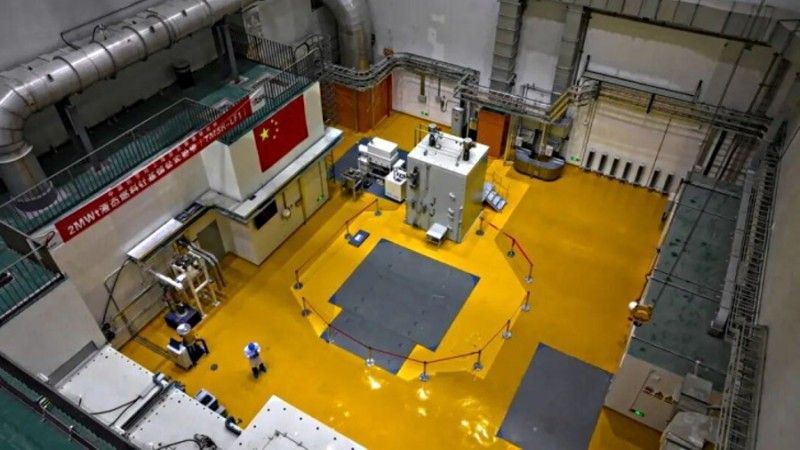
This accelerating technology and underutilized resource could reshape global energy geopolitics — meet the molten-salt reactor (MSR), fuelled by thorium-232.
American origins; Chinese breakthroughs
Using a molten salt liquid mixed with nuclear fuel derived from thorium-232 is not a new concept. It was demonstrated in the US Molten-Salt Reactor Experiment (MSRE) at Oak Ridge National Laboratory in the late 1960s. Instead of solid fuel rods, the MSRE circulated liquid fuel dissolved in hot salt, which served both as the reactor coolant and as the medium for transferring heat for power generation. The design was intended to be safer and more efficient.
The MSRE ran for four years, but its success was not built upon and commercialized. At the time, US nuclear strategy prioritized solid-fuel reactors, and R&D funding was redirected to other projects. Moreover, MSRs were less suited to the efficient production of weapons-grade plutonium than other reactor types, which were therefore more aligned with military priorities in the Cold War context. Consequently, MSR technology was largely forgotten for the remainder of the century.
It was only in 2011, when China revived the MSR concept, drawing on publicly available American research. Chinese scientists then pushed a thorium-based variant in which thorium is introduced into the molten salt, where it can gradually be converted into uranium-233, the isotope that actually produces energy through fission. This is because thorium-232 is „fertile,” not „fissile” — it cannot sustain a chain reaction on its own. But when it absorbs a neutron, it can be transformed into uranium-233, a fissile fuel that splits, releases heat, and keeps the reaction going.
In September 2018, construction of TMSR-LF1 — a thorium-based molten-salt experimental reactor — began in northwest China. Completed in August 2021, the reactor achieved its first criticality (a sustained chain reaction) in October 2023 and reached full operational power in June 2024. Another series of breakthroughs came in the next months with the world’s first in-operation refuelling and thorium-to-uranium conversion. As one leading Chinese engineer put it: „We are now at the frontier of global nuclear innovation.”
See also 

Thorium: promise, limits, and costs
Why is powering MSR by Thorium such a big deal? Mainly because this raw material is estimated to be three to four times more abundant than uranium. It is typically found in monazite, an ore already mined for rare earth elements, from which it must be then chemically separated.
China may hold 1.3–1.4 million tonnes of thorium reserves in total. A recent national geological survey found that the Bayan Obo rare-earth mining complex in Inner Mongolia could yield around one million tonnes alone, which is enough , in theory, to satisfy China’s energy needs for 60,000 years. This prospect is likely to motivate further investment in the technology that could reduce dependence on imported uranium and bolster resilience, a strategic imperative for Beijing.
Nuclear energy suffers from a poor reputation, which often obstructs its progress. The technology behind thorium molten-salt reactors could help rebuild confidence thanks to its safety. Unlike conventional reactors operating at pressures of 75–150 bar, MSRs function at near-atmospheric pressure and can shut down passively by draining fuel into a safe tank if overheating occurs. These features make severe accidents, such as explosions or meltdowns, highly unlikely.
It is also argued that thorium-based reactors could be more environmentally friendly, leaving a significantly shorter-lived, less voluminous nuclear waste. While uranium waste remains radiotoxic for tens of thousands of years, thorium-based waste is often described as declining to much lower hazard levels within hundreds of years.
A common claim is that the thorium fuel cycle is harder to weaponize than traditionally used Uranium, making it a more desirable option to prevent proliferation. Yet many studies have concluded that its byproduct, namely uranium-233, is highly weaponizable and does not require enrichment in the way uranium-235 typically does.
But what may kill the future of thorium MSR reactors is the opportunity cost of switching to them from uranium reactors. Pouring billions of dollars into the research, development, and testing of a technology built almost from scratch — rather than devoting those funds to improving already existing, well-performing solid-fuel uranium reactors — is a trade-off many countries may not be willing to make. At the resource level, thorium extraction also competes with rare earth production, as both are typically derived from the same monazite sands.
The emerging thorium nuclear race
Having invested billions and holding vast thorium reserves, China is poised to take two major steps in the coming years. First, it plans to construct a small modular TMSR producing 10 MW by 2030, up from the 2 MW demonstrated by TMSR-LF1. Second, it aims to complete and demonstrate a much larger 100 MW prototype roughly five years later.
China also wants to install a 50 MW TMSR in its developed world’s largest cargo ship, as revealed last November. It will be capable of carrying 14,000 containers, while allowing for longer voyages, years without refueling, and zero CO2 emissions.
Even though China clearly leads the thorium race, it has rivals trying to close the gap. Copenhagen Atomics, a Danish company, combines two ideas: TMSR and small modular reactor (SMR). Its goal is to mass-produce container-sized TMSRs at a pace of one unit assembled per day.
„We believe thorium energy is going to supply more than half of all energy to humans before the year 2100,” says Thomas Jam Pedersen, co-founder and CEO of the company. Cost is central to that vision: according to its estimates, thorium could cost roughly $50 per kilogram (around $2.22 per GWh of energy), compared with about $4,500 per kilogram for uranium fuel (roughly $3,125 per GWh). The company plans to deploy its first test reactors next year, with commercial units targeted for 2030.
India and the United States are also positioning themselves in the emerging race. Last year, the US firm Clean Core Thorium Energy received a license to export its thorium fuel and related technology to India. New Delhi possesses some of the world’s largest reserves of the material, but only scarce domestic uranium, which pushes it to invest in this technology.
What’s unique in Clean Core’s fuel is that it blends thorium with higher-enriched uranium than today’s standard reactor fuel. In this form, it can be used in existing pressurized heavy-water reactors, which make up the majority of India’s nuclear fleet (19 units). If successful, this route could be far less costly, since it would not require developing new TSMRs.
Meanwhile, the French–Dutch start-up Thorizon is charting its own course with an unconventional approach that combines thorium with recycled nuclear waste as fuel. The company has already raised more than €40 million from the Netherlands, France, and EU sources to develop the technology, and aims to begin construction of its first reactor, Thorizon One, in 2030.
In all these cases, the crucial question is whether these thorium-based nuclear ideas can attract both public and private capital on the order of tens of billions of dollars over many years, if not decades. This is why incorporating thorium into modularity, nuclear waste reprocessing, or existing nuclear technologies may prove more investable and therefore more likely to scale. It will also be worth watching whether any one of these approaches emerges as the dominant, making certain firms and countries the repositories of outsized influence in a reshaped nuclear landscape.
Reshaping the geopolitics of nuclear power
The case for using Thorium and exploring related technologies is particularly strong in an era defined by resilience and strategic autonomy. As the prospect of being cut off from uranium supplies becomes more real, countries increasingly prioritize independence in their nuclear sectors.
States with abundant thorium resources but dependent on imported uranium may therefore be especially tempted to explore thorium-based pathways, including India and China, and potentially others such as Brazil, Turkey, Egypt, or the US. The interests of today’s leading uranium producers could, in turn, be hurt — above all Kazakhstan, which accounts for over 40% of global production, as well as Canada and Australia. Thorium-based technologies could reshape the global nuclear fuel supply chain and allow more countries to become more energetically secure.
Thorium-based molten-salt reactors will not replace established uranium-based reactors anytime soon, nor will they dominate countries« energy mixes in the coming decades. But they may still gradually expand as a viable alternative, especially in thorium-rich countries, provided sustained investment, further technological progress, and political will. On those criteria, China currently sits at the head of the emerging „thorium nuclear race”.