












- ANALIZA
- W CENTRUM UWAGI
- WIADOMOŚCI
Trump does his thing, and NASA does its own

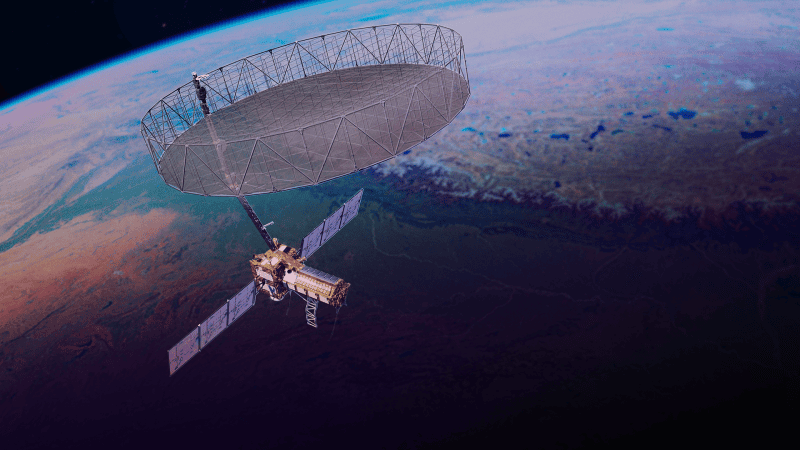
Photo. NASA/JPL-Caltech https://science.nasa.gov/blogs/nisar/2025/07/30/nasa-isros-nisar-mission-by-the-numbers/
Donald Trump is putting a lot of effort into limiting climate research in the United States. However, NASA recently managed to launch two satellites that will collect important data on the changing climate on Earth. However, agency employees are walking on eggshells and trying their best not to use the “forbidden” word “climate” when communicating about these missions. Instead, they describe their commercial and military usefulness, just so that research can continue in a country gripped by anti-climate madness.
NASA continues to study climate change despite budget cuts, layoffs, and restrictions introduced by the Donald Trump administration, reports E&E News by Politico. In recent months, the agency has launched two satellites to monitor the impact of global warming on the planet. However, NASA employees prefer to emphasize the usefulness of this data for energy companies, search and rescue teams, and real estate agencies, while neatly glossing over the issue of climate change in a United States ruled by a president who calls climate change a “hoax” and “mystification”.
NASA tiptoes around the issue
In the penultimate week of November, the Sentinel-6B satellite was launched into space from California. It will study sea level rise, which, as the National Aeronautics and Space Administration (NASA) is keen to emphasize, helps to predict the risk to coastal infrastructure, including real estate and energy infrastructure, such as energy storage facilities. The cost of this mission, amounting to USD 1 billion, is being shared by NASA and the European Space Agency (ESA). The second satellite is the NASA-ISRO Synthetic Aperture Radar, or NISAR for short, launched in July, which studies changes in ice cover, permafrost, and wetlands, among other things. The $1.5 billion mission is the result of a collaboration with the Indian Space Research Organization (ISRO).
Unfortunately, the launch of new satellites does not mean that Trump’s approach to climate science has softened. As Democratic Congressman George Whitesides of California, former NASA chief of staff, said: „While I am pleased that we launched these satellites, it should not distract us from the incredible damage being done to the world’s best space agency. The current administration does not consider Earth science to be important and is trying to limit NASA’s capabilities in every way possible.”
Despite its undoubted usefulness in climate science, NASA employees are forced to redirect public and government attention to the importance of the information collected by satellites in saving human lives or its commercial applications. Donald Trump is not only uninterested in climate science, he is actively trying to erase it. His administration threatened, among other things, to shut down two climate-studying satellites already in orbit, lay off 6,000 NASA employees, and cut NASA’s climate research budget, and attempted to halt disaster relief funding. At one point, the existence of an important measuring station on Mauna Loa, which studies CO2 levels in the air, was also under threat. Many things have been “achieved”: NASA has forcibly “lost” about 4,000 employees (about 20% of its staff), and 1,500 employees have been laid off at the National Oceanic and Atmospheric Administration (NOAA), which was forced to stop tracking the costs of extreme weather events, among other things, and in February ordered American scientists working on the latest IPCC report to suspend their activities.
What about future missions?
NASA spokeswoman Bethany Stevens emphasized that these recently launched missions are and will remain a priority for the agency, even if Donald Trump’s administration downplays the contribution of probes to climate research.
I wouldn't necessarily use the term “climate” right now. This research, these missions, and everything that fell into that category under the previous administration may be presented differently, but it is not being given less priority.
NASA spokeswoman Bethany Stevens
At this point, it looks like both missions will proceed as planned, although the future of climate research at NASA remains uncertain. George Whitesides admitted that he fears the current president’s administration will not allow further satellites to be launched for political reasons. As Politico reported, one of the main reasons why the Sentinel-6B and NISAR missions were approved was that preparations had been underway for years and involved agencies from abroad – Europe and India. Canceling them would further weaken relations with these allies.
New NASA chief?
The future of NASA may be decided by the selection of its new administrator. A confirmation hearing for the candidate is scheduled to take place soon before the Senate, where the Republican Party has a majority. On December 3, Jared Isaacman, a billionaire, entrepreneur, and ally of Musk, who was nominated for the position on November 5 (again by Donald Trump, after the nomination was withdrawn during the president’s high-profile conflict with Elon Musk), will appear before the Senate Committee on Commerce, Science, and Transportation. He was the first commercial astronaut to perform a private spacewalk during a flight he financed himself.
Politico obtained a 62-page memorandum created by Isaacman during his first nomination, in which he presented his vision for NASA. He wants to limit government climate research and shift more of the burden of funding it to universities — although Trump is also trying to cut back on spending in various ways, such as by withholding funds for scientific grants and support programs for lower-income students. Isaacman has stated that the agency’s priority under his leadership will be to “remove NASA from the taxpayer-funded business of climate science and leave that to academia.” Isaacman never intended to publish the document.
“Project Athena,” as Isaacman’s plan for NASA is called, involves outsourcing some of NASA’s missions to the private sector and treating the government agency more like a business. He also advocates purchasing scientific data from commercial companies instead of launching its own satellites, calling it “science as a service.” This mainly concerns Earth observation, not all of the agency’s missions. As the billionaire “cleverly” explained: „Why build custom satellites at greater cost and with greater delay when you can pay for data from existing providers as needed and allocate funds to more scientific missions involving planets (for example)? (…) Anything that suggests that I am anti-science or that I want to offload that responsibility onto someone else is simply untrue.”
What do satellites do?
Sentinel-6B will track sea level rise with inch-level accuracy across the globe using cloud-penetrating radar that also detects sea wave height and wind speed. The satellite continues to collect data that began about 30 years ago. NASA is collaborating with ESA on this mission, and the entire Sentinel program began in 2020 when the first satellite was launched. Both partners contributed $500 million to the project.
Sea level rise is, of course, one of the fundamental effects of global warming, but NASA omits this “detail” in its communications. Instead, it emphasizes the importance of the data for fisheries and coastal infrastructure safety. The data collected by the satellite “is the basis for navigation, search and rescue, and industries such as commercial fishing and shipping. These measurements are the basis for flood forecasts in the US for coastal infrastructure, real estate, energy storage, and other assets along our coastline,” said Dr. Karen St. Germain, director of NASA’s Earth Science Division, at a press conference before the mission launch.
As added on the website, “this data helps meteorologists improve hurricane forecasts, managers protect infrastructure, and plan coastal community actions,” and “ocean and atmospheric measurements from the Sentinel-6B satellite will enable policymakers to better protect coastal military installations from events such as severe flooding, while supporting the nation’s defense by providing critical information about weather and ocean conditions.”
The second satellite, NISAR, was developed in collaboration between NASA and ISAR. Most of the costs were covered by the US agency, with India contributing $100 million. The NISAR mission is expected to last at least three years. It can measure changes in glaciers, ice sheets, permafrost, and wetlands—all structures closely related to climate change—with centimeter-level accuracy. As with Sentinel-6B, NASA did not use the word “climate” when describing the mission launch. Instead, it emphasized that the satellite „will help scientists better understand the processes involved in natural disasters and catastrophes, such as earthquakes, volcanic eruptions, and landslides.
In addition, it will support the monitoring of infrastructure such as dams, bridges, and roads. What’s more, the satellite’s ability to penetrate clouds will help communities responding to emergencies such as hurricanes, storms, and floods. NISAR will provide key global Earth observations, such as changes in ice cover, glaciers, and sea ice, and will also provide a better understanding of the impact of deforestation, permafrost loss, and fires on the carbon cycle.


