












- WIADOMOŚCI
- WYWIADY
- PILNE
Poland in a world of chaos: Are we the voice the world hears?

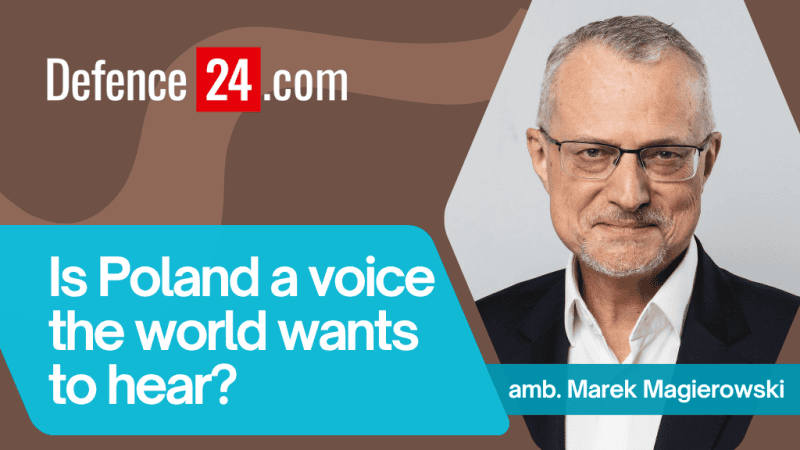
Poland stands at a pivotal moment in defining its foreign policy. The war in Ukraine, shifting transatlantic relations, and rising tensions in the Middle East and the Indo-Pacific force a strategic reassessment. Should Poland focus exclusively on its immediate strategic environment and deepen cooperation within NATO and with the United States, or aim to broaden its presence globally – including in relations with countries in Asia, Africa, and South America?
In this interview with Dr Aleksander Olech, Head of International Cooperation atDefence24, Ambassador Marek Magierowski – former Polish envoy to the United States and Israel – analyses the direction of Polish foreign policy. He argues that Poland’s strength does not lie in global ambition, but in deep regional understanding. Specialisation, not omnipresence, builds credibility and influence – especially where the security of Europe is at stake.
Dr Aleksander Olech: We live in a time of great instability – from the war in Ukraine to conflicts in the Middle East and rising tensions elsewhere. Given our capabilities, should Poland focus exclusively on transatlantic ties and Central and Eastern Europe, or pursue a more active foreign policy on a global scale?
Amb. Marek Magierowski: These two approaches are not mutually exclusive. History, geography and our collective experience make us a key actor in Central and Eastern Europe – not only important but credible. We should always emphasise that it is hard to find another country or nation with broader knowledge of the region, one that understands both Putin’s Russia and the wider post-Soviet space. That should be our bargaining chip and our signature strength.
Let me offer an example: while in the United States, I would often share Polish analysis with politicians, experts and journalists. It was well received, and I took quiet satisfaction in that small educational mission. That is also why, at the Freedom Institute, we strive to deepen cooperation with the Baltic and Nordic countries, as they can help broaden the understanding of geopolitics in our region. This does not mean, of course, that we should ignore our relations with China or Africa.
However, we must remember that global influence can also be achieved through smart specialisation. I would rather see Poland listened to attentively when it speaks about the war in Ukraine and Kremlin policy, than ignored when it tries to weigh in on Taiwan. Take Australia: a global actor by all measures. But frankly, who cares what Canberra says about the future of the European Union? What we care about is Australia’s voice on China. The same applies to Poland.
Much has been said about the differences between Donald Trump’s foreign policy and that of the Biden administration. As an ambassador during Biden’s term, could you identify areas of continuity rather than change? Where do you see course corrections, and where do you see real shifts in U.S. international policy?
The differences are many but let me mention just a few of the most important. First, during Donald Trump’s second term, the concept of alliances – both political and military – collapsed before our eyes. Alliances had been one of the guarantees of international order and U.S. security. Trump made it clear: „His” America didn’t need allies.
He replaced that category with three others: competitors (he slapped them with tariffs), enemies (he imposed sanctions or launched military strikes, as with Iran), and countries with rich natural resources that should be pressured into deals with the U.S. (as partly happened with Ukraine, and more recently during Trump’s summit with West African leaders).
Secondly, Trump focused on economic tools rather than military means in pursuing U.S. interests worldwide (though the recent strike on Iranian nuclear facilities may signal a shift). Thirdly, there is a notable change in policy towards Israel. Despite occasional friction, the current administration is much friendlier towards Benjamin Netanyahu’s government, which also translates into a tougher stance on combating antisemitism.
How do you see the future of NATO in the context of potential U.S. policy changes under Donald Trump? Should European states consider building more independent defence structures?
Unfortunately, Europe faces a devil’s dilemma. On one hand, it’s clear that Trump is no enthusiast of NATO. He sees it as an organisation where nearly all members benefit from U.S. protection without being willing to increase their defence spending.
On the other hand, Trump is not entirely wrong. Europe is seriously behind and weakened when it comes to its own defence capabilities. Put simply: without America, Europe cannot defend itself – no matter who is in the White House.
As a neighbour of Ukraine and a front-line NATO state, to what extent is Poland shaping European policy towards Russia? Do we have real influence over decisions made in Brussels and Washington? From a diplomatic perspective, more than three years into the full-scale war, how do you assess the pace and character of Western support for Kyiv?
Too little, too slow, too cautious. Of course, this enters the realm of speculation – what if Ukraine had received long-range missiles in the first months of the war, and a green light to strike targets on Russian territory? Putin managed to bluff everyone, especially Jake Sullivan, President Biden’s National Security Advisor, with his nuclear escalation rhetoric.
He also successfully disrupted NATO unity. All those phone calls from Macron and Scholz, now talks with Trump… If Western leaders cannot even agree not to speak with Putin – even by phone – how can we expect a coherent, unified response to Kremlin aggression?
Poland’s influence on Western policy towards Russia is mostly long-term and mental, not immediate. We cannot force Germany to send Taurus missiles to Ukraine, but we can and should continue reminding everyone that we were right about Russia’s neo-imperial ambitions – and German political elites consistently got it wrong.
Israel has come under heavy international criticism for its military actions in Gaza. Given Poland’s history and ties with Israel, should Warsaw take a clearer position? And how has the war in Gaza affected Polish-Israeli relations?
I’ll keep this brief: I believe we are taking a balanced position and should continue to do so. We should not follow the American approach of turning a blind eye to every atrocity committed by the Israeli army in Gaza or by settlers in the West Bank.
But we also shouldn’t follow the lead of Spain or Ireland, who view the conflict from an exclusively pro-Palestinian perspective, ignoring the legitimate fears of Israeli leaders and the vast majority of Jews.
In today’s world, does diplomacy still matter, or is real power increasingly defined by military capability and the willingness to use it?
I’ve often emphasised the growing importance of economic and cultural diplomacy in recent years – areas still neglected in Poland. The most striking example: does our western neighbour need to use military strength (which is rather limited anyway) to shape favourable narratives in Polish media? Or send in its ambassador to block an investment project?
For many Polish politicians, the peak of our diplomatic achievements is the Weimar Triangle, which has no real weight. For the Germans, it’s putting up a symbolic stone in Berlin meant to close the debate on the extermination of Poles by Germany during WWII. Cynically speaking: we should learn from them.
Marek Magierowski– former spokesman for President Andrzej Duda, former Deputy Foreign Minister, and Ambassador of Poland to Israel (2018–21) and the United States (2021–24). Currently Director of the „Strategy for Poland” programme at the Freedom Institute.


