












- WIADOMOŚCI
East Front News #65: Moldova stays on the European path; Poland with AMRAAMs

East Front News is a weekly newsletter summarizing the past week’s most important events concerning security and the situation in the Central and Eastern Europe region. It includes original opinions and comments, along with key news items significant from a Polish perspective. If you would like to receive this newsletter, please sign up by clicking .
Ukraine to receive billions of euros for drone development
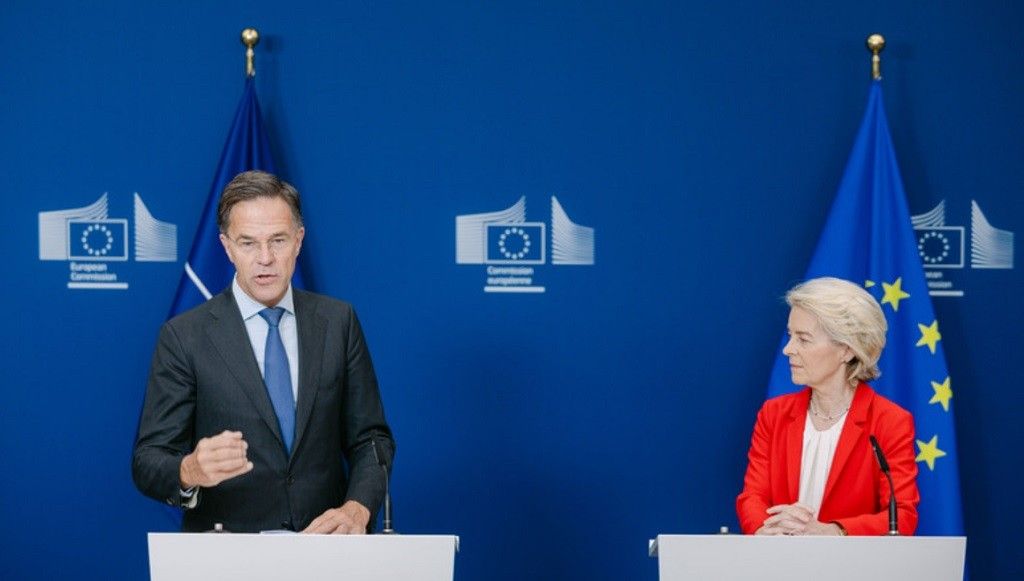
The „drone wall” and the urgent strengthening of security on NATO’s eastern flank are the latest priorities in cooperation between the North Atlantic Alliance and the European Union. They were announced at a joint press conference by Mark Rutte and Ursula von der Leyen.
At the joint press conference, European Commission President Ursula von der Leyen and North Atlantic Alliance Secretary General Mark Rutte spoke about cooperation aimed at significantly increasing the security of the airspace over NATO’s eastern flank.
According to Ursula von der Leyen, economic pressure on Russia should increase significantly, and interoperability between member states in the field of defence should improve. Achieving the latter is to be possible, among other things, through an increase in joint purchases of military equipment. The EU’s and NATO’s priority will also be the „drone wall.” One of the main pillars of that wall is to be Ukraine, which will receive substantial financial support.
Author: Michał Górski
Urgent call-up of reservists in Denmark
The Danish armed forces have urgently summoned reservists to service in response to a growing drone threat in the country’s airspace. The information about the sudden call-up was revealed by Danish TV.
Security expert Jacob Kaarsbo, who previously served as chief analyst at the Danish Military Intelligence Service, emphasizes that such calls are extremely rare. He noted that the developments show Denmark is facing a completely exceptional situation. He continued, saying that extraordinary measures are implemented, that had not been used in the past.
Author: Bartłomiej Wypartowicz

Moldova stays on the European path following parliamentary elections
The pro-EU Party of Action and Solidarity (PAS) won Sunday’s parliamentary elections in Moldova, securing more than 50% of votes and an absolute majority of seats in the future parliament. The pro-Russian leftist coalition, the Patriotic Electoral Bloc (BEP), came in second with 24.20 percent of the vote. That is despite unprecedented Russian hybrid interference in the campaign, including massive vote buying and disinformation efforts. In this context, the large European Moldovan diaspora played a decisive role in the election, strongly supporting PAS and effectively granting it the majority.
This victory gives PAS a strong mandate to continue EU integration and ensures relative political stability for years ahead. However, the results also highlight a growing internal polarization between the urban Romanian-speaking population and the pro-Russian, Russophone, rural, and older demographics, which Moscow could further exploit in future to sow unrest.
Author: Kacper Kremiec

Poland secures approval and funding for purchase of AIM-120D AMRAAM missiles for F-35s
On October 2, 2025, the Polish Ministry of National Defence confirmed that Poland has received approval to purchase the latest version of AIM-120D AMRAAM air-to-air missiles intended for the F-35. The acquisition will be financed through the Armed Forces Support Fund, which ensures stable financing and mitigates the risk of delays associated with the national budget. During a briefing, Deputy Prime Minister and Minister of National Defence Władysław Kosiniak-Kamysz emphasised that Poland was given a unique opportunity to acquire this version of the missile, one of only a few countries, and must finalise its commitments by December 10 this year. The ministry stressed that there are no obstacles from financial institutions (the Ministry of Finance and the National Development Bank) that could hinder the transaction. According to the Ministry, the decision is clear-cut and forms part of a broader plan for transforming and modernising the Polish Armed Forces. The purchase of AIM-120D missiles will enhance the operational capabilities of Poland’s F-35 fleet and confirm that Poland is equipping itself with state-of-the-art weaponry within allied partnerships.
Author: Justyna Smoleń
Transnistria looms over Moldova's EU accession path
Romania’s president, Nicușor Dan, has declared that the unresolved status of Transnistria will not prevent Moldova from joining the European Union. He suggested the separatist territory could be granted autonomy similar to Gagauzia within an EU framework, with Moldova’s border incorporating both regions. His remarks followed the landslide win of Maia Sandu’s pro-European Party of Action and Solidarity (PAS), which secured over 50 percent of the vote in the September parliamentary elections despite an intense Russian disinformation campaign and attempts at interference. Dan emphasised that if the pro-Russian bloc had prevailed, Moldova’s accession process would have been frozen, drawing a parallel with Georgia.
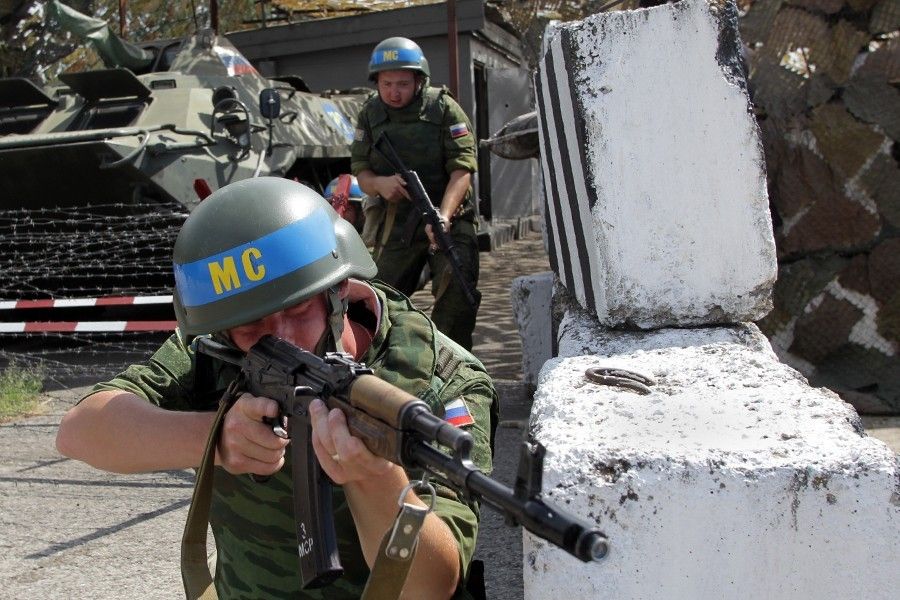
The question of Transnistria, however, remains central. The self-proclaimed Pridnestrovian Moldavian Republic is sustained by Russian military presence and entrenched Soviet-era elites, mirroring Moscow’s proxy enclaves in Georgia and eastern Ukraine. While its armed forces are outdated and isolated, the region retains symbolic value for the Kremlin, which uses it as leverage to obstruct Moldova’s European integration. Despite economic hardship and Russian pressure, Moldovan voters have reinforced their westward course. Chişinău now faces the delicate task of pursuing EU accession while preparing for the costly but necessary reintegration of Transnistria.
Author: Michał Bruszewski
Ukraine moves to establish its own space force
The Ukrainian government has submitted a draft proposal to the Verkhovna Rada to create a dedicated Space Force as part of a wider restructuring of the Armed Forces. The new branch is expected to be formally established by the end of 2025, with a target of reaching 60 per cent operational readiness this year. Its main responsibilities will include monitoring outer space, providing early warning of missile and aerial threats, and developing Ukraine’s own intelligence and satellite capabilities. The initiative builds on Kyiv’s recent participation in the EU’s Copernicus Earth observation programme and reflects a push to strengthen sovereignty in orbit.
Ukraine’s plan mirrors a growing international trend, with countries such as the United States, Russia, China and France already developing military space components. Kyiv has also set up a Department of Space Policy to coordinate cooperation between the Armed Forces, private industry, and scientific institutions. Despite the ongoing war, officials stress that Ukraine’s
space ambitions remain intact, aiming to design and launch its own satellites in the coming years. Deputy Defence Minister Kateryna Chernohorenko underlined that this effort is not only about modernisation but about securing the country’s future defence posture in an increasingly technology-driven battlefield.
Author: Mateusz Mitkow

Germany's bid for security leadership raises central European concerns
Berlin has increasingly positioned itself as a future guarantor of Europe’s security, signalling ambitions to strengthen the Bundeswehr, reduce reliance on the United States, and drive EU-led defence initiatives. While presented as „greater responsibility,” such moves inevitably stir unease in Central Europe, where historical memory of German dominance remains strong. Calls from Chancellor Merz to raise the costs of Russian aggression sit alongside proposals for EU-only frameworks, raising questions about whether Berlin seeks to reshape the continent’s security order outside NATO’s established structures.
A revitalised Bundeswehr could indeed strengthen Europe’s collective defence if developed transparently within NATO. Yet the prospect of Germany monopolising EU security mechanisms risks undermining allied trust and creating new divisions across the continent. Central, Northern, and Southern Europe all have reason to demand clarity on Berlin’s long-term intentions. Europe’s security architecture has thrived when balanced by solidarity, not dominance — a principle that will be tested if Germany pursues unilateral leadership.
Author: Aleksander Olech

If you would like to receive this newsletter, please sign up by clicking.
East Front News is a weekly newsletter and article on Defence24.com summarizing the past week’s most important events concerning security and the situation in the Central and Eastern Europe region. It includes original opinions and comments, along with key news items significant from a Polish perspective.


