- WIADOMOŚCI
East Front News #72: Attack on the Polish ambassador in St. Petersburg

East Front News is a weekly newsletter summarizing the past week’s most important events concerning security and the situation in the Central and Eastern Europe region. It includes original opinions and comments, along with key news items significant from a Polish perspective. If you would like to receive this newsletter, please sign up by clicking
Attack on the Polish ambassador in St. Petersburg
Polish Ambassador to Russia Krzysztof Krajewski reported that last Sunday, he was attacked on Nevsky Prospect in St. Petersburg by an organised group of about ten men, first verbally and then through an attempted physical assault, which was neutralised by diplomatic security. The incident is part of growing pressure on the Polish diplomatic mission in Russia. It shows the Russian authorities« limited willingness to provide absolute protection for representatives of countries considered hostile.
In response, the Ministry of Foreign Affairs summoned the Russian chargé d’affaires, Andrei Ordash. It conveyed its protest against the attack on the ambassador and, at the same time, a note withdrawing consent for the operation of the last Russian consulate in Poland, in Gdańsk, which is to be closed by December 23. The conversation also touched upon the removal of the bas-reliefs in Katyn, which further strains bilateral relations. The incident in St. Petersburg has once again shown that Russia is escalating its hostility towards Poland by allowing aggressive actions against Polish diplomats. The incident is part of a broader series of Russian provocations and hybrid operations that are systematically increasing tension in bilateral relations. Despite this, the Ministry of Foreign Affairs has announced that it does not plan to close the Russian embassy in Warsaw or sever diplomatic relations.
Author: Justyna Smoleń

Poland positions itself as the central player in the EU's SAFE defence investment program
Poland is emerging as the flagship beneficiary and de facto leader of the EU’s €150 billion SAFE programme, preparing to secure €43.7 billion in loans for defence investment—a scale unmatched by any other member state. With nearly 100 projects spanning armaments, military mobility, border security, cyber defence, and industrial expansion, Warsaw is coordinating an unprecedented whole-of-government effort while maintaining continuous dialogue with Brussels to ensure compliance with strict procurement rules and delivery deadlines. Despite concerns in other capitals over evolving guidelines and unresolved negotiations with non-EU partners like the UK and Canada, Poland expects to receive the full allocation and is shaping the standards by which other countries will follow, reinforcing its role as a central pillar of Europe’s defence modernisation.
Author: Jakub Borowski

Europe accelerates efforts to fix military mobility gaps
Europe is finally moving to confront the long-standing logistical barriers that could cripple NATO’s ability to reinforce the eastern flank in a crisis. With troop and equipment movements sometimes taking more than a month, the EU is launching major infrastructure upgrades, harmonising border procedures, and advancing projects like Rail Baltica to enable rapid eastward deployment. The creation of a Central–Northern European Military Mobility Area and Germany’s new investments in roads, rail and defence-industry support highlight growing political urgency. As NATO now requires allies to spend 1.5% of GDP on infrastructure alone, Europe is acknowledging that without modern transport networks, even well-equipped armies will struggle to deter or respond effectively to Russian aggression.
Author: Michał Górski
See also 

Washington and Riyadh Reinforce Their Strategic Partnership
Trump’s meeting with Mohammed bin Salman highlighted one of the most substantial resets in U.S.–Saudi relations in years. The approval to sell 48 F-35 fighters and the signing of a new Strategic Defence Agreement signal Washington’s readiness to restore deep military ties, even if the arrangement stops short of a full mutual-defence commitment. Riyadh’s pledge to invest $1 trillion in the U.S., alongside new cooperation in AI and civilian nuclear technology, reflects a strongly transactional approach that both sides appear comfortable with. While the lack of progress on Saudi-Israeli normalisation and the unresolved issue of uranium enrichment remain significant obstacles, the visit clearly strengthened the Kingdom’s international position and confirmed its role as a central U.S. partner in the Middle East.
Author: Amelia Wojciechowska

Poland commits $100 million to US weapons for Ukraine
Poland will fund $100 million worth of US-made weapons for Ukraine under the Prioritized Ukraine Requirements List (PURL), Foreign Minister Radosław Sikorski announced ahead of this week’s EU Council meeting. The pledge comes after Poland initially opted out of the NATO initiative launched earlier this year to supply Ukraine with high-demand American military systems.
PURL has become one of the most significant channels of military aid to Ukraine, though it has not prevented the broader decline in total Western assistance in recent months. Poland’s contribution matches Spain’s recent $100 million commitment and
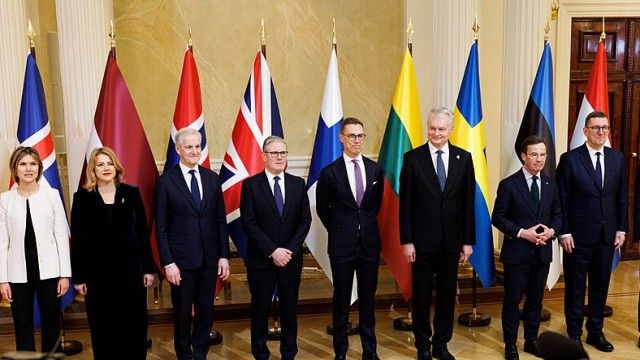
complements the joint $500 million package announced last week by Nordic and Baltic states.
Author: Kacper Kremiec
The Huntingdon attack exposes critical vulnerabilities in UK rail security
The mass stabbing aboard a London-bound train at Huntingdon has reignited serious concerns over the UK’s rail-security posture, highlighting how easily a lone actor can exploit an open, unscreened transport system. Although quickly contained and ultimately deemed non-terrorist, the incident underscored the fragility of rail infrastructure in an era of hybrid threats, where even low-tech attacks can generate national disruption and psychological impact. With railways playing a crucial role in crisis logistics and national resilience—as demonstrated in Ukraine—the UK faces mounting pressure to treat its rail network not merely as a civilian service but as strategic infrastructure requiring tighter coordination, faster response mechanisms, and a more unified security framework.
Author: Andrzej Marszewski

If you would like to receive this newsletter, please sign up by clicking.
East Front News is a weekly newsletter and article on Defence24.com summarizing the past week’s most important events concerning security and the situation in the Central and Eastern Europe region. It includes original opinions and comments, along with key news items significant from a Polish perspective.