












- WIADOMOŚCI
- ANALIZA
Putin’s last chance? Major expansion of Russia’s Unmanned Systems Forces [REPORT]

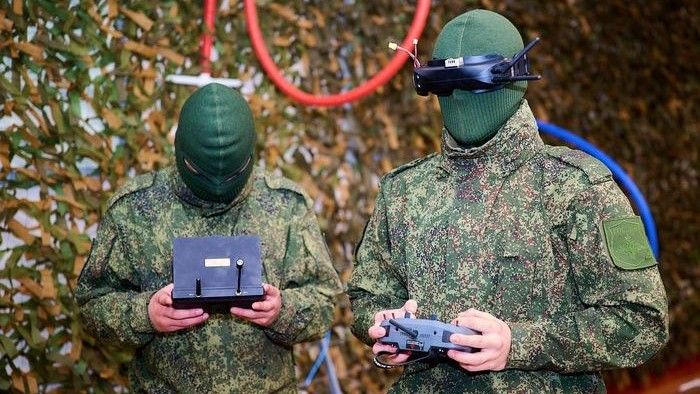
Photo. Russian MoD
Russian generals will not admit it publicly, but deep down they realise that the war against Ukraine is not going their way. Perhaps this explains why they have recently intensified the development of their unmanned forces, seeing them as their last chance to reverse their fortunes on the front line.
The Soviet Army was a pioneer in bringing unmanned aerial reconnaissance systems into service during the Soviet era. These were large, heavy and relatively ineffective, but provided a sound starting point for further development. The collapse of the USSR and the emergence of Russia disrupted these plans. Research and design work on new types of reconnaissance aircraft continued throughout, but few new types entered service. The best-known systems from this period are the Orlan-10 and Forpost.
As Soviet-era unmanned aircraft were withdrawn, the units operating them were progressively disbanded, with no new units formed to replace them. Consequently, at the beginning of 2022, unmanned aerial vehicles were being introduced into service with UAV companies. These formed part of reconstituted tank and motor rifle divisions, as well as some combined arms brigades. Their company-level organisation indicated how few assets they had at their disposal. At the time, the entire Russian military had only one larger UAV unit: the Northern Fleet’s 216th Unmanned Aerial Vehicle Regiment. It was formed on 1 December 2016 at Severomorsk-2 airbase.
For many years, the General Staff of the Russian Armed Forces had a Directorate for the Establishment and Development of the Unmanned Aerial Vehicle Employment System (Russian: Управление строительства и развития системы применения беспилотных летательных аппаратов). Subordinate to it was the Russian Ministry of Defence’s 924th State Centre for Unmanned Aviation, comprising a UAV Specialist Training Centre and a Centre for UAV Research, Combat Employment and Military Trials. As these names suggest, both the directorate and the subordinate 924th Centre focused exclusively on the air domain. Little was being done with unmanned ground vehicles, while maritime unmanned systems remained the responsibility of the Navy Main Command and the Main Directorate of Deep-Sea Research (GUGI).

Photo. Russian MoD
In February 2022, the Russians expected Ukraine to capitulate quickly and submit completely to Russian control. As is well known, these plans proved unrealistic, and Ukraine mounted a determined defence of its independence. Its army was smaller and had less military equipment in virtually every category. Therefore, alongside extensive deliveries of equipment to the Ukrainian military by European and North American countries, the Ukrainians had to seek additional effective means of fighting.
One of these was unmanned aerial vehicles, ranging from very small to large platforms. They quickly made their presence felt on the battlefield. The most important factor behind their success was the development of reconnaissance and strike variants. They became not merely reconnaissance assets but, above all, strike weapons. Ukrainian wartime propaganda quickly identified footage of drone attacks as excellent material for sustaining the morale of Ukrainian soldiers and civilians. These videos were, and continue to be, widely shared by Western media, making them accessible in Russia.
Russians caught off guard by Ukraine’s drone offensive
The opening months of Ukraine’s drone offensive were undoubtedly a succession of successes. Alongside unmanned aircraft, Ukraine quickly began introducing unmanned ground, surface and underwater vehicles. Maritime systems in particular achieved remarkable successes in the initial period. Thousands of drones of every kind entered service in Ukraine, not only with the Armed Forces but also with the National Guard, the Main Directorate of Intelligence and even the Security Service.
The Russians were taken completely by surprise by this unmanned offensive, particularly its scale and effectiveness. The first stage of the Russian response focused primarily on countermeasures. Virtually all forces taking part in the war in Ukraine began adapting to counter drones. Some solutions were introduced centrally, but many improvised measures were developed locally at unit level. The world then became familiar with various forms of protective structures for combat vehicles and netting shielding fortifications, roads and even warships. After some time, the Russians began strengthening their counter-drone defences by deploying electronic jamming systems and active countermeasures more extensively. Overall, Russian countermeasures reduced the losses inflicted on their forces. They did not eliminate them, however, and Ukraine continues to see value in developing new unmanned systems operating across all domains, actively refining and fielding them.

Photo. Russian MoD
In Russia, the initial focus on countermeasures was followed by the introduction of its own reconnaissance and strike systems. The Russians quickly recognised the effectiveness of Ukraine’s approach and decided to respond in kind. Mass production of numerous new drone types began, alongside the organisational expansion of the forces operating them.
Various estimates are available for the scale of unmanned systems production in Russia and Ukraine, but they are highly uncertain. The figures presented by both sides for the number of enemy drones they have shot down are more reliable. These must, of course, be treated with considerable caution, but one thing is certain: drones are now being used on a massive scale. To employ them in such numbers, both armies need specialists organised effectively into subunits and units at various levels. They also need organisations to train operators and a higher-level management structure to introduce regulations, instructions and guidance. This management body must also have at least some influence over what is procured centrally for the armed forces as a whole.
The extensive development of these systems in Russia led to the formation of an Unmanned Systems Forces Directorate (Russian: Управление войск беспилотных систем) within the General Staff. These forces became a new branch of the Russian military. The change of name was deliberate. The new forces are intended to encompass drones operating in all environments, rather than exclusively in the air. Equivalent directorates were established simultaneously within armed services and military district headquarters, alongside unmanned systems staff sections within formations and units.
The appointment of the new branch’s commander also demonstrates its importance to the Kremlin. On 5 August 2026, three-star Colonel General Denis Igorevich Lyamin took command. He had previously served as Chief of Staff and First Deputy Commander of the Central Military District. He replaced the branch’s first commander, Lieutenant Colonel Yuri Vaganov.

Photo. Russian MoD
To launch a major campaign of attacks against Ukraine, a decision was taken to continue expanding subunits within combined arms and specialist military units, but above all to form entirely new unmanned systems units.
The initial plan envisaged an independent unmanned systems brigade at central level, one independent unmanned systems regiment in each military district and fleet, and one independent unmanned systems battalion in each combined arms army and corps. Airborne Forces divisions and naval infantry divisions were also to receive independent battalions of this kind.
These units began springing up rapidly, but the plan was soon revised to create even larger formations. Military districts’ independent unmanned systems regiments began to be reorganised into independent brigades, while independent battalions in some combined arms armies were expanded into independent regiments. Motor rifle divisions also began receiving battalions, becoming the next formations to do so after Airborne Forces and naval infantry divisions. Moreover, an independent battalion formed under the direct authority of the Commander of the Airborne Forces has already been reorganised into an independent brigade (!).

Photo. Russian MoD
Naturally, the Russians keep most details of the expansion of their unmanned systems forces secret. This also applies to detailed information about units being formed and reorganised. Nevertheless, an attempt can be made to compile the information already available, with the clear caveat that these data are not exact. Many instances of unit formation and reorganisation remain unknown. Some of these units may already have new designations, as regiments rather than battalions, or brigades rather than regiments.
The new Unmanned Systems Forces branch currently includes, among others:
- Rubikon Advanced Unmanned Technologies Test Centre — a central-level organisation and the largest unit, whose individual elements are fighting on virtually all the main sectors of the front in Ukraine;
- 19th Independent Unmanned Systems Brigade;
- 25th Independent Unmanned Systems Brigade — Southern Military District;
- 26th Independent Unmanned Systems Brigade (formed from the 20th Independent Unmanned Systems Battalion) — Airborne Forces;
- 27th Independent Unmanned Systems Brigade;
- 40th Independent Unmanned Systems Brigade (formed from the 7th Independent Unmanned Systems Regiment) — Central Military District;
- 50th Independent Unmanned Systems Brigade ‘Varyag’ — directly subordinate to the central command;
- 65th Independent Unmanned Systems Regiment — Leningrad Military District;
- 71st Independent Unmanned Systems Regiment — Moscow Military District;
- 75th Independent Unmanned Systems Regiment — Southern Military District;
- 77th Independent Unmanned Systems Regiment — Eastern Military District;
- 78th Independent Unmanned Systems Regiment (formed from the 8th Independent Unmanned Systems Battalion) — 2nd Combined Arms Army, Central Military District;
- 83rd Independent Unmanned Systems Regiment (formed from the 9th Independent Unmanned Systems Battalion) — 8th Combined Arms Army, Southern Military District;
- 85th Independent Unmanned Systems Regiment — Black Sea Fleet;
- 86th Independent Unmanned Systems Regiment (formed from the 2nd Independent Unmanned Systems Battalion) — 41st Combined Arms Army, Central Military District;
- 87th Independent Unmanned Systems Regiment — Central Military District;
- 1st Independent Unmanned Systems Battalion — 5th Combined Arms Army, Eastern Military District;
- 3rd Independent Unmanned Systems Battalion ‘Drofa’ — 6th Combined Arms Army, Leningrad Military District;
- 6th Independent Unmanned Systems Battalion ‘Hyperion’ — 25th Combined Arms Army, Moscow Military District;
- 7th Independent Unmanned Systems Battalion — 1st Tank Army, Moscow Military District;
- 11th Independent Unmanned Systems Battalion — 51st Combined Arms Army, Southern Military District;
- 12th Independent Unmanned Systems Battalion — 29th Combined Arms Army, Eastern Military District;
- 13th Independent Unmanned Systems Battalion;
- 14th Independent Unmanned Systems Battalion — 36th Combined Arms Army, Eastern Military District;
- 15th Independent Unmanned Systems Battalion — 90th Tank Division, Central Military District;
- 21st Independent Unmanned Systems Battalion — 76th Air Assault Division;
- 22nd Independent Unmanned Systems Battalion — 98th Airborne Division;
- 23rd Independent Unmanned Systems Battalion — 106th Airborne Division;
- 24th Independent Unmanned Systems Battalion — 7th Air Assault Division;
- 25th Independent Unmanned Systems Battalion — 104th Air Assault Division;
- 28th Independent Unmanned Systems Battalion;
- 29th Independent Unmanned Systems Battalion;
- 31st Independent Unmanned Systems Battalion — 68th Army Corps, Eastern Military District.
Although incomplete, this list still illustrates the impressive scale on which new units are being created. Nor should it be forgotten that further unmanned systems battalions and companies are being formed and expanded as organic subunits of brigades and regiments. This applies not only to tank and motor rifle units, but also to engineer, sapper, chemical defence and special forces units.

Photo. Russian MoD
This extraordinary expansion of Russia’s new forces has already led to a significant increase in Ukrainian personnel and equipment losses. Russian internet platforms and television are now also flooded with footage of their own drones in action, just as such material was once shown on a large scale only by Ukrainian media. Russian drones attack not only individual soldiers or combat vehicles, but also infrastructure and, for example, ships in Ukrainian ports.
The Russians have always believed that their large manpower resources would enable them to win any war. Yet the war in Ukraine appears to be bringing this philosophy to an end. Russia is becoming increasingly depopulated, while the hundreds of thousands killed and seriously wounded in the war are already adversely affecting the functioning of the state as a whole. Whether this explains the expansion of Russian unmanned combat systems described here, and the further growth expected in the near future, will probably become clear soon.
This is why it is so important for Poland to develop a comprehensive response to possible deliberate Russian drone attacks on our country. The next war will, in part, be a war of robots.


