












- WYWIADY
- WIADOMOŚCI
Readiness Is not passivity. The 2nd Polish Corps Is growing stronger


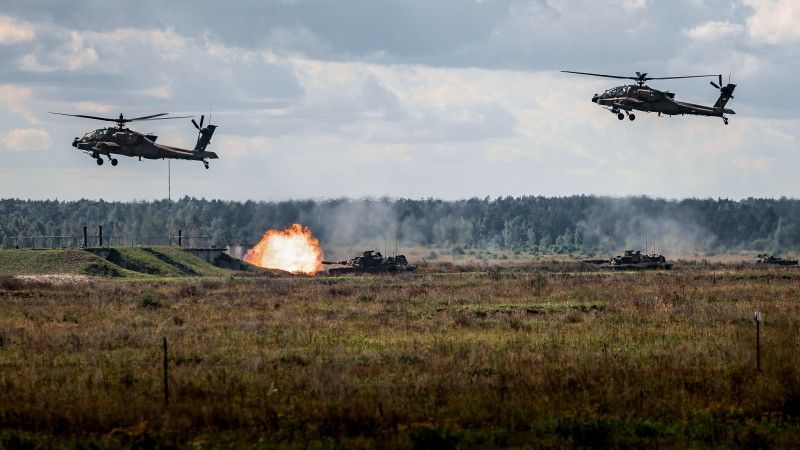
Photo. Platoon Leader Anna Wolska / 1. “Pomorska” Logistics Brigade
„We must carry out the process of developing our forces,” says Lieutenant General Dr. Adam Joks, Commander of the 2nd Polish Corps–Land Component Command, in an interview with Defence24.pl. As he explains, in a dynamically changing security environment, building new competencies and nurturing existing capabilities is a necessity.
Interview done in collaboration with Jędrzej Graf
The formation of the 2nd Polish Corps–Land Component Command in Kraków marked the first step toward achieving full operational readiness by this tactical formation. Maintaining full capability to cooperate with NATO allies requires continuous work and constant coordination with multinational commands.
Last week, the author had the pleasure of visiting the headquarters of the 2nd Polish Corps. The host was Lieutenant General Dr. Adam Joks. In the second part of the interview, we discussed issues such as certification of the 2nd Corps, challenges connected with the development of the Polish Armed Forces and technical modernization, the implementation of new command tools, and the development of cooperation with the civilian sector.
This article is the second part of the interview with Lieutenant General Dr. Adam Joks, Commander of the 2nd Polish Corps–Land Component Command. The first part of the interview is available here.
Antoni Walkowski, Defence24: Does the location of allied corps headquarters in Poznań and Szczecin help the 2nd Polish Corps achieve and maintain interoperability?
Lieutenant General Dr. Adam Joks, Commander of the 2nd Polish Corps–Commander of the Land Component: Yes, but not everyone is aware of just how strong Poland’s position is when it comes to corps-level command structures. On Polish territory we have three high-readiness corps headquarters with the highest-level capabilities. The Multinational Corps Northeast, which during Exercise Loyal Leda-26 was certified as a Warfighting Corps — meaning it successfully completed certification — is now at the so-called peak of operational readiness. At the same time, the U.S. V Corps conducted its own Warfighter Exercise. During that exercise, it confirmed full operational readiness together with the divisions and brigades subordinate to it in Europe, which constitute its combat power.
In November last year, during Exercise Jesion-25, the 2nd Polish Corps was also certified as a warfighting corps. We were assessed against all criteria by a certification team led by General Czosnek, Deputy Chief of the General Staff. In every area, the Corps was rated above 90 percent, so it too achieved full operational readiness.
At present, we have three corps headquarters on Polish territory that are fully certified and ready to conduct operations. Nothing like this existed in the past. Our aim is to maintain this state of affairs. Accordingly, the Operational Commander has declared that next year the 2nd Polish Corps will undergo NATO certification as part of Exercise Avenger Triad-27. This obliges us to maintain and further develop our capabilities, so that next year, in this structure, the 2nd Corps can carry out all of its tasks and confirm its readiness.

Photo. Junior Warrant Officer Mariusz Bieniek / 2nd Polish Corps–Land Component Command
A new Development Programme for the Polish Armed Forces was recently adopted. What challenges does this create from the perspective of the 2nd Polish Corps?
The Development Programme for the Polish Armed Forces covers technical modernization, structural development, and capability building. In order for the potential we are developing under the Programme to be used effectively, the 2nd Polish Corps must have the appropriate command structures.
As the 2nd Polish Corps, we must carry out the process of developing our forces. A very important issue in the context of developing drone forces, introducing F-35 aircraft and Apache helicopters, is so-called Air-Land Integration, or ALI. These are the challenges facing the Corps. We are developing a Joint Air-Ground Integration Cell, or JAGIC. The goal is for all components, both on the ground and in the air — including air defence and drone defence, meaning counter-air, missile defense, and counter-drone capabilities — to be fully integrated, and also to ensure that they do not interfere with one another.
It is important that coordination in the airspace be well organized and seamless. For this purpose, we are using the latest solutions, including artificial intelligence, which is becoming increasingly important in the context of time, space, and management efficiency. As we know, all processes at command posts require time, and we can shorten that time through the use of artificial intelligence.
That makes sorting, organizing, and presenting data easier.
Of course. These are further technical challenges facing my command and the Polish Armed Forces. As you noted, this is not happening only in the land domain, but also in the Operational Command, the Air Component Command, the Maritime Component Command, as well as in the Cyberspace Defense Component Command. It is the Cyberspace Defense Component Command that integrates artificial intelligence solutions and automated command systems.
Of course, this is a serious challenge for us, but we are drawing lessons from ongoing conflicts. As you heard, in Rzeszów the Prime Minister outlined the directions for where and how we are to adapt the experience gained from Ukraine. Actions are being taken at the government level that will materialize in our military environment.
I would like to emphasize that, as the Polish Armed Forces, we are fully integrating with NATO’s effort. Recently I spent three days in Valencia, at Spain’s High Readiness Force Corps, with General Donahue, Commander of LANDCOM — Allied Land Command, NATO’s Allied Land Component Command. As corps commanders, we discussed how we can support one another. The Spaniards demonstrated the development of their drone and counter-drone capabilities, as well as the process of implementing artificial intelligence. The individual corps presented their lessons learned.

Photo. General Command of the Polish Armed Forces
Soon I will travel to the United Kingdom. There, the commander of the ARRC — Allied Rapid Reaction Corps — is organizing workshops. He will present his conclusions and the way in which they are implementing them. My team is gathering experience and integrating it with the U.S. V Corps.
As corps, we must operate holistically, across the entire environment. We will fight together, so we must have a fully integrated battlefield visualization system and cross-border fires — that is, the conduct of fire support across national borders. We must strengthen air-land integration in order to jointly carry out defensive tasks, both for the so-called eastern flank and for NATO as a whole. The 2nd Polish Corps fits into this effort.
Of course, we also have other challenges. That is why LANDCOM in Izmir, under General Donahue, conducts exercises with us. For example, during Exercise Loyal Leda-26, we participated alongside the 1st German-Netherlands Corps and the Multinational Corps Northeast. Under the command of LANDCOM in Izmir, we carried out an operation and the full exercise scenario. We achieved all the objectives assigned to us.
Recently, for the first time, the JFTC — Joint Force Training Centre, located in Bydgoszcz — conducted an exercise of this scale. Four NATO corps were involved under a single command. We had fully deployed command posts, where we could comprehensively test our systems and identify gaps that we still need to close, whether in procedures or technology.
Interoperability is people, procedures, and technology. That is why, as corps commanders, we participate in all Land Corps Commanders Conferences. Our deputies have their own forum, convened by the Deputy Commander of LANDCOM. There they discuss how to support and implement full interoperability and the ability to act. Chiefs of staff have their own forum as well. This is something that systematically enables us to achieve full interoperability and operational capability. For me, this is the most important effect influencing deterrence.
Where does the 2nd Polish Corps see the greatest challenges in connection with the changing nature of the battlefield? Today, the war in Ukraine looks very different from what we saw in February 2022. The situation in the Persian Gulf remains unstable. Meanwhile, in the West, approaches to force protection and satellite reconnaissance are changing dynamically.
The issues you mentioned are very important to us. The pace of development and ongoing changes require us — me as commander, the chief of staff, and all heads of my staff cells — to inspire our personnel so that we are able to respond to the changing environment. New capabilities are crucial and constitute our greatest challenge. Of course, we understand the issue of developing elements of our divisions and reconnaissance units. But these elements must be fully integrated, and the process must be fully synchronized.
We cannot forget an extremely important matter that is often mentioned only at the very end. Reconnaissance is important, fire support is important, but sustainment — logistical and medical support — is critical. I am pleased that the Medical Troops Command is being established in Kraków. Cooperation with the Commander of the Medical Troops, Colonel Kiszka, is going well. Based on lessons from Ukraine, we are discussing how we can provide medical support under projected casualty levels, both in the military and civilian environments. Of course, there is no escaping the fact that, as commander, I will focus on the military, but I must also see the elements of the combat formation within the civilian environment.
Therefore, we participate in all possible local-government and regional forums, where we discuss how society should prepare in the event of war. We cooperate within the framework of CIMIC, Civil-Military Cooperation. I am fortunate to have had the opportunity to observe in practice how important the integration of the military and the civilian environment is. We are in contact and cooperate with provincial governors and local governments in order to develop resilience — the resilience of the civilian environment. At the same time, we make the civilian side aware of how important their support is for our operations, and that they can also count on our assistance. We place great importance on this, because dynamic operational activity does not take place in a vacuum.

Photo. Junior Warrant Officer Mariusz Bieniek / 2nd Polish Corps–Land Component Command
In the case of the average citizen, even resilience against disinformation is a form of support.
Of course it is. As Prime Minister Tusk and Minister Kosiniak-Kamysz often emphasize, when involving us in activities related to the civilian environment and training, it is extremely important that we act with the support of government and local-administration bodies, and that we act together. The entire country must be aware that the military will defend our Homeland. That fundamental duty rests with us. However, the civilian environment in which we operate must also recognize this. That is why this is a major challenge for me.
For this reason, the upcoming Exercise Brave Hussar has been organized by the Operational Commander with very significant involvement of the civilian environment, local-government bodies, and government administration. We must prepare. Only in this way will we truly be ready to prevent the adversary from crossing our border.
It seems that these actions are effective, because the Polish Armed Forces are among the public institutions enjoying the greatest trust of Polish society. What are the plans of the 2nd Polish Corps for the near future?
We have completed Exercise Loyal Leda-26. We are collecting and processing lessons learned because, as I mentioned, we identified areas that require improvement. We must implement these changes quickly.
I have established cooperation with the U.S. Multi-Domain Command Europe, or MDC-E. Its commander is General Carpenter. The coordination teams that visited us identified certain issues that need refinement in our cooperation with MFC-E. In the near future, we will implement this in order to prepare for Exercise Avenger Triad-26 in October of this year, and then for Exercise Breakthrough-26. Significant challenges lie ahead of us. But I know one thing: with personnel this well prepared and motivated, we are capable of accomplishing all assigned tasks.


