












- WIADOMOŚCI
- ANALIZA
Starlink on the Ukrainian front: Lessons for Europe’s strategic autonomy

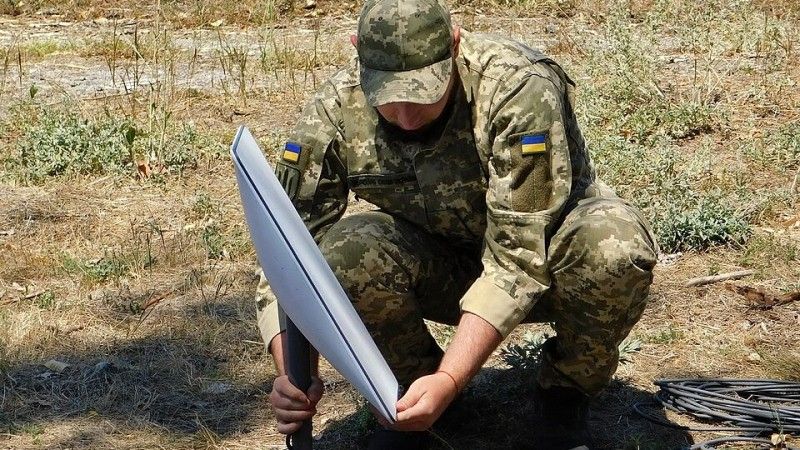
The disruption of Russian access to Starlink briefly shook the invaders’ capabilities on the frontlines, and it revealed something important about the nature of the modern battlefield.
Resilient satellite connectivity has become essential for communication, intelligence gathering, drone operations, and battlefield coordination, making it as critical to military effectiveness as many conventional tools of war. For Europe, this is not only a lesson from Ukraine, but also a warning: as warfare becomes increasingly dependent on secure and scalable communications infrastructure, the lack of a fully sovereign European alternative exposes a growing strategic vulnerability. The question is no longer whether satellite connectivity matters in war, but whether Europe will be able to secure control over this critical layer before the next crisis.
How Starlink became a battlefield system
Starlink, a system that provides internet access through small user terminals connected to a satellite constellation, was originally developed primarily for commercial use. Shortly after the beginning of the Russian invasion of Ukraine, the process of activating Starlink service on Ukrainian territory was significantly accelerated. In the first phase, access was provided free of charge, while later the costs of maintaining and expanding the service were increasingly covered by the United States government and other Ukrainian allies.
From the very first days of the invasion, Starlink connectivity has played a crucial role in Ukraine’s defence effort. On February 24, 2022, Russia launched not only a conventional military assault, but also a cyberattack targeting Ukrainian communication systems, including the satellite infrastructure of Viasat, Ukraine’s main satellite communication provider. That attack successfully disrupted an important part of Ukraine’s communication network and demonstrated how vulnerable traditional systems could be in the opening phase of a large-scale war. Since then, Starlink has remained one of the core elements of Ukraine’s communication architecture.
Although Starlink terminals are also used by civilians, public institutions, and parts of the government, their most important role has emerged directly on the frontlines. Because of its decentralised structure, encrypted communication, and the relatively small size and mobility of the terminals, the system is much harder to disrupt than many traditional forms of battlefield connectivity. This made Starlink especially valuable in conditions of intense Russian electronic warfare, where maintaining stable communication and access to real-time information quickly became essential for coordinated and effective defence.

Starlink on both sides of the front
Despite American sanctions, SpaceX satellite terminals have also appeared on the other side of the frontlines. Russian forces operating in occupied areas and near the line of contact have reportedly relied on Starlink for both combat and communication purposes, in ways that increasingly resembled its use by Ukrainian forces. Although Russia has no official access to the service, terminals were allegedly obtained through third-party companies linked to actors cooperating with the Russian military. These intermediary entities, often based in the Middle East or former Soviet republics, provided both the hardware and the registration pathways needed to activate accounts outside Russia and bypass existing restrictions.
Access to fast and relatively reliable internet allowed Russian forces to maintain forms of battlefield communication that had already become deeply embedded in their operational culture. In particular, it supported continued reliance on Telegram for a wide range of military activities, including the distribution of orders, coordination between units, battlefield reporting, and the exchange of intelligence. Starlink terminals also seem to have played an important role in Russian drone warfare. In that context, stable satellite connectivity improved the flow of targeting data, supported coordination between operators and command elements, and with that enabled more precise strikes.
What the disruption actually changed
On February 1, 2026, SpaceX took action to shut down the unauthorised use of Starlink terminals by Russian forces in Ukraine. The crackdown was confirmed by Elon Musk via his X post and, as per the Ukrainska Pravda article, took the form of terminal verification and the introduction of a whitelist for users in the area. The first results of the new SpaceX policy were observed as early as February 4. As reported by Defence24, the “hysterical reaction” of Russian forces was caused by disrupted communication, poor coordination, less precise and less numerous drone attacks, and the suspension of some Russian offensives along the frontline.
Russian forces attempted to adapt to the new situation by switching to other communication systems. Connectivity was established through RS-30M, a Russian domestic analogue to Starlink, and Gazprom Space Systems’ Yamal satellites. These attempts proved unsuccessful, as both alternative systems failed to provide the combination of scale, accessibility, reliability, and quality of data transfer offered by Starlink.
As Reuters reporting suggests, cutting off Starlink access for Russian forces affected the situation on the frontlines and, according to Ukrainska Pravda, contributed to local territorial gains for Ukraine. However, it is impossible to assess the direct impact of the loss of access to such crucial technology on the frontline situation alone. The February and March Ukrainian successes resulted primarily from earlier planning, command reforms, the use of the Delta system, and strikes on Russian rear positions, which makes any narrative reducing these developments solely to Starlink oversimplified.
See also 

Europe’s strategic vulnerability
The war in Ukraine continues to redefine the understanding of modern warfare, and the exposure of vulnerability in the field of satellite connectivity is one of the most recent lessons drawn from more than four years of conflict. The ability to communicate, gather intelligence, and control unmanned systems through fast and accessible means has proven to be nearly as important as any conventional instrument of war. In a battlespace shaped by decentralised operations and electronic warfare, resilient satellite communication is no longer a supporting tool, but part of the operational foundation of combat effectiveness.
These conclusions are especially important for the European Union, both because of its geographical proximity to the war and because of the rapidly evolving security environment across the continent. The European Union White Paper, which outlines the direction of future European defence capabilities, makes clear that secure communications and space assets are no longer treated as secondary support tools, but as strategic enablers close to the core of Europe’s defence posture. In that sense, the Ukrainian battlefield has not only exposed the importance of such systems, but has also revealed how vulnerable Europe remains in this area.
The European Union is currently facing three closely connected challenges in the field of satellite communications. First, it still lacks the technical depth, scale, and readiness needed to field a fully sovereign and mature system capable of matching the flexibility and operational relevance of the most advanced existing constellations. Second, Europe remains heavily reliant on capabilities provided by overseas allies, which creates both political and operational dependence. Third, and currently the most destructive, is an internal battle for industrial dominance. What was meant to be a unified European front is rapidly degenerating into fiercely competitive, fragmented industrial development. In a security environment marked by changing strategic priorities and uncertainty over long-term commitments from overseas allies, this internal division, driven by national interest, makes the continent’s dependence increasingly risky. This is why the debate is no longer only about access to connectivity from foreign providers, but about whether Europe can overcome its own political and corporate friction to achieve true sovereignty over a critical layer of modern warfare.
GOVSATCOM: interim capacities, not a full replacement
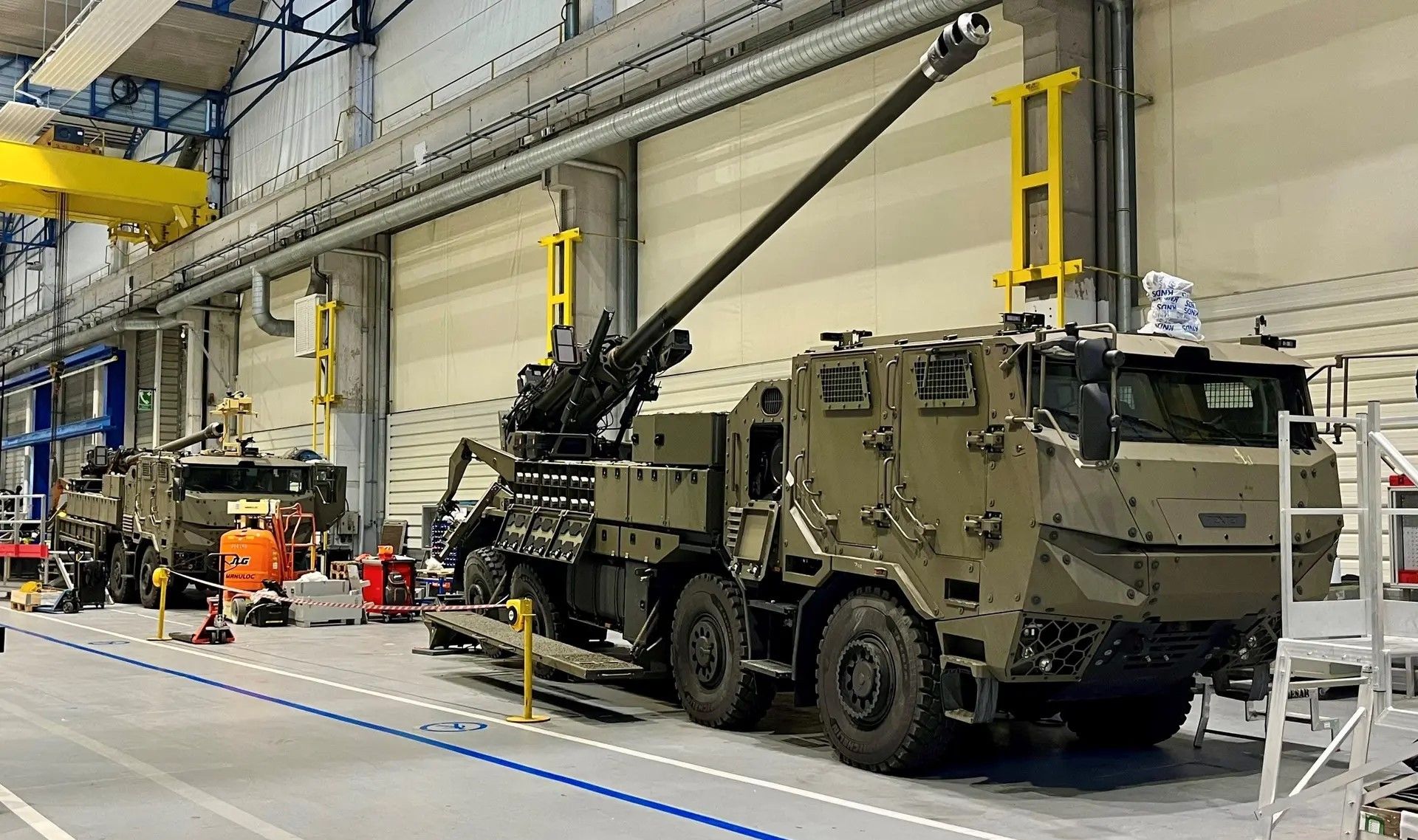
Europe does not start from zero in the field of satellite communications. Over the last few years, it has built the first institutional mechanisms that allow Member States and EU institutions to access secure governmental satellite services without relying exclusively on non-European providers. The most important step in that direction is GOVSATCOM, which entered operations in early 2026 and gives Member States access to sovereign satellite communications built and operated in Europe. At the heart of this system is the GOVSATCOM Hub, a 24/7 platform managed by EUSPA that connects governmental demand with available satellite communication resources and combines both governmental and commercial capacities for critical missions. In practical terms, these services are already designed to support crisis management, border surveillance and protection, and the defence of key infrastructure. This means that Europe has moved beyond political declarations and created a functional but still limited operational layer. The operational status of the system was confirmed in March 2026, when Cyprus completed the first acquisition and use of GOVSATCOM services through the Hub.
At the same time, these capabilities should not be mistaken for a full European replacement of a system such as Starlink. What Europe has today is still a patchwork of combined capacities, managed access, and existing national or commercial resources rather than a single, mature, and large-scale constellation built for high-intensity conflict. These mechanisms reduce vulnerability, buy time, and provide sovereign access for critical governmental users to some extent, but they do not yet offer the same combination of scale, availability in crisis situations, flexibility, and operational reach that characterises the most developed satellite internet systems. In that sense, Europe’s current answer, however real and useful, is still transitional.
See also

From GOVSATCOM to IRIS2: The fragmented road to autonomy
If GOVSATCOM represents Europe’s first operational step, IRIS2 was meant to become its long-term strategic answer. The logic behind the project was clear: the European Union concluded that satellite connectivity is becoming a strategic asset for security and that guaranteed access can no longer depend on third-party providers. For that reason, IRIS2 was designed as a multi-orbital constellation to provide secure communications to the EU and its Member States, moving Europe from shared access to true ownership of a critical layer of secure connectivity.
However, this strategic answer is currently threatened by severe internal fragmentation and the inherent contradictions of its Public-Private Partnership model. The critical negotiation phase, which was supposed to finalise the system’s architecture and costs by April 2026, has stalled. The core issue is a clash: European governments demand absolute sovereignty, combined with military-grade resilience and quantum encryption, while private operators in the SpaceRISE consortium refuse to subsidise these expenses with their shareholders’ money. This financial impasse has sparked industrial infighting over contracts, with operators attempting to bypass traditional European defence giants to cut costs.
This bureaucratic paralysis makes the current moment strategically hazardous. While the €10 billion IRIS2 project is stuck in negotiations, key Member States are reverting to national solutions. Driven by domestic security needs and a desire for direct control, countries are demonstrating that sovereign capabilities can be acquired much faster outside the EU framework. For instance, in May 2026, Poland achieved full operational capability of its POLSARIS radar satellite constellation in a record-breaking 12 months. Similarly, Spain announced a national Special Modernisation Program for sovereign satcom, with Prime Minister Pedro Sánchez explicitly referencing the Starlink disruptions in Ukraine as a warning against foreign “servitude”. GOVSATCOM and IRIS2 show that Europe has started to construct an answer, but they also highlight how industrial egoism and bureaucratic delays could derail those projects.

Outlook: connectivity as a future battlespace priority
Europe has already moved beyond declarations and created the first operational layer of sovereign satellite communications through GOVSATCOM. Yet this remains a limited and transitional framework rather than a full-scale answer to the demands of high-intensity conflict. The EU’s own roadmap shows that genuinely sovereign and unified connectivity will take years to mature and will likely not be fully operational until 2030.
In the meantime, Europe’s security will continue to depend on a hybrid model built around public capacity, combining shared national assets and selected commercial partnerships. The growing trend of building separate national constellations means that sovereign resilience is being tested not just by external threats, but by internal divisions. Recent institutional attempts to artificially mandate a unified European space market through top-down regulations have only exposed a deeper struggle between centralised ambitions and sovereign interests. Consequently, the challenge is no longer just to define the need for secure satellite connectivity, but to force strict interoperability between these agile national initiatives and slower institutional mega-projects. If Europe cannot prevent the fragmentation of its space assets, it must at least guarantee that these systems can work together seamlessly.
Conclusions
The Starlink episode was not simply a story about one technology used by two armies on one battlefield. It exposed a deeper transformation in the logic of war, in which connectivity and the flow of data shape combat effectiveness and strategic resilience. For Europe, the lesson is particularly clear: ambition in the field of security must be matched by the ability to secure the technological foundations of modern defence.
Until that happens, Europe will remain vulnerable not only because of what it lacks militarily, but because of what it still does not fully control. In that sense, the struggle over satellite connectivity is no longer just about access to the internet in war, but about sovereignty over one of the essential foundations of future military power. However, this sovereignty will remain out of reach if Europe continues to trap itself between slow, over-regulated bureaucratic mega-projects and fragmented national industries. The ultimate test will be whether Europe can bridge the gap between institutional ambition and the agile operational readiness demanded by the modern battlefield before the next crisis strikes.
Author: Piotr Fonfara


