Royal Navy breaks up with alcohol and tradition [COMMENTARY]

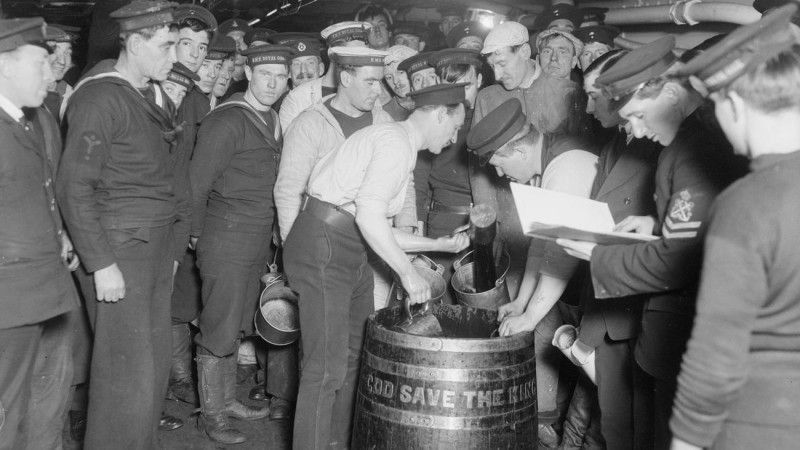
Photo. Wikimedia, Royal; Navy
The British Royal Navy is limiting the amount of alcohol sailors can consume during operations at sea. Traditionalists are sounding the alarm.
According to new government guidelines, British sailors are now prohibited from consuming alcohol at least two days per week, with a weekly limit set at fourteen units of alcohol (each unit equals 10 ml or 8 g of pure alcohol), equivalent to six pints of beer (3.4 liters). This replaces the long-standing „two-can rule” used across the UK armed forces, which was originally introduced to boost morale during operations.
However, that rule effectively allowed the consumption of 21 units of alcohol per week—one-third more than the NHS (National Health Service) recommended limit of 14 units. The decision to limit alcohol was not based solely on NHS guidelines. The Royal Navy’s own report, Alcohol Policy Onboard Ships, highlighted a serious problem with alcohol consumption aboard naval vessels.
The report noted the need to address the permission to sell beer in ship canteens. Ordinary sailors could buy up to three half-pint (approximately 284 ml) cans of beer per day, while non-commissioned officers and officers faced no restrictions at all. On ships, this posed particular risks, since full crew readiness is often required immediately, not just that of the watch on duty. Alcohol could hinder, or even prevent, emergency operations.
Another step toward total prohibition in the Royal Navy
Limiting the number of pints allowed on board is another step toward complete abstinence for crews during deployments. The first „alcohol revolution” was the end of the three-century-old tradition of daily rum rations, known as the tot. The last daily rum ration in the Royal Navy was issued on 31 July 1970, a day remembered as Black Tot Day—a „black day” because it was seen as eliminating an important element of naval tradition for which the Royal Navy is famous.

Photo. British MoD
In fact, this tradition originally arose out of necessity. Hundreds of years ago, British ships faced serious problems with fresh water, which spoiled quickly in wooden barrels. Sailors were given up to eight pints of weak beer daily. Later, the rule of issuing a half-pint of rum or brandy daily was introduced, and from 1740 the alcohol was diluted with water at a ratio of four to one.
Since the rule was introduced by Admiral Edward Vernon, nicknamed „Old Grog,” the mixture of rum and water became known as grog. Alcohol also helped mask the taste of lime juice stored in wooden barrels, which was also issued to sailors on long voyages.
Rum also served as a reward for sailors« successes and a motivation before hard work. This is the origin of the traditional order „Splice the Mainbrace” (signal code BRAVO-XRAY), used aboard Royal Navy ships to issue extra rum rations. The order originally applied to work on the main rigging of sailing ships, one of the most difficult and dangerous tasks, particularly in bad weather. Since 1773, the order has also been issued to mark royal births, monarchs« visits to a ship, or victories in battle or war.
Today, the original reasons for issuing beer and rum no longer exist, yet alcohol consumption is still permitted. The result is that, according to the Royal Navy itself, nearly half (48%) of British sailors currently consume excessive amounts of alcohol. According to the Admiralty, this can significantly reduce operational capabilities. The first step to address this is a mandatory two-day alcohol ban and a weekly allowance of 14 units.
What is already seen as a success still allows each sailor to consume up to 300 ml of vodka per week.

Why Alcohol on Ships?
The debate within the Royal Navy surprises other navies worldwide. In Poland, for example, alcohol consumption is completely prohibited in military units, including ships. The same applies to the US Navy, where total prohibition applies on all vessels. However, since 1914, US Navy ships spending more than 45 days at sea have had a tradition called beer day, allowing sailors to drink two cans of alcohol to boost morale.
In the Royal Navy, famous for its almost obsessive attachment to tradition, the issue is far more complicated. Prohibition is being implemented gradually. Beyond limiting alcohol units, there are plans to introduce a wider selection of non-alcoholic and low-alcohol beverages in ship canteens. The Navy also aims to „promote responsible drinking habits,” although this is the most ridiculed element of the initiative.
In practice, new sailors may help most, as they often prefer a healthy lifestyle and gym training over traditional smoke-filled bars. Submarine crews are particularly aware of the dangers of alcohol, where there is near-unanimous agreement that no alcohol should be consumed at all. Every submariner knows that the absence of even one crew member during an emergency can pose a lethal risk to the entire crew.
According to Commander Serena Brotherton, Royal Navy spokesperson, the updated policy aligns with the recommendations of the Chief Medical Officer of the United Kingdom, ensuring that our people remain fit to conduct maritime operations and meet modern military and civilian standards. The priority is the health of our personnel, ensuring they are ready to respond to the dynamic challenges of maritime operations, while still allowing them to enjoy their downtime.
It is highly likely that sailors serving on surface ships will soon reach the same conclusion, especially those operating in dangerous areas such as the Persian Gulf. The harmful effects of alcohol are increasingly recognized everywhere. A similar effect was achieved in the fight against tobacco, which was historically linked to rum rations on British ships. Rum was not measured precisely but poured from the pipe head, creating a symbolic daily allowance.
That tradition, however, will almost certainly not return.