












- WIADOMOŚCI
- ANALIZA
Russia’s bases abroad. A shadow of the former power of the USSR [MAP]

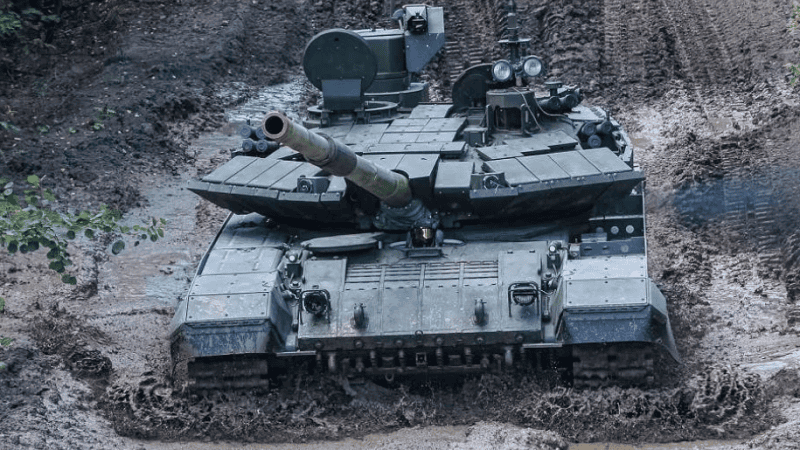
Photo. Uralvagonzavod
One of the hallmarks of a state’s great-power status is having a network of military bases spread across the world. During the Cold War, the USSR tried to compete with the United States in this respect. After its collapse, a multi-year process began of dismantling troops stationed outside Russia. But in some countries, they still remain.
Empires rose and fell, and new ones took their place. Before the outbreak of the Second World War, a classic example of such an empire was Great Britain. It had military bases in almost every part of the world, and where it did not, it could occasionally make use of bases belonging to allied and friendly states.
After the Second World War, the British Empire began to disintegrate, and the United States took its place. It created an even larger system of basing its troops abroad. The Americans remained militarily present in Europe and Japan, and later entered other countries. During the Cold War, the Soviet Union tried to counter US hegemony. Its forces remained in Eastern Europe, and later gradually appeared in other states. It should be acknowledged, however, that the Soviet system of overseas bases could never match the American one for as long as the USSR existed.
The collapse of the USSR dashed the Kremlin’s plans, and Soviet, and later Russian, troops had to leave many countries, such as Germany, Poland, Czechoslovakia, Hungary, Mongolia, Lithuania, Latvia, Estonia, Cuba and Vietnam. The newly independent states formed on the basis of the Soviet republics began to build their own armed forces, usually on the basis of the Russian units stationed there. The process of dismantling the Soviet system of troop deployment lasted several years. It was not a simple process, because the forces that had to be redeployed were enormous. While transporting military equipment and personnel was „only” a logistical operation — a huge one, but still feasible — the same could not be done with the technical infrastructure, which Russia still needed.

Photo. mil.ru
Other changes in the deployment of the Russian military resulted from shifts in the political and military situation across the territory of the former USSR. Russia systematically became involved in successive wars on those territories or recognised self-proclaimed republics that were not recognised by others. The result of these events was the systematic regrouping of Russian military units and contingents of Russian private companies employing former servicemen (but that is a completely different topic).
Russian bases on foreign soil
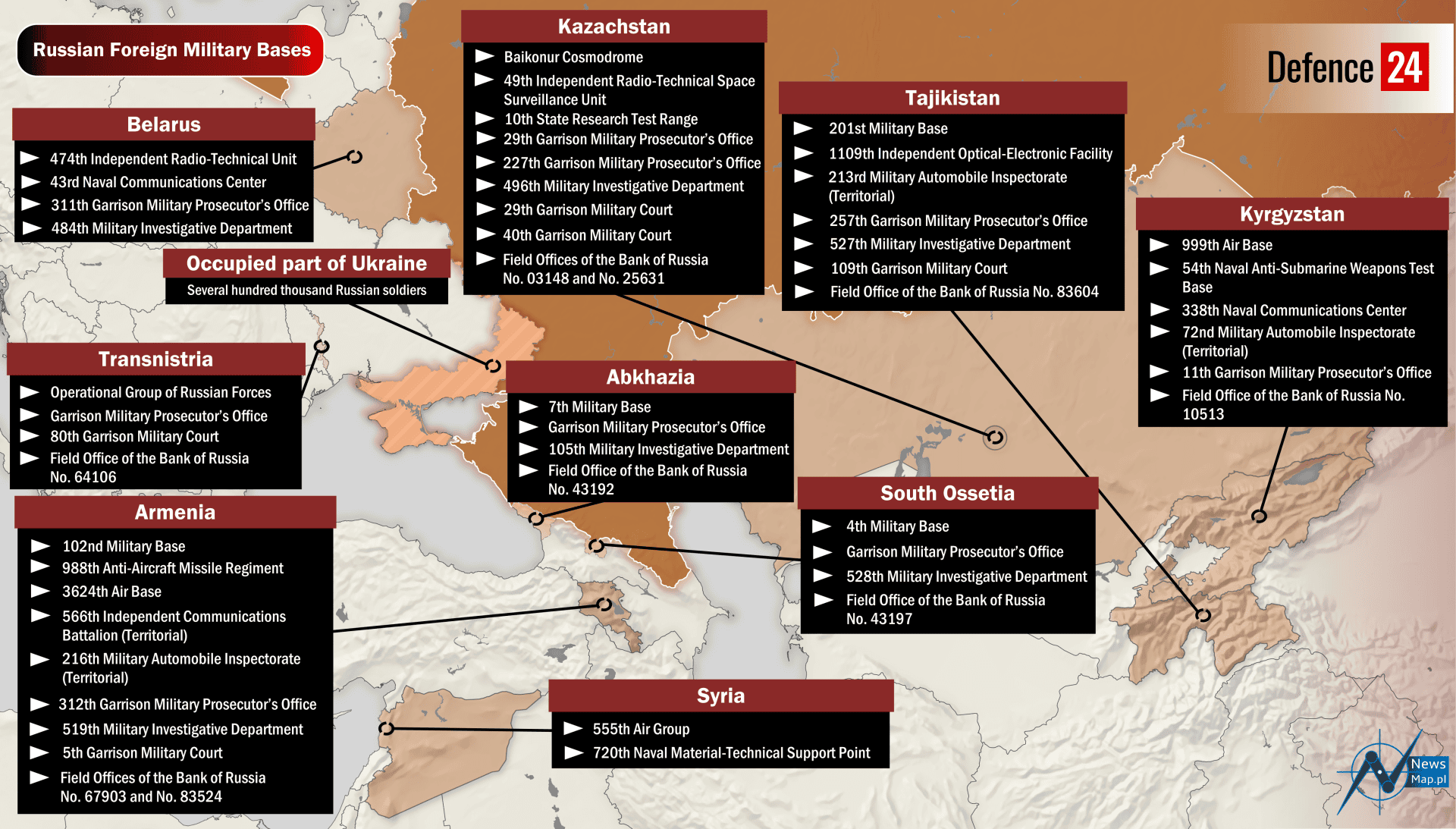
What does Russia’s military presence outside Russia look like today? Below is an overview in alphabetical order.
Abkhazia
Virtually nobody in the world recognises the self-proclaimed Republic of Abkhazia. Because Russia recognises it, it maintains a sizeable contingent there of over 3,500 troops. They are organised into the 7th Military Base. A base is nothing other than an enlarged brigade. It consists of four mechanised battalions, one tank battalion, one reconnaissance battalion, one engineer-sapper battalion, one command battalion and one repair-and-maintenance battalion, as well as two self-propelled artillery battalions, one multiple rocket launcher battalion and one anti-tank artillery battalion. Air defence for the base is provided by a group of battalions armed with S-300, Osa, Strela-10, Tunguska and Igla air defence systems.
Recently, the strength of this base was probably temporarily reduced. Russian requirements on the front in Ukraine led to the formation of the 77th Separate Mechanised Regiment from selected sub-units. It has already been transported to Ukraine and is part of the Russian Southern Grouping of Forces.
Abkhazia also hosts a Military Garrison Prosecutor’s Office, the 105th Military Investigative Unit, and Bank of Russia Field Office No. 43192.
Armenia
Russian forces in Armenia number more than 3,000 troops. Most of them belong to the 102nd Military Base. This name conceals an enlarged brigade. It includes, among other elements, three mechanised battalions, a tank battalion, a reconnaissance battalion, a logistics battalion and a self-propelled artillery battalion. Support is provided by the 988th Anti-Aircraft Missile Regiment, the 3624th Air Base and the 566th Separate Communications Battalion (Territorial). The air base is equipped with a squadron of MiG-29 aircraft, while the 988th Regiment has one battalion of S-400 launchers and one battalion of Buk launchers.

Photo. mil.ru
Russian combat units are supported by the 216th Military Vehicle Inspectorate (Territorial), the 312th Military Garrison Prosecutor’s Office, the 519th Military Investigative Unit, the 5th Military Garrison Court, and Bank of Russia Field Offices No. 67903 and No. 83524.
Belarus
Belarus is a country that is heavily dependent on Russia and closely allied with it. That is why the Russian military feels most at home there. It takes part in joint military exercises with Belarus under the so-called Union State, trains Belarusian soldiers and specialists, and when it wishes, launches attacks on Ukraine from Belarusian territory. However, the presence even of a very large number of units, military equipment and soldiers in Belarus is temporary. In everyday terms, Russia has very few permanent facilities there, and the number of troops permanently stationed there is relatively small.
These mainly comprise the personnel of the 474th Separate Radio-Technical Node, that is, the large fixed Volga radar, belonging to the 820th Main Centre for Missile Attack Warning, which is part of Russia’s Aerospace Forces. This is currently the only installation of its kind outside Russia, not counting occupied Crimea. The second unit, the 43rd Communications Node in Vileyka, belongs to the Navy and is used mainly for communications with Russian submarines.

Photo. Belorussian Ministry of Defence
At the end of 2025, the Russians and Belarusians released a propaganda television video from a ceremony marking the start of duty by an unspecified unit armed with Oreshnik ballistic missile launchers. However, the footage showed only command vehicles, not the launchers themselves. In Russia, the first missile brigade armed with this type of launcher was supposed to have been formed. This brigade is part of the Strategic Missile Forces, and the flag of those forces was displayed in the aforementioned video. For now, there is very little verified information about the Oreshnik missile system itself, which is why it is difficult to assess conclusively how much of the reported deployment of these missiles in Belarus is fact and how much is propaganda.
Kazakhstan
Russian presence on the territory of this state is relatively small and stems more from geographical conditions and remnants of Soviet-era infrastructure. The Russians still lease the Baikonur Cosmodrome, and some of the operations conducted there involve the military. Although satellites with purely military applications are launched into Earth orbit from Russian territory, this is done from the Plesetsk Cosmodrome.

Photo. Roskosmos\Flickr
The 929th Chkalov State Flight-Test Centre from Akhtubinsk, belonging to the Aerospace Forces, uses its flight range in Kazakhstan. Also belonging to this branch of the armed forces is the 49th Separate Radio-Technical Space Reconnaissance Node. It falls under the 821st Main Space Reconnaissance Centre of Russia’s Space Forces.
In Kazakhstan, Russia’s Strategic Missile Forces also have their own unit. At the Sary-Shagan proving ground operates the 10th State Scientific Research and Test Range. It forms part of the 4th State Central Range of the Russian Ministry of Defence.
The Russian military detachment in Kazakhstan is supported by the 29th Military Garrison Prosecutor’s Office and the 227th Military Garrison Prosecutor’s Office, the 496th Military Investigative Unit, the 29th Military Garrison Court and the 40th Military Garrison Court, as well as Bank of Russia Field Offices No. 03148 and No. 25631.


