












- WIADOMOŚCI
- KOMENTARZ
US-UK special relationship in action: Seizing Putin’s tanker

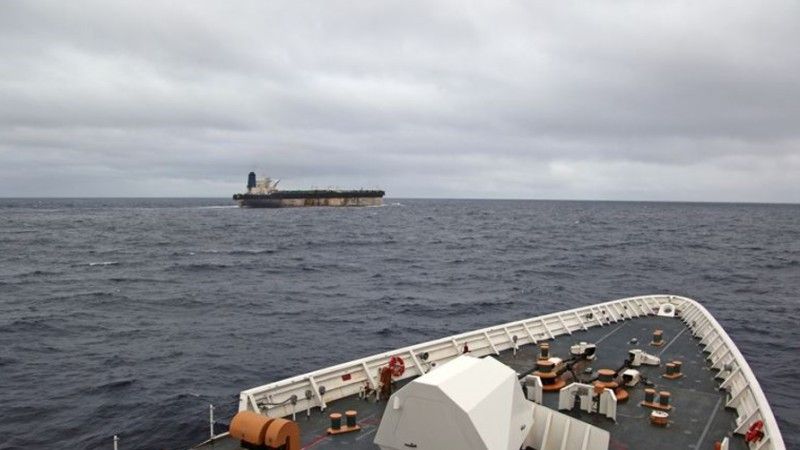
The seizure of Marinera: a test of global sanctions, alliance resolve and Britain’s quiet but indispensable role in making enforcement power credible.
Following the operation to capture Maduro in Caracas, the dynamic strategic focus shifted to the north Atlantic with the 7th of January US seizure of the oil tanker Marinera in a ”Shadow Fleet” busting operation. This was not, however, just a maritime diversion nor an attempt at a show of force for domestic political consumption. It was a clear and deliberate politically calculated assertion of authority in a contested operational space, in which sanctions enforcement, hybrid warfare and NATO alliance politics are all increasingly overlapping.
While Washington led and directed the operation and will doubtless assume the bulk of its legal and diplomatic risks, the role of the United Kingdom deserves a closer scrutiny. Whilst it did not command the boarding team, it nonetheless in a discreet and supportive way made the whole operation possible. This is a distinction that matters from a political perspective as it gave the UK the opportunity to demonstrate its strategic worth as a key operational NATO ally. It helped send a consistent message that sanctions, once imposed, will be enforced globally and persistently, even against vessels seeking to shelter behind reflagging, jurisdictional ambiguity or proximity to hostile state power. In that sense, the Marinera seizure was not just a test of US political will but rather a demonstration of wider NATO allied unity and integrated operational capability.

The Marinera: A shadow fleet test case
The vessel which was formerly known as Bella‑1, displayed all the defining characteristics of contemporary „shadow fleet „operations. These include the following features- vague ownership structures, repeated and opportunistic flag changes, a history of ship‑to‑ship transfers designed to obscure cargo origin and finally, links to sanctioned Venezuelan oil exports all of which are entangled with Iranian and Russian interests. This is far from being accidental behaviour but rather reflective of hybrid maritime economic warfare which is conducted below the threshold level of open conflict to avoid wider repercussions.
After the vessel evaded a US Coast Guard interdiction in the Caribbean in December, it then fled northward, repainting its identity as it went and then formally entered the Russian shipping register mid‑voyage. This was all done with a clear purpose of obfuscation to mitigate escalation risk by the vessel’s operators. By reflagging to Russia, they sought to complicate legal justification by hoping to deter further pursuit through forcing Washington to ask itself this stark question: was it prepared to enforce sanctions against a vessel now claiming Russian protection on the high seas? They did not have to wait too long for the answer!
Washington decided to act anyway
President Trump responded to this challenge by ordering US forces to seize the tanker in the North Atlantic, between Iceland and Scotland, after issuing a federal warrant for sanctions violations. The boarding was led by the US Coast Guard which all served to underline the law‑enforcement nature of the action which was facilitated with military assets whose role was to support the securing rather than front‑loading phase of the whole operation. Russian naval assets, which included a submarine, were known to be operating in the wider area. There was thankfully no confrontation or incident at sea, but the risk calculus was unmistakable, and all parties were doubtless acutely aware of this.
This whole operation was the first seizure in recent memory of a Russian‑flagged oil tanker by the United States, and it is a threshold moment in the wider current tense geopolitical context. That fact alone should dispel any suggestion that this was some kind of routine enforcement exercise but rather it demonstrates that a very serious and deliberate precedent has been set.

Britain's role: Enabler, not passenger
London’s contribution to the whole operation was not symbolic or marginal but operationally significant. According to the Ministry of Defence, the UK provided „pre‑planned operational support” at the request of the United States, a support that included maritime assistance, air surveillance and the use of base facilities. RAF aircraft tracked the tanker’s movement through the strategically vital Greenland–Iceland–UK (GIUK) gap, while the Royal Fleet Auxiliary’s support ship RFA Tideforce assisted operations at sea. Coincidentally this ship had only very recently played a key role in the NATO monitoring operation of the Russian submarine Krasnodar as it passed through the English Channel.
In relation to this particular operation, the UK, by allowing the use of its territory and infrastructure, enabled the operational pace to make the whole seizure feasible. US maritime patrol aircraft, transport assets and special forces enablers have few substitutes east of the Atlantic comparable to UK bases such as RAF Mildenhall, RAF Fairford as well as the surrounding network of logistics and intelligence. Without that vital access, the pursuit operation would not have been possible to achieve with such efficiency. This in turn would have given adversaries more time and more options to evade and escape.
This is the often‑ignored reality of alliance power in contemporary operations. Influence is no longer measured solely by who fires the first shot or crosses the deck, but rather by who enables persistence, discretion and decision space. Britain did not need to board the tanker to be as indispensable as it was to affect its capture.
Conclusion
Ultimately, shadow fleets thrive on permissive spaces such as the vast oceans, weak registries, overstretched regulators and the assumption that no state will escalate over „just another tanker.” By enabling this decisive enforcement action in the North Atlantic, the UK has successfully helped to dispel that assumption. The message to sanctions evaders was unambiguous and clear that distance and disguise will no longer guarantee immunity and reflagging as in this case there will not be any form of shield.
In decisively supporting the seizure of Marinera, the UK has demonstrated a careful balance between legal restraint and strategic resolve, all the while grounding its role in compliance with international law whilst avoiding the timidity that would further erode the credibility of sanctions. The operation reflects a wider shift in which commercial shipping—particularly the shadow fleets linked to Russia and Iran—has become an instrument of economic warfare rather than straightforward neutral trade. Sanctions enforcement is therefore no longer merely regulatory, but a joint endeavour in which intelligence, logistics, legal authority and crucially military credibility all converge. Britain’s role was publicly enabling rather than leading, yet strategically highly consequential. Refusal to play its part would have risked NATO alliance dilution and division leading to a weakened deterrence posture.
Sources:
Reuters; Ali, Idrees & Stewart, Phil. „U.S. seizes Venezuela‑linked, Russian‑flagged oil tanker after weeks‑long pursuit.” Reuters, 7 January 2026.
NBC News; „U.S. seizes Russian‑flagged oil tanker linked to Venezuela after weekslong pursuit.” NBC News, 7 January 2026.
Sky News; „What we know about US seizure of Russian‑flagged oil tanker linked to Venezuela.” Sky News, 7 January 2026;
The Telegraph; Crilly, Rob; Kelly, Kieran; Cleave, Iona. „US seizes »Russian« tanker in North Atlantic as British forces assist.” The Telegraph, 7 January 2026.


