












- WIADOMOŚCI
300,000 anti-tank barricades are heading east. MOD is fortifying the border

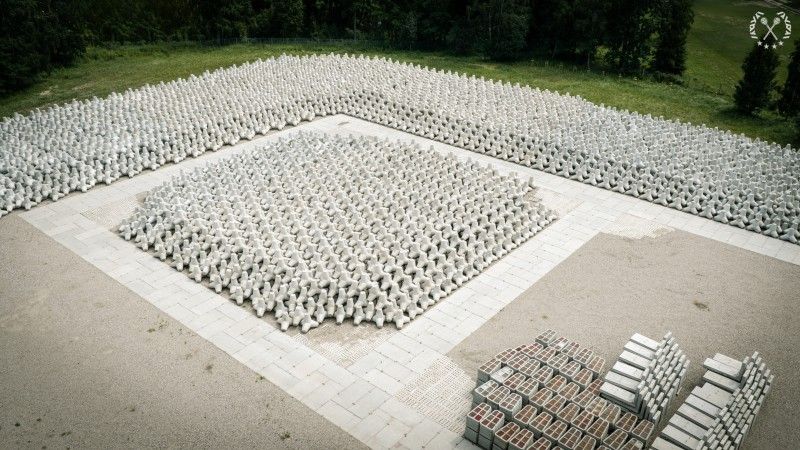
Photo. General Staff of the Polish Armed Forces
Nearly 300,000 concrete hedgehogs are to be transported to northern and eastern Poland by mid-October 2026. The Ministry of National Defence (MOD) reports that actions have already covered 100 km of sensitive border sections, and by the end of the year, the security measures are to encompass over 200 km. According to the ministry, East Shield is now entering the stage of mass scaling.
The Ministry of National Defence has summarised two years of the National Deterrence and Defence Programme „East Shield”. Information presented by the ministry indicates that the first phase of design, solution testing, and the construction of initial system elements has been completed. The year 2026 is expected to bring an increased pace of work, while for 2027, the MOD announces its full intensification.
The ministry states that 100 km of the most sensitive sections of the state border have been secured so far. This figure includes both linear engineering expansion elements and the construction of storage sites for fortification materials. Taking into account infrastructure completed in previous years, the security measures are to cover over 200 km of the border by the end of 2026.
According to the MOD, five road and rail border crossings have also been blocked. A further 12 crossings – seven road and five rail – have been prepared for rapid blocking.
A thousand concrete hedgehogs per day
One of the largest undertakings is to be the logistical operation related to equipping storage sites for engineering materials. The MOD informs that construction work and deliveries are currently being carried out in 18 locations in northern and eastern Poland.
Every day, approximately a thousand concrete hedgehogs reach these sites, and the delivery rate is set to be increased. By mid-October 2026, the military plans to move nearly 300,000 such elements. According to ministry calculations, this will require more than 10,000 transports.
The materials are to be deployed as close as possible to potential areas of use. In the event of a threat, this should shorten the time required to create barriers, block roads, and prepare the terrain for defensive operations.

579 hectares and new military complexes
The MOD reports that in the years 2025–2026, 109 plots with a total area of almost 579 ha were acquired for the programme’s needs. As many as 103 properties came from the resources of the National Support Centre for Agriculture (KOWR). The remaining areas were taken over from local governments and the State Forests or purchased from private owners.
Fifteen military complexes for fortification and storage purposes have been established on the acquired lands. They are intended to enable the storage of equipment and materials, as well as the further expansion of defensive infrastructure.
The ministry maintains that State Treasury land not under lease is utilised as a priority. In the case of land used for agriculture, the takeover is to be planned in a way that allows farmers to complete their production cycle. If the military requires only a fragment of a property, the military side is to finance its geodetic division.
Heavy equipment and additional companies
The potential of the Engineer Forces is also being expanded. According to the MOD, 462 million PLN (approx. €107 million / $115 million) has been allocated for their equipment, and two additional engineer companies have been formed. In 2026, the military is to acquire, among others, 50 crawler bulldozers, 15 crawler excavators, seven excavators on truck chassis, and 10 road rollers. The contract is to provide for the possibility of purchasing another 10 rollers. Light and heavy road coverings are also being delivered to enable troop movement and work in difficult terrain.
The MOD is also developing Ultimate Building Machine technology. This allows for the rapid erection of self-supporting structures made of profiled sheet steel, including warehouses and garages. The Military University of Technology (WAT) has prepared structural solutions adapted to the needs of the army, and on 20.07.2026, a catalogue standardising the use of this technology was implemented in the Polish Armed Forces. So far, two UBM facilities have been built. The ministry announces the construction of a further 16, six of which are to be ready before the end of 2026.

Warehouses and roads for wartime
In the next phase of the programme, at least 20 engineering material depots are to be established, located primarily in a belt approximately 15 to 50 km from the border. The MOD plans three such facilities in the Pomeranian Voivodeship, five each in the Warmian-Masurian and Podlaskie Voivodeships, three in the Masovian Voivodeship, and four in the Lublin Voivodeship.
The ministry also announces an expansion of the list of roads of defensive importance to include local government routes associated with East Shield. This is to enable applications for funding for their expansion from the Government Road Development Fund starting from 2028.
According to the MOD, East Shield is ceasing to be a collection of pilot investments and is beginning to create permanent support facilities for operations. It is intended to make it difficult for an adversary to cross the border, while simultaneously increasing the capabilities for moving and deploying Polish troops and allied forces.


