












- WIADOMOŚCI
SCO tests its limits

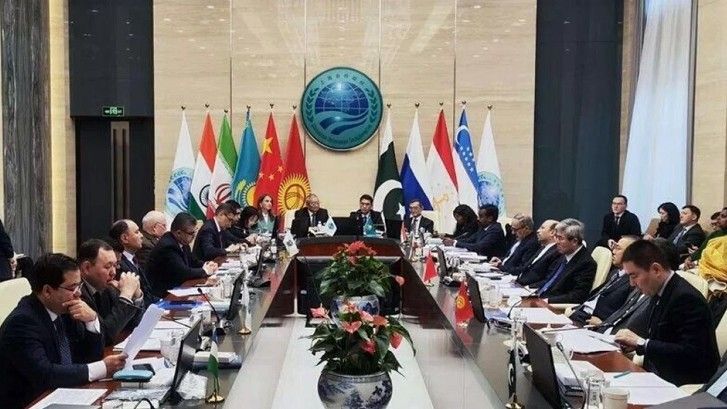
Photo. The Shanghai cooperation organisation
The Shanghai Cooperation Organisation summit in Bishkek is much more than another meeting of leaders calling for a multipolar world. For Russia, it is an opportunity to demonstrate that Moscow remains an important player in Eurasia despite the war in Ukraine. For Iran, however, the summit is something more serious: a test of how much political, economic and security support the organisation can actually provide to a member state confronted by the United States and Israel.
For Vladimir Putin, the summit has clear political value. In one place he can meet Xi Jinping, Narendra Modi, Masoud Pezeshkian and the leaders of Central Asian states. This allows Moscow to reject the narrative of international isolation. At the same time, Russia’s position inside the SCO is changing. China provides the main economic weight, while Moscow increasingly tries to preserve its importance through military capabilities, energy cooperation, arms exports and political influence.
Iran is therefore the most important test. Tehran became a full member of the SCO in 2023 and today it is involved in an open conflict with the United States and Israel. The organisation has already politically supported Iran and condemned attacks against its territory. However, the SCO is not NATO. It has no equivalent of Article 5, no common military command and no mechanism automatically obliging Russia, China or other members to defend Iran. This is the key difference between political solidarity and a real military alliance.
Russia nevertheless remains one of Iran’s most important partners. The two countries have a twenty-year strategic partnership agreement covering military, technological, energy and economic cooperation. But even this agreement does not provide a mutual defence guarantee. Moscow can therefore support Tehran through intelligence, satellite imagery, technology, arms cooperation and diplomatic protection without directly entering the conflict. This gives Russia considerable room for manoeuvre, particularly because it also maintains channels of communication with Washington.

This is why the Putin–Pezeshkian meeting deserves particular attention. The important question is not whether Russia will send forces to defend Iran. It almost certainly will not. The issue is how far Moscow is prepared to increase military-technical, intelligence and economic assistance while avoiding direct confrontation with the United States. The SCO summit will show whether support for Iran remains primarily political or begins to produce additional practical instruments.
India is equally important, but for a different reason. Narendra Modi can meet Putin and Xi Jinping within the SCO while at the same time publicly calling for an end to the war in Ukraine. Delhi maintains close relations with Moscow, buys Russian energy and participates in organisations built without the West, but it does not automatically accept Russian or Chinese positions. The SCO should therefore not be described simply as an anti-Western bloc.
This dimension is particularly important for Poland ahead of Prime Minister Donald Tusk’s planned visit to India. Warsaw should approach Delhi as an independent power with its own interests, not merely through the prism of India’s relations with Russia. India is simultaneously cooperating with Moscow, competing with China, developing relations with the United States and looking for new partners in Europe. Tusk’s visit should therefore be used to strengthen the Polish-Indian relationship not only economically, but also in defence, security and political cooperation.


