












- WIADOMOŚCI
- ANALIZA
Le Pen condemns Russia, but sovereignty remains the core of RN foreign policy

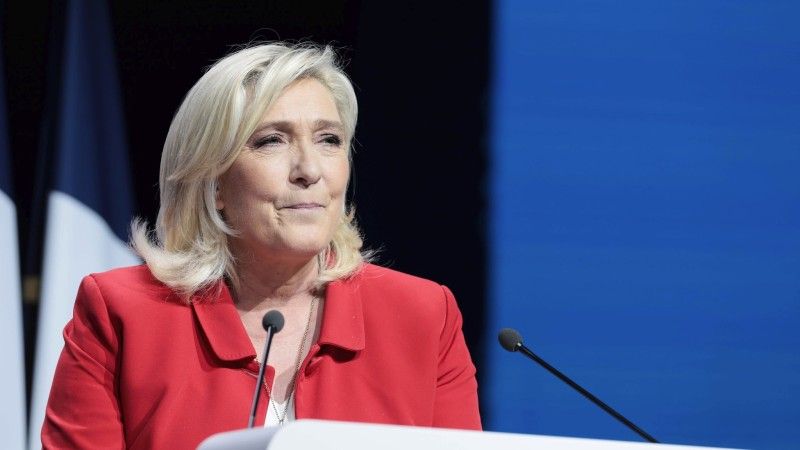
Marine Le Pen and Jordan Bardella have issued one of the Rassemblement National’s strongest statements on Russian hybrid activity in Europe. They condemn sabotage, intelligence operations, economic pressure and attempts to influence French decision-making. But the communiqué should not be confused with a huge change. To understand what an RN presidency could mean for French foreign and defence policy, it is necessary to look beyond this declaration – at NATO, Ukraine, nuclear deterrence, the European Union and, above all, the party’s understanding of French sovereignty. The presidential election is coming and the campaign has already started.
The statement of 19 September is important because the language towards Moscow is unusually clear. Le Pen and Bardella describe Russia’s seizure of French and European corporate assets as a hostile act, acknowledge the use of so-called disposable agents by Russian intelligence and accept that European infrastructure, companies and public opinion are being targeted. They also state that hostile operations against France should receive a proportionate response and that Moscow cannot be allowed to influence French policy through intimidation or destabilisation.
However, as a policy document, the declaration itself means relatively little. It does not announce additional sanctions, additional military deployments, more weapons for Ukraine or a new French posture towards Russia. The wording is harder, but the fundamental RN doctrine remains unchanged. Firmness against Russian interference and negotiations with Russia are presented as compatible rather than contradictory.
This distinction matters because the foundation of RN foreign policy is not primarily whether France should be „pro-Russian” or „anti-Russian”. It is sovereignty. The party wants France to retain control over military decisions, nuclear weapons, strategic industries and diplomacy. At the same time, it does not advocate military weakness: Bardella has called for defence spending to reach 3 per cent of GDP, while the party argues for stronger conventional forces, better air defence, long-range strike capabilities and a stronger domestic defence-industrial base.
The same logic explains the RN’s position on Europe. Le Pen and Bardella do not reject military cooperation between European countries. Joint exercises, industrial cooperation, coordinated procurement and stronger European production of ammunition, drones or missile systems are acceptable. What they reject is transferring the final political decision to EU institutions. The preferred model is therefore not a European army or increasingly integrated European defence, but cooperation between sovereign states whose governments retain control over their own forces.
NATO is another example. Le Pen continues to advocate France leaving NATO’s Integrated Military Command, while remaining a member of the Alliance. Bardella has taken a more cautious position, arguing that such a decision should not be implemented while a major war continues in Europe. The disagreement is therefore not primarily about NATO membership, but about how far France should subordinate its military planning to integrated allied structures.

There is even less ambiguity over nuclear weapons. The RN considers the French nuclear arsenal an exclusively national instrument. Strategic consultations with European partners, exercises and defence-industrial cooperation are acceptable, but the party rejects turning French deterrence into an instrument of European political integration. The decision over nuclear use must remain under exclusive French control. This is one of the most consistent elements of Le Pen’s security policy.
Ukraine demonstrates where this approach produces the clearest differences with the current French policy. Le Pen has said that France can continue training Ukrainian soldiers and providing equipment for defence, while arguing that financial support cannot continue at the existing level. Bardella has similarly said that defensive, humanitarian and training assistance could continue where it is compatible with French rearmament, but should not come at the expense of French stocks or national defence.
This is not a proposal to end all assistance to Ukraine. It is a proposal for a more limited and conditional model of support. The RN also remains opposed to direct French participation in the war and places considerably greater emphasis on negotiations with Moscow. In practice, an RN presidency would therefore have to reconcile two objectives that are already visible in the September communiqué: resisting Russian pressure against France while simultaneously seeking to reduce the risk of direct escalation with Russia.
Beyond defence, the same model applies to the European Union. The RN no longer campaigns for Frexit, but it wants a substantially looser Europe in which national governments recover greater freedom over borders, economic policy, diplomacy and defence. European cooperation is useful when it increases French power; it becomes unacceptable, in the RN’s understanding, when it restricts the ability of Paris to take the final decision independently. This is also why economic sovereignty, strategic industries and reducing external dependencies occupy such an important place in the party’s programme.

Outside Europe, the party has traditionally viewed foreign relations through the same combination of sovereignty and domestic security. Le Pen has favoured close cooperation with Egypt and the United Arab Emirates, particularly in relation to Islamist movements, while the relationship with Algeria is likely to be far more contentious because migration, visas, readmission, historical disputes and security cooperation are closely connected. This is not isolationism. It is a preference for bilateral relationships in which France retains maximum room for manoeuvre.
There is also an obvious political dimension. Marine Le Pen is campaigning for the 2027 presidential election and wants to become President of France. Foreign and defence policy can therefore no longer be treated only as ideological positioning by an opposition party. Her opponents are already focusing on Europe, Ukraine and Russia precisely because these are areas where an eventual president would have very wide constitutional powers and where RN positions differ substantially from the policies pursued under Emmanuel Macron.
The 19 September communiqué should therefore be read in this broader context. It allows Le Pen to state clearly that Russia cannot intimidate France, while avoiding any commitment to Macron’s approach to Ukraine, NATO or European defence. The rhetoric towards Moscow has hardened, but the doctrine has not fundamentally changed: stronger French armed forces, national nuclear control, greater autonomy within Western structures, less supranational European integration and more conditional support for Ukraine.
For the RN, the central question is ultimately not whether France should cooperate with Europe, NATO, Ukraine or even Russia. It is who takes the final decision, and Marine Le Pen’s answer remains the same – Paris and the Rassemblement National.


