












- ANALIZA
- WIADOMOŚCI
Sweden steps into Finland’s drone defence

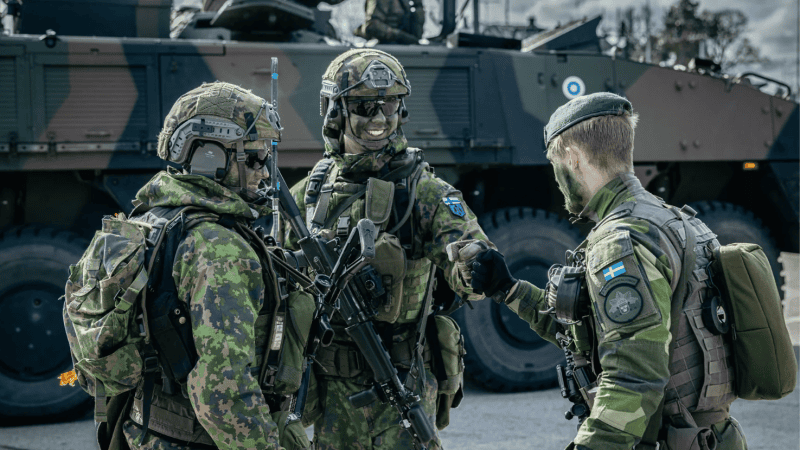
Sweden and Finland are taking their defence cooperation to another level. On 28 August, the two countries announced that they will jointly strengthen the surveillance and protection of Finland’s territorial integrity, with particular emphasis on detecting and countering drones. This is more than an exchange of information. The legal and military mechanisms already exist for Swedish forces to operate on Finnish territory, including in peacetime, if Helsinki and Stockholm decide that such support is necessary.
The decision comes after several incidents that demonstrated how quickly the security situation around Finland can change. On 29 March, two drones entered south-eastern Finland during Ukrainian attacks against Russian infrastructure in the Gulf of Finland region. Finnish F/A-18 Hornets were scrambled to identify the objects, which later crashed near Kouvola. Finnish authorities subsequently assessed that the drones had probably deviated from their original route, potentially as a result of Russian countermeasures.
An even more serious situation occurred on 15 May. Finnish authorities received information that larger drones carrying heavier explosive payloads could deviate towards Finnish territory. An emergency warning was issued for the Uusimaa region, counter-drone readiness was increased and changes were introduced to air and maritime traffic. The drones ultimately did not enter Finland, but the incident showed that a country bordering Russia can face an aerial threat even when it is not the intended target.
Finland builds its own anti-drone shield
Finland is already investing heavily in counter-unmanned aerial systems. In 2026, Helsinki allocated an additional €50.2 million for counter-drone capabilities, including €44 million for the Border Guard and €6.2 million for the police.
The objective is to create a layered system combining permanent sensors and countermeasures along the Russian border and the coastline with mobile systems that can be deployed elsewhere in the country. Finland is also seeking an additional €35 million in EU funding for further development of detection, tracking and counter-drone capabilities between 2027 and 2029.
Swedish support should therefore be seen as an addition to a system that Finland is already building, rather than as a substitute for national capabilities.
See also 

What can Sweden provide?
Sweden is sending JAS 39 Gripen fighter jets, military units, and naval support to Finland at the Finnish government’s request, focusing on patrols and surveillance along the eastern frontier. The move addresses heightened concerns over airspace incidents and stray drones tied to the Ukraine war, with Finnish President Alexander Stubb praising it for boosting drone detection and Nordic unity. As recent NATO members with deep defence ties, the countries are integrating air and naval efforts—Sweden providing advanced sensors, Finland providing ground depth—while keeping operations under Finnish command to strengthen NATO’s northern flank.
Sweden has a rapidly expanding portfolio of counter-UAS capabilities. The Swedish Armed Forces use systems ranging from equipment carried by individual soldiers to vehicle-based, naval and stationary solutions. One of the most interesting is LOKE, which combines radar, electronic intelligence, electro-optical sensors, jamming and countermeasures.
Sweden is also developing the heavier Gute II system. Its architecture combines command-and-control, active and passive sensors, electronic warfare and kinetic effectors, including 30 mm and 40 mm guns. Stockholm has additionally allocated several billion Swedish kronor to the development of counter-drone and electronic-warfare capabilities.
More than anti-drone systems
The most interesting element may eventually be not the physical deployment of Swedish equipment, but the further integration of Finnish and Swedish surveillance and command systems.
The two countries have spent years developing closer air-force cooperation, including joint air operations, reciprocal use of bases, a common air situational picture, sensor management and joint command-and-control arrangements. Their accession to NATO has created another framework for accelerating this process.
In this context, “jointly strengthening surveillance” can mean much more than placing several anti-drone systems near the border. It can also mean combining sensor data, improving the speed of threat identification and shortening the decision-making process. A drone detected by one country can then become part of the operational picture available to both almost immediately.
Defence cooperation between Finland and Sweden is taking a new step forward today. Finland and Sweden are jointly strengthening the surveillance and protection of Finland's territorial integrity. The cooperation will enhance our ability to detect and counter drones.
— Alexander Stubb (@alexstubb) August 28, 2026
The Nordic…
The legal framework already exists
This is also why the latest announcement should not be treated merely as a political declaration. Finland and Sweden signed a bilateral Host Nation Support arrangement in 2022 covering the activities of one country’s armed forces on the territory of the other in peace, crisis and war.
Swedish legislation has gone even further. Since 2020, the Swedish government has had the legal possibility to decide on the deployment of Swedish armed forces to Finland in order to prevent violations of Finnish territory.
This matters. The question is therefore no longer whether Swedish forces could participate in protecting Finland. The mechanisms already exist. The question is how far both governments are prepared to use them. For Finland and Sweden, this process has now reached the level of directly protecting the territorial integrity of one another.


