












- WIADOMOŚCI
- ANALIZA
Will an EU Army be created? There are concrete proposals on the table

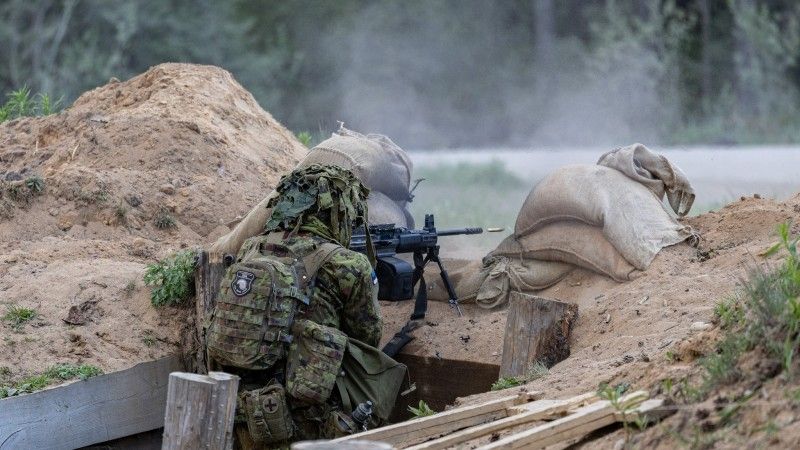
Photo. Sõdurileht / Facebook
Andrius Kubilius, European Commissioner for Defence and Space, has published a document presenting arguments for the creation of a European Security Council. He also addressed the question of a common European army.
The Lithuanian politician’s document concerns changes that have taken place in European Union countries in recent months regarding collective security. The analysis raises questions about how the Old Continent will position itself in light of the recent publication of the U.S. National Security Strategy. It also does not shy away from uncomfortable questions regarding Europe’s defence capabilities.
According to Kubilius, achieving European defence independence is inevitable. He adds that further postponing important and difficult decisions—which have been discussed at least since 2017—this time could have tragic consequences for millions of people. This is a pivotal moment for Europe’s independence in defence, he says, paraphrasing the words of European Commission President Ursula von der Leyen.
What about the US?
Kubilius argues that Europe has had to (and still must) navigate American geopolitical ambiguity. He refers to Max Bergman, an analyst in the Europe, Russia, and Eurasia program at the Washington think tank Center for Strategic and International Studies (CSIS), who notes that the U.S. is now urging Europeans to take stronger responsibility for their own defense, despite previously resisting European initiatives aimed at strengthening European defence capabilities.
„The United States has been the greatest opponent of integrated European defence, of any EU-led defense initiatives, or of creating a European pillar within NATO. This leaves Europe out on a limb,” Bergman recently wrote, illustrating a certain inconsistency in the American approach in light of the recently published U.S. National Security Strategy. On one hand, the Pentagon document expresses concern over a more united European Union; on the other, it gives Europe more leeway to strengthen its own defences.
A critical view of Washington’s actions does not equate to rejecting the need for continued European-American cooperation. Kubilius emphasizes that transatlantic relations remain a „cornerstone” of European security, aligning with remarks by NATO Secretary-General Mark Rutte and Polish Defense Minister Władysław Kosiniak-Kamysz. At the same time, the Lithuanian politician stresses that this does not mean Europe should expect the U.S. to take responsibility for ensuring the continent’s security. He recognizes that the time has come for Europe to take care of its own defence rather than rely on others.
The EU and its security
As the EU Commissioner for Defence notes, in recent months the European Union has accomplished more in the field of its own security than in several previous years. He specifically mentions the 2025 ReArm Europe program, including the SAFE instrument. „European defense independence and strength has become a clear strategic priority for the European Union,” he said, also acknowledging the significant increase in European countries« defence spending.
Key questions, according to Kubilius, concern whether merely increasing spending will be enough to ensure Europe’s defence readiness. Does the fact that EU countries« defense expenditures in 2025 exceeded Russia’s by $100 billion mean that NATO’s European component is ready for a potential confrontation with Russia? Kubilius argues that a positive answer would be naive, given that Russia possesses a battle-tested army—something European armies cannot claim. „Increasing defense investment alone does not solve all the critical problems related to our defense readiness,” the politician states, drawing on critical commentary by Max Bergman.
„European discussions focus almost exclusively on financing, rather than the enormous structural problem: the fragmentation of the European defense landscape into at least 25 separate armed forces. Simply put, these forces are not structured to defend Europe. It is good that Europe is ambitious in financing, but it must also be ambitious in reforming and integrating Europe’s armed forces,” the CSIS representative observes realistically.
The analysis identifies three essential pillars of European defence readiness: material, institutional, and political. „If any of these fail, our entire defence readiness fails,” the document states.
According to Kubilius, European states« efforts so far have focused almost exclusively on the first pillar. Questions remain: how to organize defence on the European continent if the U.S. limits its presence? How to prepare for „fighting as Europe” and creating a „European NATO pillar”? How to mobilize political will to deter, defend, and, if necessary, fight? How to defend citizens« „hearts and minds” against Russian attempts to undermine political will to defend our societies? These questions have not yet been fully answered.
Joint European army?
The document then addresses a highly controversial topic: the recurring public debate over creating a common European army. According to Kubilius, Europe is now in a situation where such an idea deserves serious consideration, primarily due to the current fragmentation that hampers real effectiveness—especially if the U.S. Army withdraws from Europe.
„Qualitative improvement will only happen if our institutional defense readiness is fundamentally transformed and unified at the EU level. To understand why, let us ask an obvious question with an easy answer: would the United States be militarily stronger if it had 50 state armies, 50 sovereign state-level defense policies, and 50 defense budgets?” the EU politician rhetorically asks, adding commentary from other analysts critical of the current situation.
„Given that NATO countries in Europe have 1.86 million active soldiers, it is striking—if not embarrassing—that the withdrawal of fewer than 100,000 U.S. troops could create a strategic vacuum,” he writes, citing Max Bergman and Otto Svendsen. They argue that Europe „must have its own pan-European armed forces of at least 100,000 soldiers, which could be mobilized and deployed to any region of Europe. (…) Such forces would not replace national armies but would complement them, providing added value currently provided by U.S. forces stationed in Europe.”
Specific solutions
Without going into treaty details, the article notes several proposals that are likely to be implemented faster and more easily gain approval from most EU countries, which, as Kubilius rightly notes, prefer to focus on developing their own defence capabilities.
Since the European Commission, according to Kubilius, is not capable of serving as a platform for strategic debate, informal leadership formats are increasingly playing a role. Examples include the E5+ and G5+ groups, where representatives from countries such as Poland, Germany, France, Italy, the U.K., and Spain meet (for example, to coordinate military aid for Ukraine or cooperation with the U.S.). Other similar formats are being considered.
One proposal is to revive the idea of a European Security Council, which, according to Kubilius, could consist of permanent members (E5: Germany, France, Italy, Spain, Poland), rotating members, and EU institutional representatives.
„It is clear that the European Security Council should be more than just a crisis management instrument; it should also serve the highest coordinating role during peacetime or defense readiness, to ensure material defense preparedness—for example, implementing the 2030 Defense Readiness Action Plan,” the proposal reads. Other proposed responsibilities include coordinating policies to reduce fragmentation in Europe’s defense industry, developing pan-European defense projects, designing the „European NATO pillar,” and integrating Ukraine’s defence potential with the EU.
„It is hard to imagine that in the event of military aggression, crisis management would be handled by traditional EU institutions based on the consensus of 27 member states. The European Security Council must have a pre-authorized mandate to act without restrictions as the EU’s highest coordinating and decision-making body, with decisions subject to ex post approval by the Council. Relations between the chairs of the European Security Council, the EU Council, and the European Commission during such a crisis should be more precisely defined in a special EU regulation on military crisis management,” the text concludes—offering a good summary of the idea. The road to implementing it is long, though certainly shorter than the path toward a common European army, as Kubilius envisions.


