












- WIADOMOŚCI
- KOMENTARZ
Between Trump and Netanyahu: trust, but verify

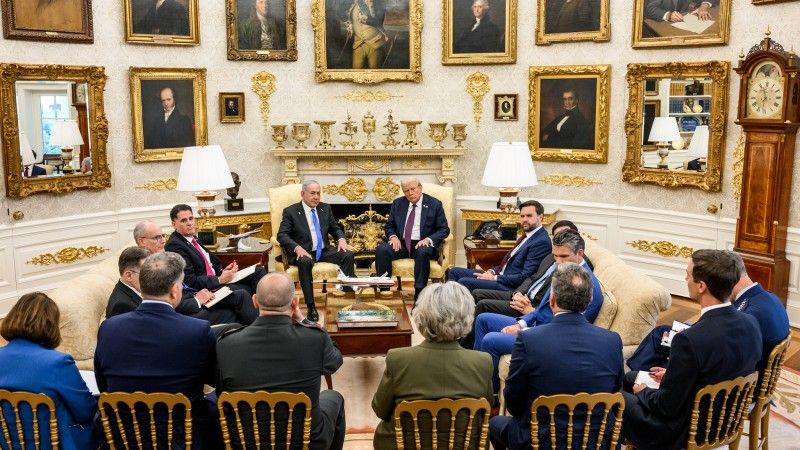
„You can be a little bit nicer, Bibi, because you’re not at war anymore” said Donald Trump during his historic Knesset address. He was just the fourth U.S. president to speak before the Israeli parliament.
The same day, Benjamin Netanyahu was wery warm in his assessment of the nature of the Israeli-American bond, as he hailed Donald Trump as „the greatest friend Israel has ever had in the White House”.
But looking back at the Trump–Netanyahu relationship, it wasn’t a bed of roses - more of a power struggle. The two leaders have a complicated history of ups and downs, but somehow it led to the solution awaited by many - the Gaza peace deal. The future of the „New Middle East” envisioned by the American president depends heavily on his personal relationship with his Israeli ally.
From the ideological point of view, there shouldn’t be tensions between them. Unwavering support for Israel is an important part of the MAGA agenda. During his 2024 campaign, Donald Trump was vocal about helping Israel defeat Hamas once and for all. In September, during the Israeli-American Council summit in Washington, D.C., the Republican candidate called himself „Israel’s protector” and warned against voting for his rival, Kamala Harris. He argued that if elected, Harris would contribute to the annihilation of Israel.
While the Democratic candidate - and sitting vice president - was more outspoken about the Gaza humanitarian crisis, Trump firmly stood on the position of full support for Israel without any further conditions. Without any doubts, he had the upper hand over any Democratic opponent. The Republican Party was more unanimously pro-Israel (according to the Gallup poll, in June 2024, 76% of Republicans approved Israeli military actions in Gaza), while Democrats were more divided (23% of Democrats were supportive of Israel’s strategy in Gaza). A more accepting stance toward Netanyahu’s actions drew criticism among the pro-Palestinian faction of the party - that’s how the „Genocide Joe” moniker was born.
But before October 7, the situation was quite different. Trump was disappointed with the Israeli prime minister. After contesting the 2020 election loss to Joe Biden, he couldn’t forgive Netanyahu for his congratulatory message to the new Democratic president - sent just after the American media called the election. In Trump’s zero-sum game approach, it was regarded as political treason.
The renewed relations between the two leaders after the 2024 election could have had a rocky start. But October 7 changed everything. After months of criticizing Biden and Harris on Middle East policy, Trump knew exactly who the true enemy was - and for him, it wasn’t just Hamas. It was also what he saw as a failed strategy of the previous administration -a strategy that tried to reach a deal benefiting both Israel and Palestinian statehood aspirations. The Democratic plan couldn’t be a good fit for the new president, who promised to protect Israel. That’s why Netanyahu became - again - an important ally. Not only in speeding up the peace process but also in creating a legacy for the American leader who wants to go down in history as a president of peace.
It was an ambitious plan. Trump started his second term with two major conflicts - in Ukraine and in Gaza - the second one with a fragile ceasefire negotiated by both the outgoing and incoming administrations. He wanted success on all fronts from the start. Netanyahu, however, preferred to conduct a stress test. That’s why the ceasefire didn’t hold -but Trump’s support for Israel remained strong.
Even though the president’s image as a firm supporter of Netanyahu’s government seemed to worsen, the world was appalled by the images of the humanitarian catastrophe in Gaza. At the same time, Trump released an AI-generated clip of the „Riviera of the Middle East.” It presented the Gaza Strip transformed into a luxury resort, symbolizing his vision of postwar reconstruction. Some regarded it as a joke, some as a benchmark, others as a policy blueprint. But public opinion - both in the U.S. and in Europe - had doubts about how realistic it was.
Frictions aside, Netanyahu was the first foreign leader to visit the White House -a clear indication that Trump wanted to reaffirm the American-Israeli alliance.
See also 

During the first month of his second term, it seemed Trump had more luck with resolving the war in Ukraine. After a rift in the White House, he built leverage over Volodymyr Zelenskyy and rekindled his relationship with Vladimir Putin, trying to use the carrot-and-stick method to achieve a ceasefire. Trump aimed to act as an impartial moderator - something he didn’t even attempt in the Gaza conflict. There, he wholeheartedly sided with Israel, even when Netanyahu tried to pressure him into specific decisions. The tipping point of this stress-test diplomacy was an attack on Iran’s nuclear facilities.
It is said that Trump wasn’t informed well in advance and Netanyahu acted on his own. It was a gamble -but with an enormous prize: tightening ties with Washington, annihilating Iran’s nuclear program, rising again as a regional superpower, and defeating an Axis of Evil nation. It could potentially serve as a „get out of jail free” card for a prime minister suffering from a negative public image. The sole condition was simple: Trump had to join him. And he did. Even though Trump campaigned on ending American involvement in foreign wars, when it came to Israel, such rules didn’t apply. For him, it was a risky situation too. His MAGA base wasn’t on board with the idea of intervention - and, with midterms approaching, it could become a blow to the Republican Party.
This dual gamble brought the leaders closer, as they came to understand they needed one another. But the stress-test diplomacy from the Israeli side prevailed: Trump was caught off guard by the Israeli attack on Syria and immediately called Netanyahu to rectify the situation. It was more of an action - reaction game than a stable alliance. In the name of the holy alliance between Israel and the U.S., Trump was willing to play - and wait for the perfect opportunity to advance his vision.
The window of opportunity opened when Netanyahu attacked Qatar -a close U.S. ally. Qatar was among the Gulf states where Trump paid his first formal visit as a new head of state. It was the moment he had waited for. Reading The Art of the Deal was enough to understand why. He sought leverage and a stronger position among Gulf allies. That way, he could negotiate with Israel from a position of strength. Netanyahu couldn’t stress-test him any longer without consequences. The American leader - for whom communication strategy is at the same time diplomacy - used the power of the picture and released one depicting Netanyahu during his apology call to the Qatari leader. For Trump, it was regaining control he occasionally lost in their relationship. But he didn’t leave Netanyahu defeated or humiliated. On the contrary - during his Knesset address, Trump stressed the prime minister’s role in the peace process and offered him his happy ending, claiming the victory of Israel.
What’s ahead? The future of the New Middle East depends on Netanyahu’s conviction about the potential political gains from betting on Trump’s vision. For the American president, keeping Netanyahu’s ambitions in check is the cost of his greatest political triumph of the second term. With his eyes on next year’s Nobel Peace Prize, he won’t let the peace slip away.
Author: Magdalena Górnicka-Partyka


