












- ANALIZA
- WIADOMOŚCI
Bogs on guard of Europe. New NATO weapon

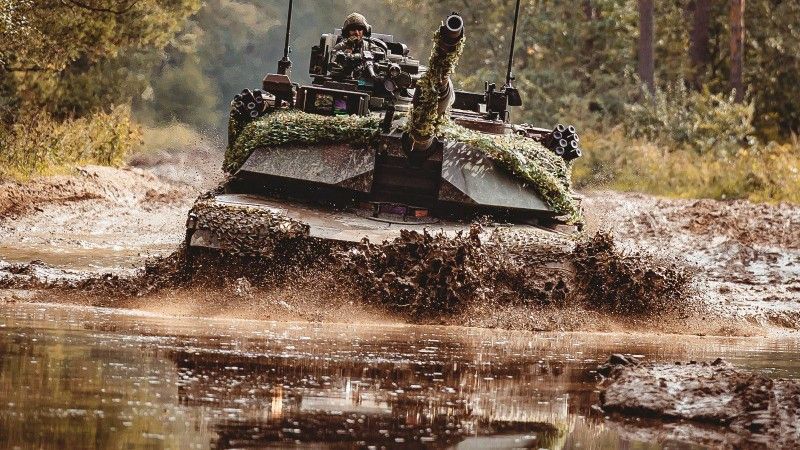
Photo. Młodszy chorąży Aleksander Perz/18. Dywizja Zmechanizowana
Experiences from the war in Ukraine have shown that wetlands can be a valuable ally in the fight against Russia. Bogs create terrain impassable for hostile forces. At the same time they are an ally in limiting climate change – they effectively absorb carbon dioxide from the atmosphere and help fight drought. Now not only scientists, but also politicians, are beginning to see the possibility of dual use of bogs to achieve two goals of the European Union – improving resilience and slowing climate change.
Experts from various European countries point out that re-wetting degraded peatlands can bring two benefits – support climate action and improve a country’s defense. They emphasize that in recent years the priority has shifted from spending on climate and transformation to spending on armaments. As Prof. Hans Joosten from the University of Greifswald, who specializes in the study of peatlands and paleoecology, said, currently the two greatest threats to Europe are Russian imperialism and anthropogenic climate change. This approach therefore provides funds for environmental protection and emissions reduction while maintaining defense spending.
Wetlands to the Rescue
Using wetlands for defensive purposes is nothing new – the Ukrainians used such a strategy at the start of the Russian invasion in March 2022, when they destroyed a dam on the Irpin River north of Kyiv, flooding the surrounding areas and causing Russian military equipment to get stuck in the mud. What would be new, however, is actively restoring natural peatlands to stop potential hostile forces.
About half of the peatlands located within the territory of the European Union are degraded. Bogs and swamps have been drained for hundreds of years, mainly for agricultural purposes, to gain land for cultivation. Bogs are those peatlands where the peat-forming process is active, which requires the substrate to be properly saturated with water. Plants growing on bogs, through photosynthesis, take CO2 from the air and accumulate carbon. When they die, they form peat.
Thanks to this process they are the most efficient carbon store in the world – they cover only 3 percent of the land surface, but store at least twice as much carbon as forests, which cover 30 percent of the land. Additionally, they improve the microclimate and provide water retention. And the stopping of enemy armored vehicles. It is estimated that wet areas can withstand loads from military vehicles 75 percent lower than drained areas. Unfortunately, after drainage peat decomposes, emitting CO2 that had been „stored” in the peatland for thousands of years. Around 12 percent of the world’s peatlands are currently degraded. They are responsible for about 4 percent of anthropogenic carbon dioxide emissions annually. In Poland about 85 percent of peatlands have been degraded.
Dual Use
In the European Union emissions from drained peatlands amounted to about 124 million tons of CO2eq in 2022, roughly the same as the entire Netherlands emitted. Experts say this value may be underestimated. After re-wetting, peatlands stop emitting carbon dioxide, and after some time begin to absorb it again. Among other reasons this is why the EU requires peatland restoration under the Nature Restoration Law. Member states must restore 30 percent of degraded peatlands by 2030 and 50 percent by 2050. Governments have until September 2026 to develop plans to implement these goals.
Some member state governments are considering whether peatland restoration could serve two purposes at once. Finland and Poland told Politico that they are currently examining the possibility of peatland renaturation to simultaneously combat climate change and defend borders.
Scientists from various countries confirm that on NATO’s eastern flank peatland restoration would be a relatively simple way to achieve both goals. „It is definitely feasible,” Politico quoted Prof. Aveliina Helm, who works on renaturation at the University of Tartu in Estonia. „We are currently developing our national renaturation plan, like many other EU countries, and I see great potential to combine these two goals,” she added.
This is a win-win situation that allows you to achieve many goals at once, also confirmed Tarja Haaranen, Director General for Nature at the Finnish Ministry of the Environment.
Peatlands - A New Means of Defence for NATO Borders
It so happens that most of the European Union’s peatlands are located on NATO’s border with Russia and Belarus. They stretch from the Finnish part of the Arctic, through Estonia, Latvia and Lithuania, to eastern Poland. When a peatland is water-saturated, and, moreover, preferably covered with forest - alder carr - it is impassable for heavy military vehicles. The idea of using re-wetted peatlands for defensive purposes is now being discussed not only by scientists but also by politicians.
A proposal to re-water peatlands in order to secure borders and protect the climate was already submitted last year by Major Pauli Aalto-Setälä, a member of the ruling National Coalition Party in Finland, addressing the Finnish government.
In Finland we have long used our nature for defense purposes. I realized that especially on the eastern border there are many excellent areas that can be restored – for the good of the climate, but also to make passage through them as difficult as possible, said major Pauli Aalto-Setälä, Finnish MP
According to Tarja Haaranen from the Finnish Ministry of the Environment, who will head a specially created working group, the ministries of defense and environment will start talks already this autumn about launching a pilot peatland renaturation project.
As Politico noted, the governments of the Baltic countries have so far shown little interest in this issue. Only the Lithuanian Ministry of the Environment said that renaturation of wetlands related to defense „is currently a subject of discussion,” without providing details. Meanwhile the Estonian Ministry of Defence and the Latvian armed forces informed that plans to strengthen borders under the Baltic Defence Line foresee natural obstacles, including peatlands, but do not include their renaturation.
Progress Made in Poland
In Poland discussions are underway between scientists and the Ministry of National Defence about using peatlands for defensive purposes. Scientists and activists have long tried to interest politicians in environmental protection on Poland’s border in this way. In January, a group of researchers led by Dr. habil. Michał Żmihorski, director of the Mammal Biology Institute of the Polish Academy of Sciences in Białowieża, was invited by military command to present a detailed plan for „using the natural environment as a means of border security.”
„During a very fruitful and long meeting with the general responsible for the Eastern Shield in January we quickly agreed that wetlands and wet forests are the best barrier against invading armies,” said Żmihorski. At the same time he criticized the idea of building a wall in the Białowieża Forest as part of the Eastern Shield: „the idea that total visibility helps in defence is wrong, because walls can be easily blown up and breached. That cannot happen with wetlands and dense forests.”
Dr. habil. Wiktor Kotowski, ecologist, professor at the University of Warsaw and member of the State Council for Nature Conservation, admitted that initial talks with the Ministry of Defence are promising.
„There were many misunderstandings and false beliefs, but overall we found that there are only synergies. The Ministry of Defence wants to recover as many wetlands as possible along the eastern border. This is also necessary from the point of view of restoring the natural environment and the climate.”, notes prof. Wiktor Kotowski
The use of natural barriers was mentioned in April this year by Cezary Tomczyk, Deputy Minister of National Defence: „we want nature to be our important ally (…) we want forests to be dense, so that natural obstacles are an element of the Eastern Shield and our defence.”
However, as Prof. Żmihorski told the Financial Times, there is still a „huge gap” between declarations and the actions of the Ministry of National Defence. When he presented the strategy for using nature for defensive purposes in July, ministry representatives „said they were very interested, but we did not see any actions on the ground.”
Is Restoring Bogs Easy?
If the area has not been completely drained, wetlands will fill with water within one or two years. Renaturation is a difficult process from an ecological point of view, but when it comes to water retention, stopping emissions and hindering passage – that is, defensive goals – it is quite simple and quick.
@ prof. Wiktor Kotowski
Professor Avelina Helm said that we have many wet areas that were drained but still exist. She added that if now we restore the water regime – we will fill in the drainage ditches that constantly dry them out and cause carbon dioxide emissions – it will be relatively easy to restore them to a more natural state.
The problem, however, is funds. At a time when Europe focuses on security and resources are allocated to defense, in some cases at the expense of transformation, scientists hope that acknowledging the military significance of bogs will accelerate their renaturation and secure unprecedented financial resources.
Currently obtaining permission to re-wet peatlands takes five years, and sometimes even ten, said Dr. Franziska Tanneberger, director of the German Greifswald Mire Centre, a research institute dealing with peatlands. She concluded that in the case of military actions there is a certain priority - one cannot wait ten years if we need it for defense purposes.

Who Else Needs Convincing About Bogs?
There is still a social group whose interests must be taken into account for peatland restoration to succeed. The greatest anthropogenic threat to peatlands was and is agriculture, and farmers« protests are something both the European Commission and member state governments would prefer to avoid. That is why, at the moment, in both Finland and Poland, peatland renaturation projects will take place on land owned by the state treasury. Scientists remind that if renaturation is to bring truly measurable benefits, talks with farmers will eventually have to take place. Many peatlands are on private land – in Poland about 85 percent of bogs were drained.
This will not be achieved without involving agricultural land. We urgently need a program for farmers that will provide them with compensation for re-wetting drained peatlands – and not only compensation, but also the opportunity to earn from it.
prof. Wiktor Kotowski
There are plants that can be cultivated on bogs – e.g. reeds, which can be used in construction. However, currently the market for these products in Europe is too small to encourage farmers to undertake this activity.
Bogs And Beyond
Of course we still need traditional defence. This (peatland renaturation – ed. Energetyka24) is not intended to replace it, as noted by Dr. Franziska Tanneberger of the Greifswald Mire Centre.
Moreover, sudden actions, like Ukraine’s flooding of the areas around the Irpin River to defend Kyiv, while effective, have negative impacts on the environment and residents. They lost their homes due to the floods, and local species did not have time to adapt to the sudden change in habitat. Estonian professor, Avelina Helm said that although the process stopped the invasion of Kyiv, which was necessary (so there is no room for criticism here), it did however cause environmental damage.
Nonetheless, the member states of the European Union have an option Ukraine did not have, namely the chance for staged and thoughtful renaturation of their peatlands, taking into account the interests of all stakeholders: the military, farmers and nature.


