












- WIADOMOŚCI
East Front News #66: Poland to pardon volunteers fighting for Ukraine, nordic cooperation

East Front News is a weekly newsletter summarizing the past week’s most important events concerning security and the situation in the Central and Eastern Europe region. It includes original opinions and comments, along with key news items significant from a Polish perspective. If you would like to receive this newsletter, please sign up by clicking
Poland moves to pardon volunteers fighting for Ukraine
Polish citizens who joined Ukraine’s armed forces without formal permission will not face punishment under a draft bill now being considered by parliamentary committees on defence and justice. The proposal recognizes that, given Russia’s aggression, such actions should not be treated as violations of loyalty or defence duties toward Poland. The amnesty would cover offences committed between February 2022 and December 2026, provided the volunteers fought within units subordinate to Ukraine’s legitimate authorities recognized by Warsaw.
The bill reflects Poland’s political and moral alignment with Ukraine’s struggle, while maintaining a legal boundary against mercenary activity. Volunteers will be required to inform the Ministry of Defence about their service details, which will remain classified. This move institutionalizes a pragmatic balance: acknowledging civic solidarity with Ukraine while preserving state oversight of citizens« foreign military service. It may also signal Warsaw’s intention to formalize and monitor Polish involvement in Ukraine’s defence efforts amid ongoing regional security tensions.
Poland to receive fuel from NATO
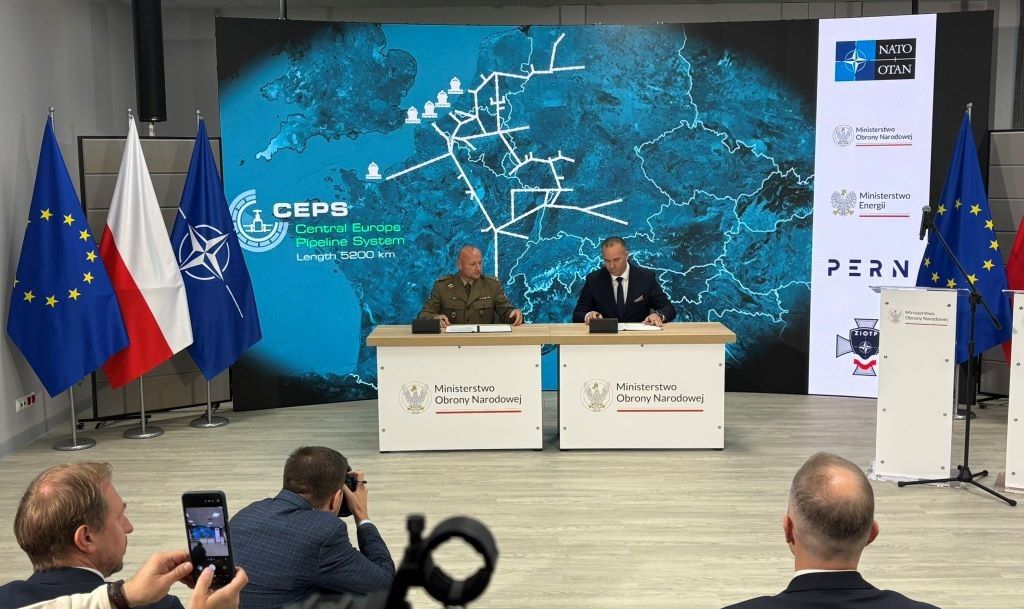
A preliminary agreement was signed in Warsaw to connect the fuel system operated by PERN S.A. to NATO’s fuel pipeline network and to build fuel storage facilities to serve the Alliance’s armed forces. In the presence of the deputy minister of defence, a framework cooperation agreement was signed between the NATO Investment Unit (Zakład Inwestycji Organizacji Traktatu Północnego, ZIOTP) and PERN to carry out a programme to expand Poland’s fuel infrastructure and link it to NATO’s pipeline system.
„In December 2024, NATO’s strategic commands — SHAPE and ACT — announced a list of investments. On that list were projects concerning Poland’s connection to the wider NATO pipeline system. The past months have been devoted to working out the details — among ourselves and within the government. I am proud to announce that NATO Headquarters, specifically the NATO Resource Office, has granted Poland funds to plan and design the investment I’ve mentioned. Under our agreement, the investment will be planned and designed by the NATO Investment Unit,” said Deputy Defence Minister Cezary Tomczyk, stressing that the project will be implemented over a number of years.
Poland is to blame for everything": converging Russian and German narratives
Recent statements by Vladimir Putin and former German Chancellor Angela Merkel reveal a concerning alignment of narratives portraying Poland as the source of Europe’s problems. While Putin’s comments at the Valdai Club revived the old Soviet trope of Poland as the provocateur of 1939, Merkel suggested that Polish and Baltic opposition to dialogue with Moscow in 2021 worsened East–West relations and indirectly paved the way for war. Though expressed differently, both narratives shift responsibility away from Moscow and Berlin — and toward Warsaw.
This rhetorical convergence mirrors historical patterns. From tsarist depictions of Poland as a „hotbed of revolution” to Soviet-era claims of an „unruly satellite,” Russia has long framed Poland as an obstacle to Eurasian stability. Today, this framing is being echoed, subtly, in parts of German political and media discourse, where Poland’s warnings about Russian aggression were once dismissed as „Russophobia.” The overlap between German self-justification and Russian propaganda risks legitimizing a distorted vision of Central Europe — one in which Poland becomes the scapegoat for the failures of others. For Warsaw, countering this narrative will require active historical diplomacy and stronger communication with Western partners.

Divorce or myth? German-NATO sky under US-made sea shield
Raytheon Technologies has just announced that its SPY-6(V)1 radar has been chosen by the German government to equip F127 frigates. Thus, the US-Germany defence industrial relationship stays strong, particularly in the area of air and missile defence.
Recently, there has been a lot of discussion on decoupling between US and Germany in defence sector in addition to other sectors. In particular, an article by Politico with a list of planned German defence procurements for this and next year was titled „Germany EUR 80B rearmament sidelines US weapons”. The authors note than less than 10 percent of the planned procurements for this and next year are planned for US-made systems,
The truth is more complex, however. It is true that currently the government in Berlin may be less inclined to buy American weapons, also for political reasons. However, stating any divorce between US and German defence industries is premature to say the least, though certainly many, including France, would like to see it.

European banks open up to Europe's rearmament: private capital joins the defence effort
Europe’s rearmament drive is increasingly backed by the financial sector. Leading banks across the continent are loosening restrictions on lending to defence industries, lured by prospects of long-term profitability and political stability. Governments, in turn, view private capital as a vital supplement to strained public budgets. France is taking the lead — BNP Paribas and Crédit Agricole have eased limits on financing „controversial weapons,” unlocking billions for advanced defence technologies. Germany and the Netherlands are following suit through initiatives like the Defence, Security & Resilience Bank, designed to raise over €100 billion in funding through AAA-rated bonds.
Poland is also expanding defence financing, though constrained by its relatively small banking sector and regulatory burdens. The broader trend marks a shift in Europe’s strategic thinking: security has become an investment priority. With the EU’s ReArm Europe plan and national reforms aligning ESG rules to permit defence financing, a new public–financial–industrial ecosystem is emerging. This „war economy” logic signals that Europe’s military renewal will increasingly depend not only on government spending, but on the active participation of its banking institutions.

Czech parliamentary elections and their implications for Poland
On October 4-5, 2025, parliamentary elections were held in the Czech Republic, where the ANO party, led by former Prime Minister Andrej Babiš, won with about 34.6 per cent of the vote. The outgoing centre-right coalition Spolu received 23.3 per cent, marking a shift in the balance of power on the Czech political scene. Babiš has declared his intention to maintain the Czech Republic’s membership in the European Union and NATO, although he may limit the scope of support for Ukraine.
For Poland, these results mean a potential tightening of relations with a government that is more pragmatic but also more eurosceptic in its outlook. However, tensions may arise in cross-border issues such as environmental or energy matters, including past disputes over the Turów coal mine. From Warsaw’s perspective, it will be crucial to maintain cooperation within the Visegrád Group and a joint stance on Eastern policy and regional security. The new political order in Prague may also influence the Czech approach to EU climate and energy regulations. A possible shift in the Czech government’s priorities could force Poland to adjust its economic and diplomatic strategy toward its southern neighbour.
Poland–Nordic diplomatic and security cooperation intensifies
This week marked a notable intensification of Poland–Nordic relations across diplomatic and security domains. On Monday, top Polish diplomatic officials held talks in Warsaw with their Finnish and Swedish counterparts, reinforcing a united front for tightening sanctions against Russia and advancing the use of its frozen assets to aid Ukraine.
Meanwhile, growing military cooperation was underscored by the opening of Camp Jomsborg in Lipa, Poland, a joint Polish–Norwegian training facility for Ukrainian soldiers. Additionally, Norwegian F-35s, along with 100 personnel, arrived in Poland on Monday as part of a NATO air policing mission.
Together, these developments point to the further consolidation of an informal Poland–Nordic diplomatic and defence coalition, underpinned by shared strategic interests and a common perception of the Russian threat, potentially paving the way for more ambitious joint initiatives in the near future.
Authors: Aleksander Olech, Jakub Palowski
If you would like to receive this newsletter, please sign up by clicking.
East Front News is a weekly newsletter and article on Defence24.com summarizing the past week’s most important events concerning security and the situation in the Central and Eastern Europe region. It includes original opinions and comments, along with key news items significant from a Polish perspective.


