












- ANALIZA
- WIADOMOŚCI
Europe is buying weapons. But can it fuel them?

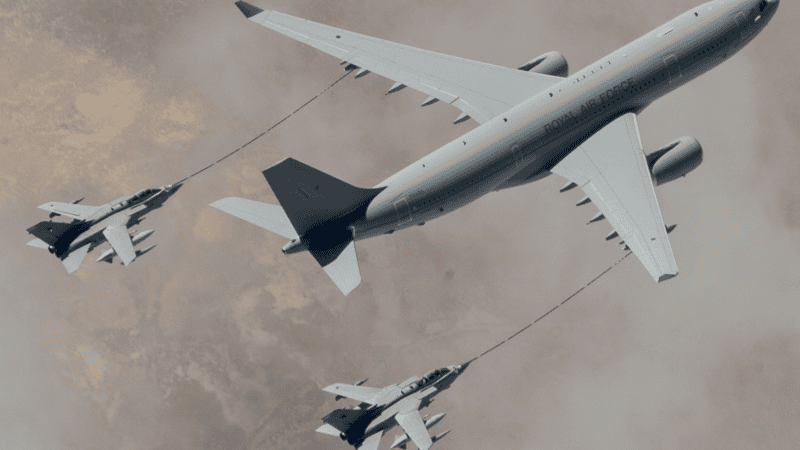
Europe is investing in ammunition, missiles, drones, tanks and combat aircraft. Much less attention is paid to something far more basic: fuel. A new NATO Energy Security Centre of Excellence study shows that the Alliance’s ability to sustain a major conflict will depend not only on how much equipment Europe can manufacture, but also on whether it has the resources, refining capacity, stocks and logistics required to keep that equipment moving.
NATO Europe’s armed forces currently consume an estimated 3.7 million tonnes of military fuel annually, rising to around 5.2 million tonnes when North American forces stationed in or transiting through Europe are included. This represents only around 1% of total liquid-fuel consumption in the region. The problem is not the overall volume, but what the military needs and when it needs it.
Aviation is the most vulnerable part of the system. Jet fuel represents around 60–72% of the military fuel mix in peacetime, rising to 75–80% during war. Yet Europe has only around 49 days of jet-fuel stock cover, compared with approximately 120 days for oil and petroleum products overall. Military aviation therefore depends most heavily on precisely the fuel for which Europe has the smallest buffer.
The second problem is dependence on external suppliers. NATO Europe obtains around 27–30% of its jet fuel from outside the region, while one supplier already accounts for 36% of external imports and the three largest for around 65%. At the same time, 16% of NATO Europe’s conventional refinery sites and 7% of refining capacity have disappeared since 2015. Production is becoming concentrated in fewer and larger refineries, which means that every major facility becomes a more significant point of failure.
The report modelled 252 possible futures, representing around 6,000 world-years of civilian and military demand, supply disruption and conflict. In a full-scale Article 5 scenario involving substantial North American reinforcement, around 45% of civilian jet fuel would have to be redirected immediately to military requirements, potentially rising to 60% by 2035. This is the point we often overlook: war would not create a separate military fuel market. Armed forces and civilian economies would compete for many of the same resources.
See also 

The problem is no longer theoretical. The current conflict in the Middle East is already affecting the civilian fuel market. Disruption to Middle Eastern supply has contributed to Europe facing a projected 510,000-barrel-per-day jet-fuel deficit in the fourth quarter of 2026, while inventories in the Amsterdam-Rotterdam-Antwerp hub have fallen to their lowest level in seven years. Diesel prices have also reached record levels as supplies from the Middle East and Russia have been disrupted.
We are spending billions on new weapons and asking how quickly European industry can produce missiles, ammunition, drones and aircraft. At the same time, we risk forgetting the simplest element of warfare: these systems need fuel. Europe therefore needs not only weapons, but also resources, refineries, strategic stocks, pipelines, ports and protected supply chains. The Middle East is already showing what happens when civilian markets begin to lose access to sufficient fuel. In a major war involving NATO, the pressure would be incomparably greater.
Full book available here


