












- WIADOMOŚCI
- ANALIZA
Expert explains what counts as help under Article 5

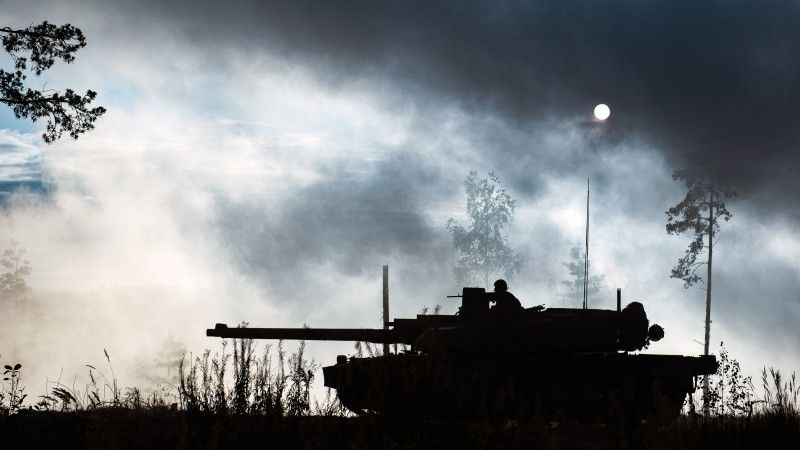
Photo. LCpl Craig Williams / Ministry of Defence / OGL v1.0
Since Russia’s full-scale invasion of Ukraine, Article 5 of the North Atlantic Treaty has been invoked and discussed in every possible context. How exactly should its provisions be interpreted? Is it a guarantee of our security?
How exactly is Article 5 of the North Atlantic Treaty worded? Do its provisions guarantee assistance from all members to an attacked ally? Is there any penalty for failing to provide assistance? Is expulsion from NATO possible? To answer these questions, we must first take a close look at the article itself.
What exactly does Article 5 say?
The text of Article 5 of the North Atlantic Treaty reads as follows:
”The Parties agree that an armed attack against one or more of them in Europe or North America shall be considered an attack against them all and consequently they agree that, if such an armed attack occurs, each of them, in exercise of the right of individual or collective self-defence recognized by Article 51 of the Charter of the United Nations, will assist the Party or Parties so attacked by taking forthwith, individually and in concert with the other Parties, such action as it deems necessary, including the use of armed force, to restore and maintain the security of the North Atlantic area. Any such armed attack and all measures taken as a result thereof shall immediately be reported to the Security Council. Such measures shall be terminated when the Security Council has taken the measures necessary to restore and maintain international peace and security.”, the 1949 North Atlantic Treaty, or the Washington Treaty reads.
Article 5 and its fulfillment conditions
Looking at the original English wording of the article, we encounter a phrase that may raise some doubts, as it allows considerable room for interpretation. The key phrase is „such action as it deems necessary,” which should be understood as „taking such action as the state considers necessary.”
Does this mean that individual member states could decide to assist an attacked NATO member only through minor support, such as providing body armour or pallets of bottled drinking water, and thereby, in effect, fulfil their obligation under Article 5? This question was answered for us by international law expert Dr Mateusz Piątkowski of the University of Łódź, who stressed that Article 5 is a legally binding obligation on the states party to the North Atlantic Treaty. This means that a violation of it constitutes grounds for the international responsibility of the state in breach.
„Attention should be paid to the 1969 Vienna Convention on the Law of Treaties, especially Article 31, which provides for interpretation in good faith, in light of the »object and purpose of the treaty.« There are differing views as to whether the activation of NATO Article 5 automatically results in a decision to co-participate in an armed conflict and immediate entry into war. Such a radical decision may, however, be subject to additional domestic requirements. For example, automatic participation in war is problematic in light of the US Constitution, which grants Congress exclusive powers in this respect — Article I, Section 8. This also influenced the wording of Article 5 during the negotiations,” Dr Piątkowski told us, before adding his interpretation regarding the „minor assistance” mentioned above.
„The delivery of bottled water is an extreme in the opposite direction. In my view, such action would not constitute performance of the treaty in good faith. NATO, however, has a clear defensive purpose and is oriented toward all actions permissible to achieve that purpose. This is precisely the »object and purpose of the treaty.« In conclusion, the delivery of bottled water or other humanitarian aid would constitute a violation of obligations arising from the North Atlantic Treaty,” the expert confirmed.

Article 5 and penalties for failing to provide assistance
Given the existing provisions, the question arises as to whether NATO can in any way sanction insufficient assistance by a member state. What about expulsion or suspension of membership rights?
As Professor Aurel Sari of Exeter points out, the issue of expulsion from the North Atlantic Alliance is not straightforward. According to Prof. Sari, unlike the Charter of the United Nations — Articles 5 and 6 — the Statute of the Council of Europe — Article 8 — or the Treaty on European Union — Article 7 — the North Atlantic Treaty does not provide for the suspension of a member state’s rights or its expulsion from NATO.
Interestingly, the topic of suspension or even expulsion from NATO, which has recently returned to public debate in connection with Donald Trump’s threats toward Spain, is not entirely new. One example is Türkiye in 2019 and its actions in Syria, as well as Ankara’s 2016 purchase of Russian S-400 air defence systems.
„The issue of so-called rogue members in NATO has been debated for some time. While there is a withdrawal clause in the Treaty — Article 13 — there is no provision for expelling a member. In such a case, the general rules of treaty law would apply: Article 60(2) of the Vienna Convention on the Law of Treaties, which concerns a »material breach of a multilateral treaty.« This may lead to the termination of treaty relations between the »rogue member« and the rest of NATO,” Dr Mateusz Piątkowski concluded, noting that this is not equivalent to the collapse of the North Atlantic Alliance, although such a possibility could arise.


