












- WYWIADY
F-35s and new missiles: U.S. strengthens its nuclear response [INTERVIEW]

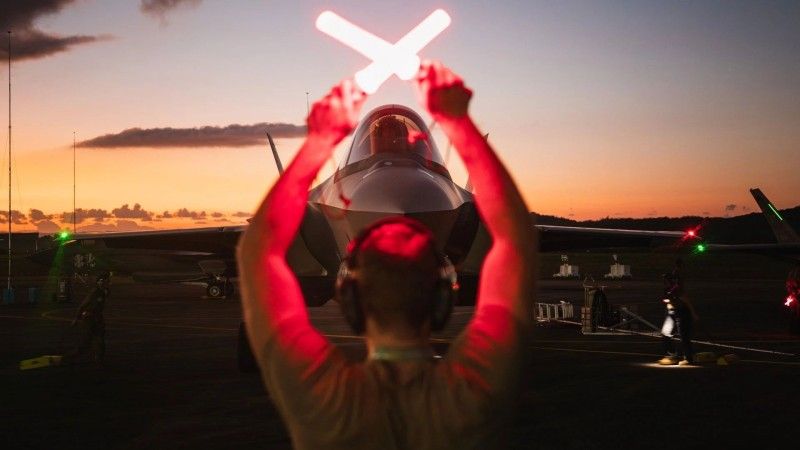
Photo. U.S. Air Force, via Department of War, public domain
“We can see U.S. red lines when it comes to nuclear sharing. Recent signals indicate that under Trump, the United States is more open to certifying Polish F-35As to carry U.S. nuclear weapons, but it still opposes stationing those bombs on NATO’s eastern flank,” Artur Kacprzyk of the Polish Institute of International Affairs told Defence24.
Why does Elbridge Colby want to expand U.S. options for the limited use of nuclear weapons? Could we see new weapons of mass destruction produced by the United States in the near future? When can we expect the publication of a new Nuclear Posture Review? These and other questions are addressed in editor Michał Górski’s interview with Artur Kacprzyk, a nuclear deterrence analyst at the Polish Institute of International Affairs.
Under Secretary of Defence for Policy Elbridge Colby is reportedly advocating changes to the current U.S. nuclear doctrine. What characterises that doctrine, and why does he believe it is insufficient today?
Artur Kacprzyk, Nuclear Deterrence Analyst, Polish Institute of International Affairs: In fact, Colby is not signaling a change in doctrine, but rather an expansion of options for the limited use of nuclear weapons. This concerns capabilities for a proportionate response to a nuclear attack on U.S. allies or on American forces deployed on their territory. An adversary could decide on such an escalation, particularly if it were losing a conventional conflict and wanted to reverse the course of the war. For example, it could use several warheads and threaten further attacks unless the war ended on its terms. The Americans would not respond by using their entire arsenal, because that would expose their own territory to the risk of a massive retaliatory strike.
That is why the United States wants to be able to retaliate with a small number of weapons while minimising the risk that the enemy would interpret this as the beginning of a larger attack. Such a strike would therefore be selective and would not cause large-scale civilian casualties. High precision would be important, and possibly also a relatively low warhead yield. The aim would be to deter further enemy nuclear attacks by sending the message: “We do not want escalation, but we will respond to it.”
The Americans have long possessed nuclear capabilities for a limited response, but they want to expand and improve them so that they can respond simultaneously in different regions. Increasingly, they have to take into account the possibility of a nuclear conflict not only with Russia, but also with China. There is also the threat posed by North Korea. All three countries are expanding their nuclear arsenals, including short- and medium-range forces — which the United States classifies as non-strategic. Although the United States itself has been rebuilding such options for several years, the challenges are continuing to grow.

Can the B61-12 aerial bombs carried by the F-35A and the W76-2 warheads currently be regarded as the principal pillars of U.S. non-strategic nuclear weapons? If so, would the announced changes automatically require work on new systems?
The Americans will probably develop additional non-strategic systems. Those already in service and those currently planned have both strengths and weaknesses, especially because adversaries’ ability to defend against them will also improve over time. Support is growing in Congress and among U.S. experts for two options.
One is an air-launched cruise missile for the F-35, which would have a better chance of penetrating Russian air defences than a bomb. Another option is a missile launched from mobile ground-based launchers. Thanks to that mobility, it would be harder to destroy than aircraft at their bases and could have an even greater range.
Supporters of these two systems argue that they could be introduced relatively quickly, even before 2030, because they would involve modifications of existing conventional missiles — for example, the JASSM-ER for the F-35, or ground-launched Tomahawk cruise missiles or Dark Eagle hypersonic missiles. It is also worth noting that the United States is already working on a new version of the former nuclear-armed sea-launched cruise missile, the SLCM-N, for multipurpose submarines. However, these missiles are not expected to enter service until the 2030s.
As for the W76-2 warheads, their introduction in 2020 was intended from the outset only as a temporary measure to fill gaps in U.S. capabilities. It was relatively easy to implement because it involved reducing the yield of existing warheads carried by Trident II ballistic missiles. Their unquestionable advantage is the high speed of those missiles, enabling a rapid response and making the interception of even a single warhead extremely difficult. They also have intercontinental range. The disadvantage is that these missiles are strategic nuclear delivery systems intended primarily for conducting a massive retaliatory strike. Their launch would also be readily detectable by early-warning satellites and radars. There are therefore concerns in the United States that Russia or China could interpret such a launch as the beginning of a larger attack and quickly respond with a major retaliatory strike.
Finally, it should be noted that U.S. strategic bombers could also carry out a precision retaliatory strike with bombs or low-yield missiles. However, it would take those aircraft a long time to reach their targets from bases in the United States. They would also be badly needed for conventional strike missions. This would, for example, severely constrain their potential nuclear use in Europe if a war over Taiwan were taking place simultaneously. The same would apply to submarines carrying the SLCM-N.

“Nuclear forces, the modernisation of our nuclear deterrent, is the most important initiative for the U.S. military,” Colby said during a recent U.S. Strategic Command deterrence symposium. What kind of modernisation was he referring to? Why is it necessary?
He was referring to replacing existing strategic nuclear delivery systems and their warheads with new ones. These are intercontinental-range forces, and therefore capabilities that are crucial to deterring a nuclear attack on the United States itself and responding to such an attack.
The strategic nuclear systems currently in U.S. service date back to the Cold War. The B-52 bombers entered service in the 1950s; silo-launched Minuteman III ballistic missiles in the 1970s; and AGM-86 air-launched cruise missiles and submarines armed with Trident II missiles in the 1980s. The B-2 appeared somewhat later, but even that aircraft has already been in service for almost 30 years.
Of course, all of these systems have repeatedly undergone modernisation and service-life extensions. But there are limits to this process: it either becomes costly and difficult — because of shortages of spare parts, for example — or the system’s architecture simply prevents further improvements to its capabilities.
In an interview with Defence24, Professor Andrew Michta said that the greater emphasis on low-yield tactical nuclear weapons stems from limitations in U.S. conventional capabilities. Do you agree with that assessment?
I do not. Colby and most supporters of this expansion clearly state that its purpose is to strengthen deterrence against nuclear attacks. Moreover, Colby presents placing the dilemma and risk of nuclear escalation on the adversary as an advantage of conventional defence and deterrence based on it — “deterrence by denial.” This is consistent with U.S. thinking over the past 30 years. The Americans drastically reduced their non-strategic nuclear forces after the Cold War and ceased to think of them as “tactical” weapons for use on the battlefield. They did not need as many of them because they had gained conventional superiority over every potential adversary.
Today, that U.S. conventional advantage is eroding significantly in the face of China’s military buildup and that of other adversaries. Nevertheless, the Americans want to halt that process through conventional rearmament, both their own and that of their allies. We can see particular emphasis on the latter in the U.S. concept of NATO 3.0. Another matter is that if the United States strengthens its short- and medium-range nuclear forces for the purposes of nuclear deterrence, this will also increase the potential utility of those capabilities in a conventional war. But there is currently no question of returning to the Cold War era, when the United States possessed thousands of non-strategic nuclear warheads.

How might Russia and China, the countries most directly concerned about U.S. nuclear capabilities, view these changes?
New U.S. nuclear capabilities certainly will not be welcomed by Russia and China, particularly if such systems are deployed in their vicinity. This is partly because they would make potential aggression against U.S. allies in Asia and Europe significantly more difficult. However, they would probably be even more concerned that such weapons would increase U.S. capabilities to conduct a rapid “disarming” or “decapitation” strike — that is, an attempt to deprive those states of their ability to retaliate with nuclear weapons by destroying their nuclear forces or eliminating their leadership.
Because of this latter issue, I have doubts as to whether the United States would decide to forward-deploy land-launched, medium-range nuclear missiles, should it develop them. The current U.S. administration, including Colby, frequently speaks about the need to build “stability” in relations with adversaries, including Russia. The deployment of such systems in Europe is even more uncertain because Europe is not a priority theater for the United States. Moreover, compared with the Indo-Pacific, distances to the most sensitive targets are shorter and missile flight times are correspondingly reduced.
All of this may have contributed to the recent cancellation of the planned rotational deployment of U.S. conventional long-range missiles in Germany, which had been announced under Joe Biden. We can also see U.S. red lines when it comes to nuclear sharing. Recent signals indicate that under Trump, the United States is more open to certifying Polish F-35As to carry U.S. nuclear weapons, but it still opposes stationing those bombs on NATO’s eastern flank.
The last official Nuclear Posture Review (NPR) was published on October 27, 2022, by the Joe Biden administration. Given the planned doctrinal changes, should a new NPR not be prepared? This is despite Colby having explicitly stated in the Senate — and also at the STRATCOM symposium — that the Pentagon does not plan to issue a new document.
I think the Trump administration should at least provide a clear summary of its nuclear policy. The purpose would be to communicate transparently with both adversaries and allies. Simply referring back to the 2018 NPR issued by the first Trump administration — in which Colby served — is somewhat insufficient. There is also relatively little about nuclear issues in the new defence and national security strategies. There have been more extensive statements on the subject by Colby and senior military officials, but the message would be significantly stronger if it came from the president or the secretary of defence — or at least carried their signatures. It is also possible that the absence of such a document or statement reflects significant differences within the administration on certain issues, such as whether new nuclear missiles should be deployed in Europe and Asia.


