












- KOMENTARZ
- WAŻNE
- WIADOMOŚCI
France fears drones from Belarus

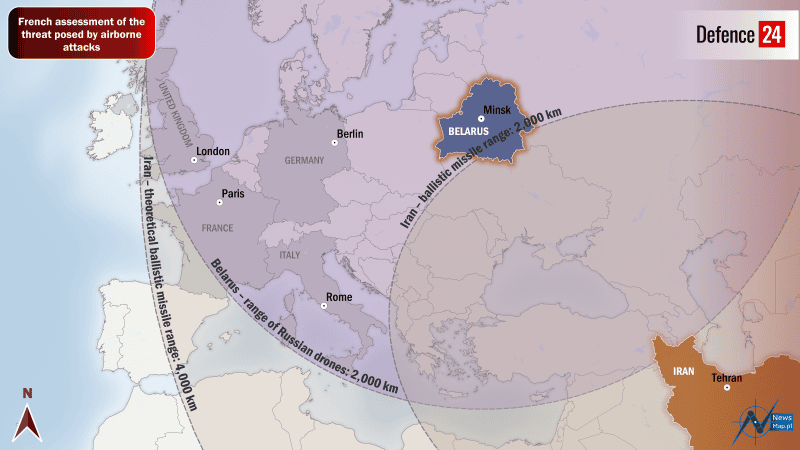
Russian drones in Belarus are no longer a problem exclusively for Ukraine and NATO’s eastern flank. At the Élysée Palace and within the General Staff, concerns are increasingly being voiced that modern warfare may reach France itself faster than previously assumed.
The French Republic is increasingly recognizing that modern war in Europe will not be based solely on open conflict conducted far from its territory. Unmanned systems are gaining importance, as they are relatively cheap, difficult to detect and allow for strikes below the threshold of open conflict.
From the perspective of Paris, the development of Russian drone capabilities is of particular importance, especially if reports about the planned launch of four control stations for long-range drones in Belarus are confirmed. In such a scenario, it is no longer only about the security of Ukraine or NATO’s eastern flank. The problem is that with the range of Shahed drones reaching up to 2000 km, part of Western Europe, including Germany and France, would also be within the reach of Russian systems.
This explains the significant concern in Paris, as the French perception of the threat from Russia and Belarus has so far been quite limited, and is now increasingly going beyond the traditional dimension of possible Kremlin actions. France has already reacted in the Baltic Sea, has sent Rafale aircraft to Poland, continuously maintains troops in Estonia and conducts exercises with Finland and Sweden. However, beyond land and maritime competition, the threat now also includes the use of unmanned systems.
Drones over France and the lesson from the Middle East
This is not, however, an unknown or new problem. France has for months been observing cases of unidentified drones appearing over its own territory, including near particularly sensitive sites such as military bases and infrastructure related to nuclear deterrence. Paris does not treat the drone threat as a distant scenario „only from the war in Ukraine”, but as a real challenge to its own security.
Additionally, France has already observed in the Middle East how important drone competition is today and how strongly it influences the way warfare is conducted. It was there that it became clear that unmanned systems are not just an addition to the battlefield, but one of its most important elements. From this perspective, the French vision of modern war is increasingly based on the assumption that the state must be prepared not only for classic missile strikes, but also for prolonged pressure exerted by unmanned systems, sabotage and activities conducted below the threshold of open conflict, that is, in simple terms, hybrid warfare.

Belarus and Russia as one threat
It is important that in French thinking the importance of Russian-Belarusian cooperation is increasingly visible. Paris sees that Belarus is no longer only a rear base for Russia, but is becoming an active element of Russian military activities, which increase Moscow’s room for manoeuvre against Europe. Information about the expansion of infrastructure for Russian drones, precisely on the territory of Belarus, is particularly important here.
This shows that Minsk is not only playing the role of a political ally of the Kremlin, but is beginning to play an increasingly practical role in the development of Russian offensive capabilities. From France’s perspective, this means that the threat to Europe is growing not only because of Russia itself, but also due to the deepening Russian-Belarusian integration.
Does France see the threat?
Interestingly, in this French understanding, the threat from Belarusian territory to Poland and the Baltic states is not strongly emphasized, although they remain on the front line of Russian and Belarusian hybrid attacks. Paris rather emphasizes its own vulnerability to long-range strikes, both from Russia and Belarus, as well as more broadly from countries such as Iran.
This shows that France looks at war not through the prism of NATO’s eastern flank, but through threats to its own territory and emerging new concerns. It is possible that the French Republic has already accepted that Poland remains one of the main targets of Russian hybrid warfare. Or it may assume that in the event of further escalation, it will be the largest European states that will be treated by Moscow as primary opponents.
US-Belarus thaw
France has begun to notice the thawing of US-Belarus relations, which from its perspective further complicates the situation in Europe. On the one hand, Minsk remains closely tied to the Russian military system. On the other hand, there are signals of political rapprochement with the United States, as evidenced by decisions regarding the lifting of sanctions and issues related to the release of prisoners. Such a picture is ambiguous for Paris, as French pragmatism dictates seeking benefits even with states that may be perceived as hostile by Eastern European countries.
This does not change the fact that, similarly to Poland, France increasingly sees how significant the impact of Russian-Belarusian cooperation is on European security. This is no longer only a matter of Minsk’s political dependence on Moscow, but a strong mechanism strengthening Russian military capabilities, increasing pressure on the entire northern and eastern flank of NATO and expanding the space from which actions against Europe, including France, can be conducted.
After Iranian missile tests and long-range Russian/Belarusian drones, in Paris there is no longer only


