












- KOMENTARZ
- WAŻNE
France is running out of missiles in the Middle East

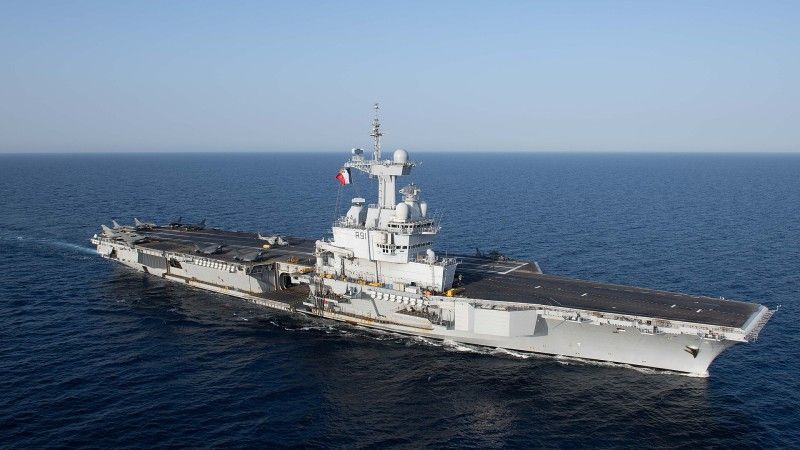
France is steadily increasing its military presence in the Middle East, yet it is becoming increasingly clear that the problem for Paris is no longer just the scale of tensions in the region, but its own financial, material and political limitations. As French media underline, ships require fuel, fighter jets are firing increasingly expensive missiles, and a €57 billion defence budget was not designed for such costly and prolonged engagement. Rising operational costs, limited stockpiles of weapons and President Macron’s political calculations mean that France will soon have to reassess its course.
France continues to maintain a defensive posture towards the confrontation between the United States, Israel and Iran. French armed forces currently maintain around 8,000 troops in the Middle East, supported by nearly 50 Rafale fighter jets and several naval vessels. The core of the naval presence is the aircraft carrierCharles de Gaulle, with around 26 Rafale jets and E-2D early warning aircraft, as well as two amphibious assault ships and several destroyers.
At the same time, France maintains permanent contingents in Djibouti (approx. 1,500 troops), the UAE (900), Iraq (1,200), Lebanon (800) and Jordan (300). The scale of involvement is therefore significant, but—crucially—its character remains defensive.
The key factor remains cost. At a time when every euro is critical for the French armed forces, it is becoming increasingly clear that the €57 billion defence budget was not designed for a conflict of this scale. Even the update of the military programming law is becoming a major challenge for France.
As General Marc Le Bouil, commander of French air operations (CDAOA), noted, „the level of engagement of the French air force is unprecedented”, and Rafale jets have already „destroyed dozens of Iranian drones and missiles”. French aviation is indeed operating on the front line of air defence for Gulf states, yet its actions remain limited to interception rather than offensive strikes.
What is more, France is now effectively protecting a large part of the Arabian Peninsula. Emmanuel Macron has recently met Saudi Crown Prince Mohammed bin Salman, underlining France’s solidarity and its commitment to defending Saudi airspace against missile and drone attacks from Iran.
Shortages today, shortages tomorrow
Rising operational costs, limited missile reserves and political concerns are pushing the French government to focus on defence and diplomacy rather than escalation. Over the past two weeks, dozens of drones have been intercepted with high effectiveness, yet the rapid consumption of missiles is raising concerns within the Ministry of the Armed Forces. Production delays—reaching nearly two years at MBDA—further complicate efforts to maintain stockpiles.
French Rafale jets have been actively involved in intercepting Iranian Shahed drones over the United Arab Emirates, implementing defence agreements between Paris and Abu Dhabi. Moreover, they have proven highly effective in neutralising incoming threats. However, this has come at a very high cost, as critics in France point out. Some media outlets state directly: „Paris is already running short of ammunition for its missions.”
The intensive use of air-to-air MICA missiles has rapidly depleted French stockpiles, exposing one of the key weaknesses of the French armed forces—limited reserves of advanced munitions—despite President Emmanuel Macron’s ongoing policy of a war economy.
These emerging shortages have raised serious concerns among French military officials, prompting the government to convene a crisis meeting to develop solutions that would allow France to maintain its capabilities over the longer term. This is particularly sensitive in the French context, where as much as 90% of military equipment is produced by the domestic defence industry.
Even such a strong industrial base is unable to respond quickly to the demands of a high-intensity conflict. This naturally raises an immediate question: what would happen if a similar conflict were to break out in Europe?
Despite the high level of tension in the region, Paris does not intend to take part in potential offensive military operations against Iran. The French posture remains defensive, focused on protecting partners and maintaining its presence in the region.
In addition, Paris has refused to participate in the US-led operation to secure the Strait of Hormuz, while its main offensive capabilities remain concentrated in the eastern Mediterranean.
The growing costs of modern military operations are also shaping French calculations. The conflict with Iran is becoming extremely expensive for the United States, and the French government clearly wants to avoid a similar scenario.
What about Ukraine?
There is another dimension to the problem. France has increasingly limited capacity to continue supplying Ukraine. Ukrainian air defence is under growing pressure from Russia, and the scale of missile and drone attacks exceeds the capabilities of existing systems. Under such conditions, it is essential to reinforce defensive capabilities with equipment that can be rapidly deployed and effectively used, both within existing structures and under conditions of ammunition shortages. Ukraine is now heavily reliant on Western support, including France.
One of the key problems is the depletion of ammunition stocks across multiple systems. Ukraine lacks missiles for two SAMP/T batteries, while the Crotale system has not been resupplied for over a year, despite still being deployed. In addition, production of missiles for the Crotale NG system has been discontinued, rendering the system ineffective without available munitions. This gap requires urgent compensation, primarily through increased deliveries of modern systems and a continuous supply of missiles.
Ukrainian officers point out that the main issue is the shortage of long-range systems capable of intercepting ballistic missiles. Currently, the southern part of the country lacks effective coverage. According to reports, Ukraine requires more systems such as the American Patriot or, to some extent, the Franco-Italian SAMP/T. The absence of these systems directly increases vulnerability to Russian missile strikes.
Increasing production of SCALP air-to-ground missiles and MICA NG air-to-air missiles remains a key element of French support. Demand from Ukraine is constant, yet current production capacity is insufficient. The issue is not only scale, but also the intensity of use. Mass production at higher volumes is needed immediately. Deliveries of additional aircraft and increased ammunition supplies are critical for Ukraine’s survival.
Paris on multiple fronts
It is becoming increasingly clear that France itself is struggling to maintain its stockpiles. Paris was not prepared for a war of this nature in the Middle East. The defence budget will have to be increased or supplemented from reserves (currently €750 million allocated for operational contingencies).
Each day of the US–Iran conflict leads to further depletion of French ammunition stocks and forces Paris to spend additional resources on a war that is not its own. France is present in the Middle East primarily to support its Arab partners and protect its interests. It is therefore likely that, once the conflict ends, Paris will seek to capitalise on this involvement through defence contracts. The states of the Arabian Peninsula will not forget French support in times of need.
Meanwhile, Ukraine is increasingly left to cope with its own needs. Although political support remains strong and President Macron continues to emphasise that Russia’s war is the greatest threat to Europe, tangible military outcomes remain limited. Kyiv needs weapons, ammunition and air defence systems. Today, it is even clearer that France does not have enough resources to simultaneously sustain high levels of activity in the Middle East and respond to Ukraine’s most urgent needs.
France will soon face a difficult decision: remain in the Middle East and maintain a defensive mission, or reduce its presence in order to preserve missile stockpiles and avoid further financial strain from what is essentially an American-led escalation. Paris will not easily forget Washington’s decisions. There is a growing risk that this situation will ultimately affect NATO security, particularly in Europe.


