












- WIADOMOŚCI
- WAŻNE
Germany as the United States’ key partner? Michta: Poland must take the initiative

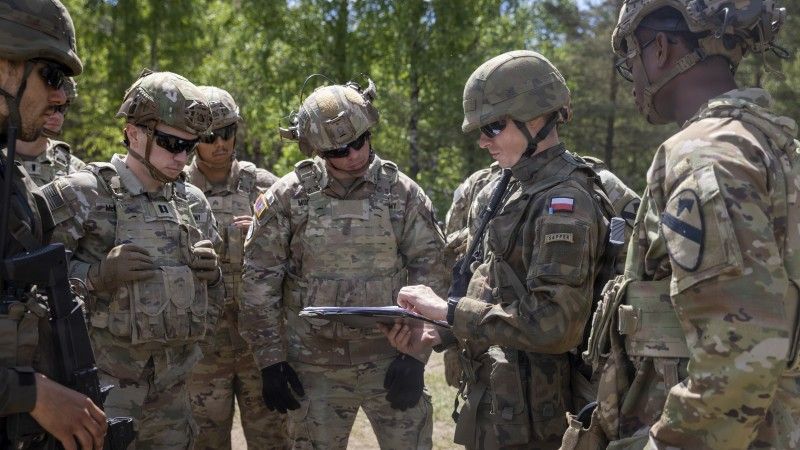
Photo. U.S. Army Reserve, Sgt. Ronald D. Bell
“We have a unique situation in Europe: Germany has the scale to build military leadership. France possesses nuclear weapons, but it is expeditionary-oriented. The British Army has shrunk to such an extent that rebuilding a single division will take it 10 years. Poland has every reason—and an urgent need—to lead this process, and in particular to build regional structures in the Nordic-Baltic region,” Prof. Andrew Michta told Defence24.
Is Poland capable and willing to play a major role in the NATO 3.0 concept? Why is the construction of the Central Transportation Hub so important from a military perspective? How has the perception of security issues in Europe changed over the past several years? Which country has adapted best to the current challenges in this area? All of this is discussed in the first part of our interview with Prof. Andrew Michta of the Scowcroft Center for Strategy and Security.
Michał Górski, Defence24: The review of the U.S. presence in Europe and the process of change within the North Atlantic Alliance have, de facto, already begun. Can we argue that Germany is being treated as a priority by the U.S. administration—considering, among other things, Elbridge Colby’s recent meetings with representatives of the German military? Under the so-called “NATO 3.0,” do the Americans intend to rely on Germany as Europe’s principal conventional military power?
Prof. Andrew Michta, Scowcroft Center for Strategy and Security: First, during the Cold War, NATO was based on integrated deterrence, underpinned primarily by U.S. leadership and U.S. forces. We then moved into the phase of Alliance enlargement and the development of expeditionary capabilities, as well as the war on terrorism.
What is happening now is a transfer of responsibility—a burden transfer. Every U.S. president since the end of the Cold War has spoken about this for years, but it was only Donald Trump who pushed the Europeans to take meaningful action. I think Elbridge Colby and Pete Hegseth already have a political framework in place for how to carry this out. Germany is the default option for several reasons:
Infrastructure and history: Germany has extensive legacy infrastructure of U.S. bases, while the U.S. military has been deeply rooted there for decades, both institutionally and through personal and family ties.
Economy: Germany is a massive economy with an industrial base that remains strong, albeit gradually weakening, as well as substantial human resources.
I am concerned that, in the absence of dynamic initiatives on Poland’s part, Berlin will remain Washington’s default partner. The devil, however, is in the details—it is not only about reducing or repositioning U.S. forces, but about how many will remain, where they will be stationed, what U.S. enabling capabilities will be retained, and what political consequences this will generate.
We have a unique situation in Europe: Germany has the scale to build military leadership. France possesses nuclear weapons, but it is expeditionary-oriented. The British Army has shrunk to such an extent that rebuilding a single division will take it 10 years. Poland has every reason—and an urgent need—to lead this process, particularly by building regional structures in the Nordic-Baltic region, which I call the Northeast Corridor—the Scandinavian states, the Baltic states, and Poland. Unlike countries farther west in Europe, these states perceive the threat from Russia as existential, which translates into a shared interest when it comes to defense within NATO. This region is the Alliance’s new center of gravity, and Poland is its hub, much as West Germany was during the Cold War. Yet, for some reason, Warsaw is not organizing this theater of operations.
Are we in Warsaw effectively giving up a role that we could otherwise play? This is suggested, among other things, by comments from former Polish Ambassador to NATO Tomasz Szatkowski regarding the provisions of the latest Polish-German agreements, in which the Polish side is said to be “ceding ground” in several important areas.
Poland holds tremendous advantages. Geography, which was once a curse, is now its principal bargaining chip—transit, logistics, and North-South infrastructure. We must not forget the Central Transportation Hub (CPK), which is critical here from a military perspective. This is not merely about getting from Baranów to Wrocław faster. What is needed are transport “spokes” along the North-South axis, in the Via Carpatia and Via Baltica corridors. A logistics component and fuel pipelines are also necessary, because Abrams tanks run on aviation-grade fuel (JP-8). From the standpoint of military mobility, this is critical.
Poland is not fully playing the hand it has been dealt. In Estonia, Finland, and Denmark, there is an expectation that Poland will take the initiative. I also see a lack of a clearly developed Polish foreign policy toward individual neighboring countries—when questions are asked about relations with Germany or the Czech Republic, the answer is often “the European Union,” whereas Germany and the Czech Republic have specific policies toward Poland.
Most importantly, if Poland wants to play a leading role in a restructured Alliance, it must be present in Washington. Yet Poland’s presence there is negligible. It lacks the institutional infrastructure, government institutions, and foundations working around the clock on relations with Congress and think tanks. German political foundations have maintained offices and representation in the United States for years. If Polish-American relations are discussed loudly in Warsaw but cannot be heard in Washington, that means Poland is simply not present there.
You have spent the past several months in Europe. From a security perspective, how do you assess the European mindset? Has anything changed over the past few years?
The worst part is that the leaders of many countries still are not telling their citizens the truth about the gravity of the situation. Discussions are taking place at the official level, but there is no societal mobilization.
We are coming out of more than 20 years of appeasement toward Russia. Vladimir Putin used military force, scored geopolitical victories, and paid no price for doing so (after the invasion of Georgia in 2008, Nord Stream 1 was completed; after the annexation of Crimea in 2014, work began on Nord Stream 2). Today, it is very difficult to rebuild deterrence without making societies aware of the situation. Peaceful times produced managers, not leaders.
The political class in Western Europe is still living through a “crisis of disbelief.” The rhetoric is tough, but the probability of a major war is still being discounted. Meanwhile, Putin is not fighting over a piece of the Donbas—he is fighting for his political and physical survival. In addition, China is determined to ensure that Russia does not lose this war.
We are now facing a potential “crisis of simultaneity” involving conflicts in four key theaters. The world is already burning in several places—Europe and the Middle East—while the Indo-Pacific and the Korean Peninsula remain potentially critical. Until now, the United States has been able to sequence conflicts. If, in addition to the ongoing wars in Ukraine and the Persian Gulf, the Indo-Pacific also erupts, America will face extraordinarily difficult decisions regarding the allocation of its resources. This is why the “NATO 3.0” project is critical—Europe must create the conventional core of deterrence within NATO, while the United States provides the nuclear umbrella, satellite intelligence and reconnaissance, and high-end command-and-control enablers. Without U.S. digital and satellite platforms, Europe is currently blind and deaf.
Staying with Europe and its approach to security issues, is there any country that stands out positively compared with the others?
Finland. It is a model example of how to build a resilient society. There, it is not just the military, but the entire nation that prepares for defense. As civilians develop their careers—in IT, medicine, construction—their skills are directly assigned to roles within the defense system. A country of five million people is capable of fielding a 280,000-strong military within two to three weeks, while its comprehensive civil-military defense structure could involve 800,000 people in an extreme scenario. Finland also possesses the largest conventional artillery force in Europe.
Poland has done a great deal in terms of increasing defense spending, but its procurement is sometimes chaotic. There is insufficient emphasis on securing technology transfers and developing domestic industry, particularly ammunition production. It is also a negotiating mistake to announce an intention to procure enormous quantities of equipment—for example, declaring plans to purchase 500 HIMARS launchers—before the contract has been finalized. That puts the buyer in a weaker negotiating position.
The second part of the interview, devoted, among other topics, to nuclear deterrence, will be published soon.


